If you need a custom learning platform rather than a repackaged template, shortlist MindStack Labs, Raccoon Gang, AnyforSoft, Aristek Systems and MindK first.
Add a platform specialist like Moodle US if customizing what you already run is still on the table.
The right pick comes down to one question: are you buying engineering depth, or are you buying content and configuration?
TL;DR
- → Custom build with assessment and integration depth = MindStack Labs, Aristek Systems, MindK
- → Open edX, Canvas or Moodle customization = Raccoon Gang, AnyforSoft, Moodle US
- → Fast MVP for a funded edtech startup = Riseapps, IT Craft
- → Enterprise corporate training rollout = Damco Solutions, HQSoftware
- → In my experience, integrations and grading workflows kill more eLearning projects than budget does, so weight those two criteria above everything on a vendor's homepage
Why I am the one writing this list
I have sat in more than a dozen learning platform scoping calls over the last few years.
I have also audited eLearning app development quotes. They range from serious engineering plans to a feature list with a number stapled on the end.
Ever read a vendor roundup where every company was the best at everything? Me neither, and that is exactly the problem with most of them.
So here is my honest bias up front: I work with the team at MindStack Labs, an education app development company that builds custom learning platforms. I have listed us at number one and I have written a real limitation into our entry, same as every other company here.
What I evaluated these companies on
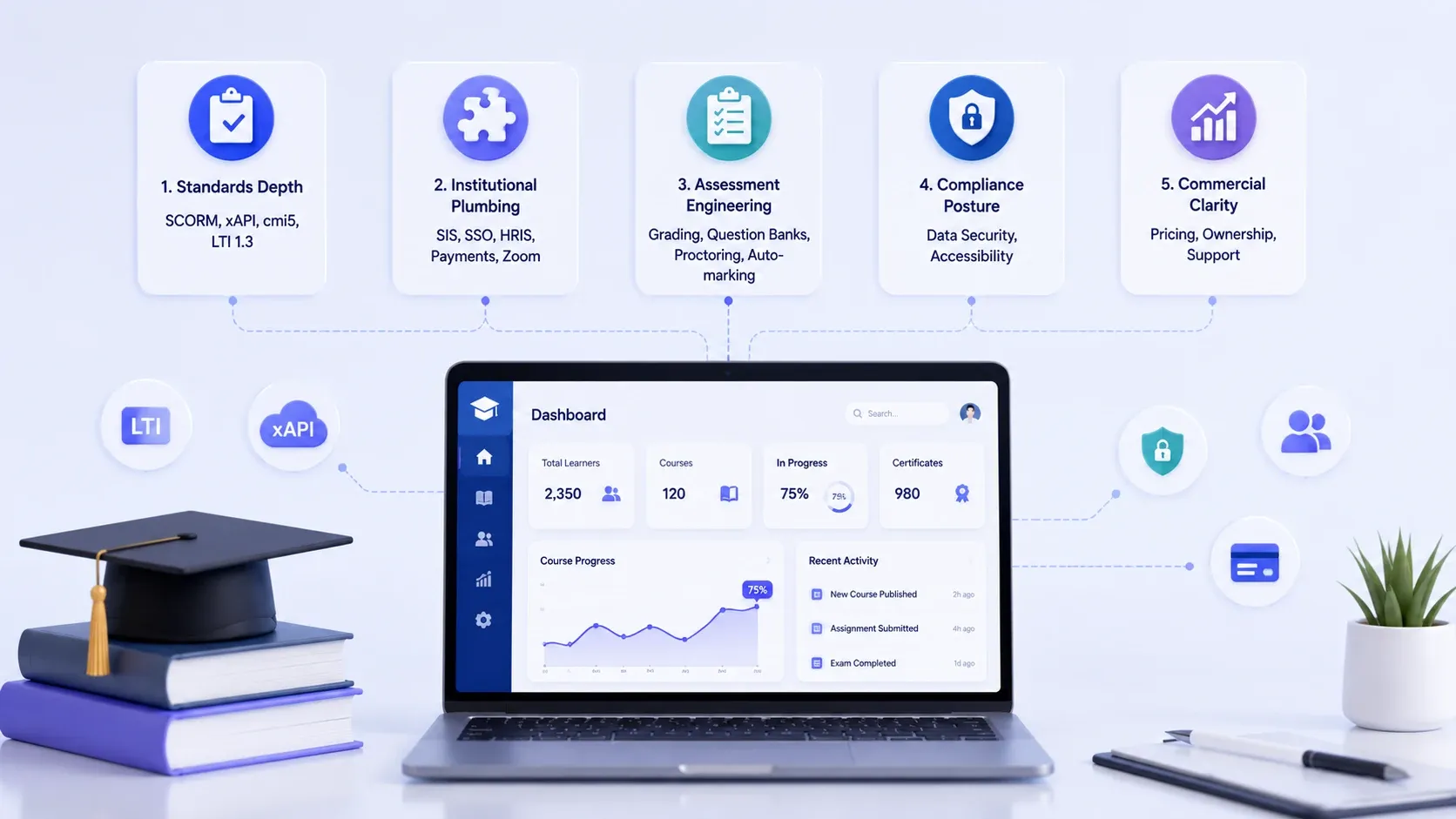
I scored every company on five plain criteria, because a ranked list without a rubric is just an advert with numbers.
- Standards depth: SCORM, xAPI, cmi5 and LTI 1.3 handled as engineering work, not a checkbox
- Institutional plumbing: SIS, HRIS, SSO, Zoom, Google Classroom and payment integrations
- Assessment engineering: grading, question banks, proctoring, auto marking with human override
- Compliance posture: student data handling and accessibility built in, not retrofitted
- Commercial clarity: named price ranges, code ownership, and what post launch support actually covers
Everything below is judged on those five, in that order.
Top 10 eLearning and LMS Development Companies in the USA (2026)
1. MindStack Labs - Custom AI Base eLearning and LMS Development Company
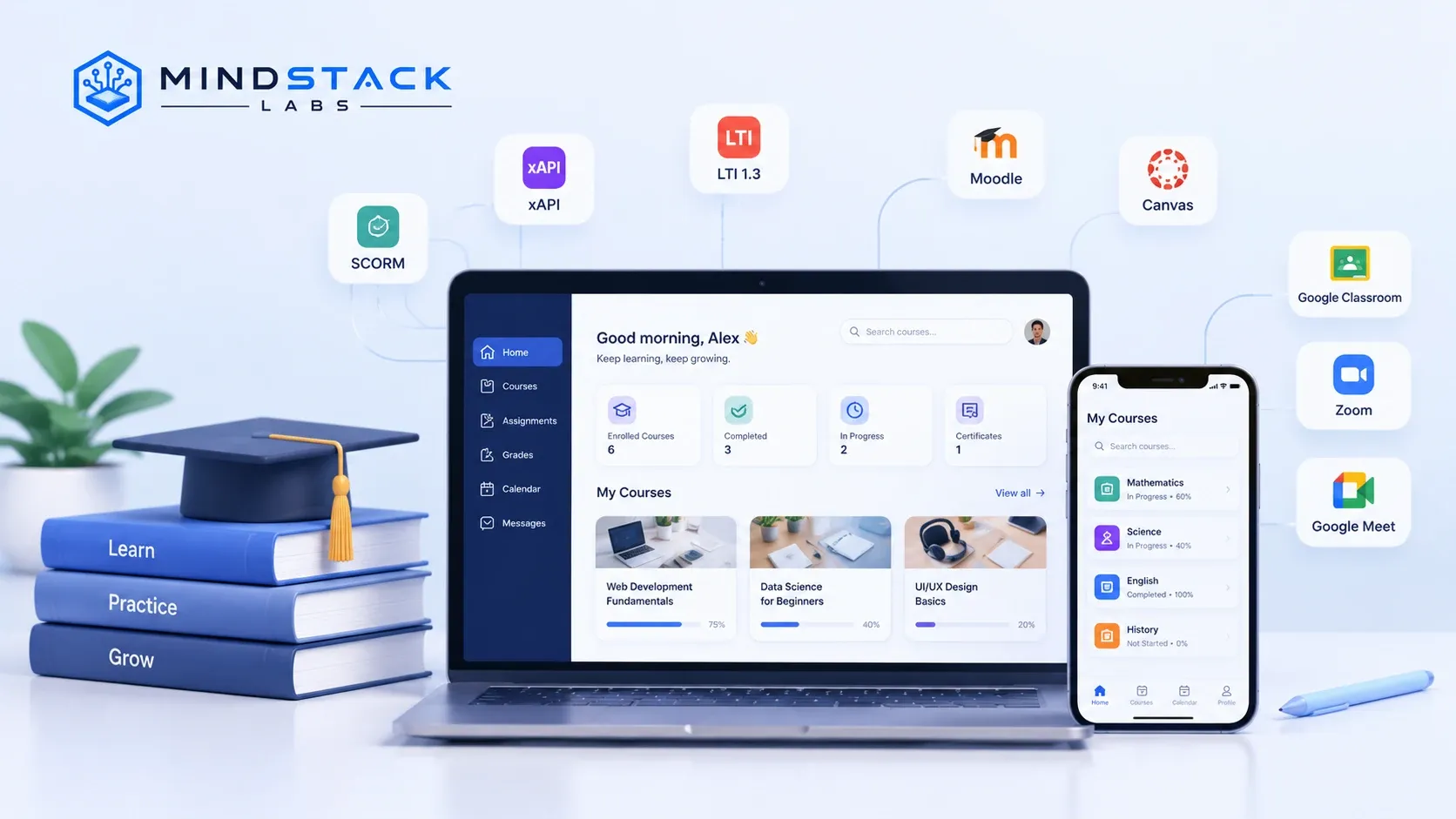
A custom software company that builds learning platforms around teacher and administrator workflows rather than feature checklists.
Key capabilities
- Custom LMS development, eLearning apps and school management software
- SCORM, xAPI, LTI 1.3, Moodle and Canvas integrations, plus Google Classroom, Zoom, Google Meet, Stripe and SSO
- Assessment and auto grading with human override, exam preparation and test prep platforms
- Cross platform mobile delivery in Flutter with Node.js and Firebase backends
Numbers and proof
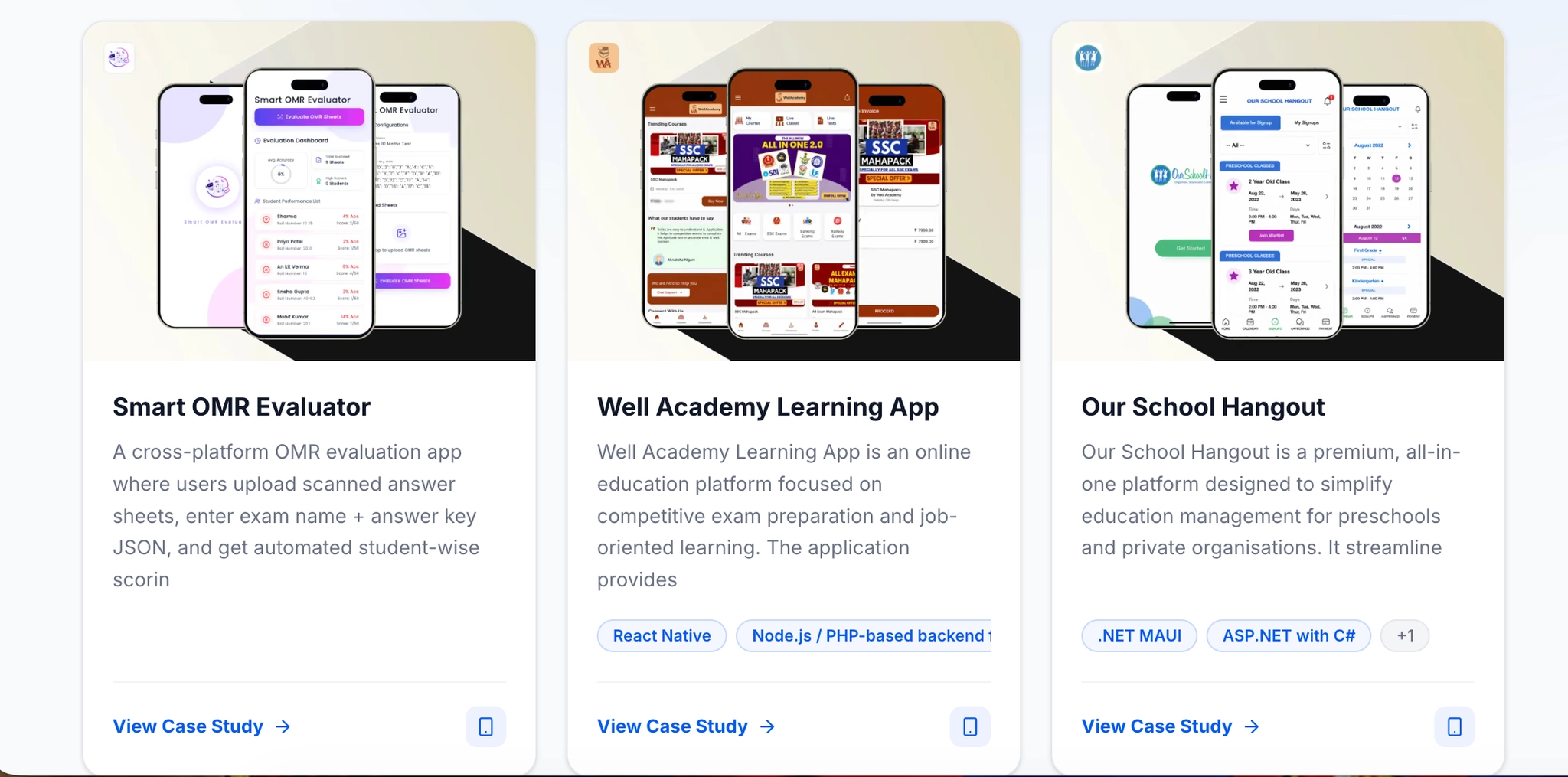
- Shipped education products include Smart OMR Evaluator for optical mark recognition and auto grading, Well Academy Learning App for mobile first course delivery, and Our School Hangout for school community and engagement
- Compliance is handled as engineering practice, meaning technical safeguards, access control and audit trails built into the architecture, not a certification claim
- Reviews and badges are published on the live site rather than paraphrased here
Honest limitation: we are an engineering partner, not an instructional design studio, so if what you actually need is 40 hours of course content authored, hire a content house and let us build the platform it runs on.
Best for: teams that need a custom platform where assessment logic and integrations are the hard part.
2. Raccoon Gang
An eLearning specialist focused on Open edX, Canvas and Moodle rather than building every platform from scratch.
Key capabilities
- Open edX development, customization and migration
- LMS workflow automation and custom content integration, including SCORM, LTI and H5P
- Third party integrations across CRM, HRM, ERP and payments
Numbers
They state more than 10 years of LMS work and platform experience since 2015.
Honest limitation: the platform first approach is a strength until your requirements fall outside what Open edX or Canvas will comfortably do.
Best for: universities and course providers who want Open edX done properly.
3. AnyforSoft
An education focused development company with separate service tracks for LMS builds, Moodle, Canvas, Open edX and migration.
Key capabilities
- Custom LMS software development and LMS migration as a named service
- Moodle and Canvas customization without modifying core, so upgrades do not break
- Open source stack work with SCORM, xAPI, LTI and AICC support
Numbers
They publish 14 or more years in education technology and a 4.9 Clutch rating.
Honest limitation: heavy open source orientation, so validate the fit if your stack is Microsoft first.
Best for: institutions migrating off a legacy LMS without losing historical data.
4. Aristek Systems
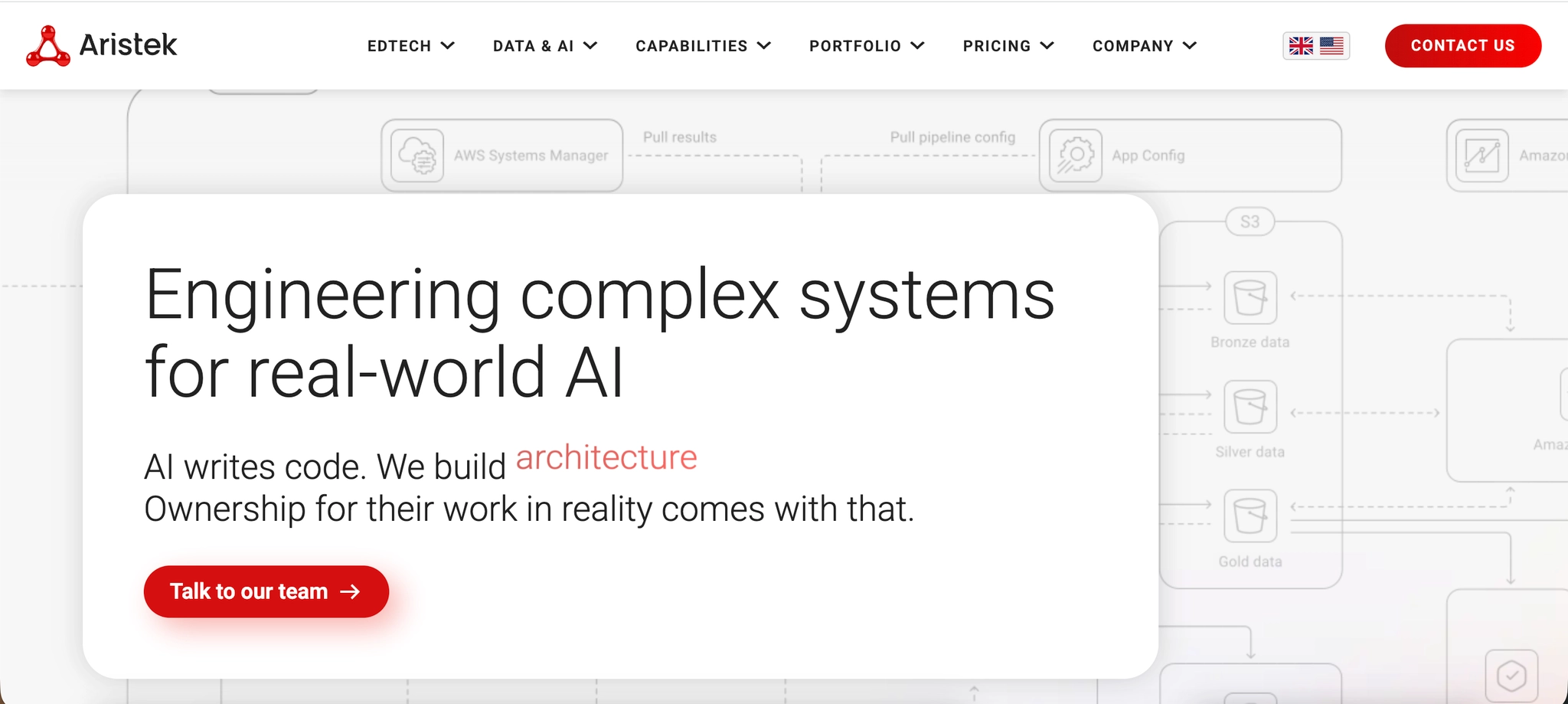
An EdTech engineering company that publishes both custom LMS and pre built LMS options.
Key capabilities
- Custom LMS development for corporate and academic use
- K-12 and higher education platforms at large user scale
- Hosting and PII handling options, in house or cloud
Numbers
Their site claims 22 years in EdTech, roughly 150 employees, and 10 custom LMS platforms delivered.
Honest limitation: a team of that size usually carries process weight, which is good for districts and heavy for a two person startup.
Best for: K-12 and higher education platforms that need to scale past pilot.
5. MindK
A full cycle development company with a distinct eLearning practice and a US presence in California.
Key capabilities
- Custom LMS platforms and mobile learning apps
- Certification systems and remote proctoring
- Data oriented engineering with global delivery
Numbers
14 or more years operating, with US and European offices per their own materials.
Honest limitation: eLearning is one practice inside a broader software business, so ask which team you actually get.
Best for: certification bodies that need proctoring and credentialing to hold up under scrutiny.
6. Riseapps
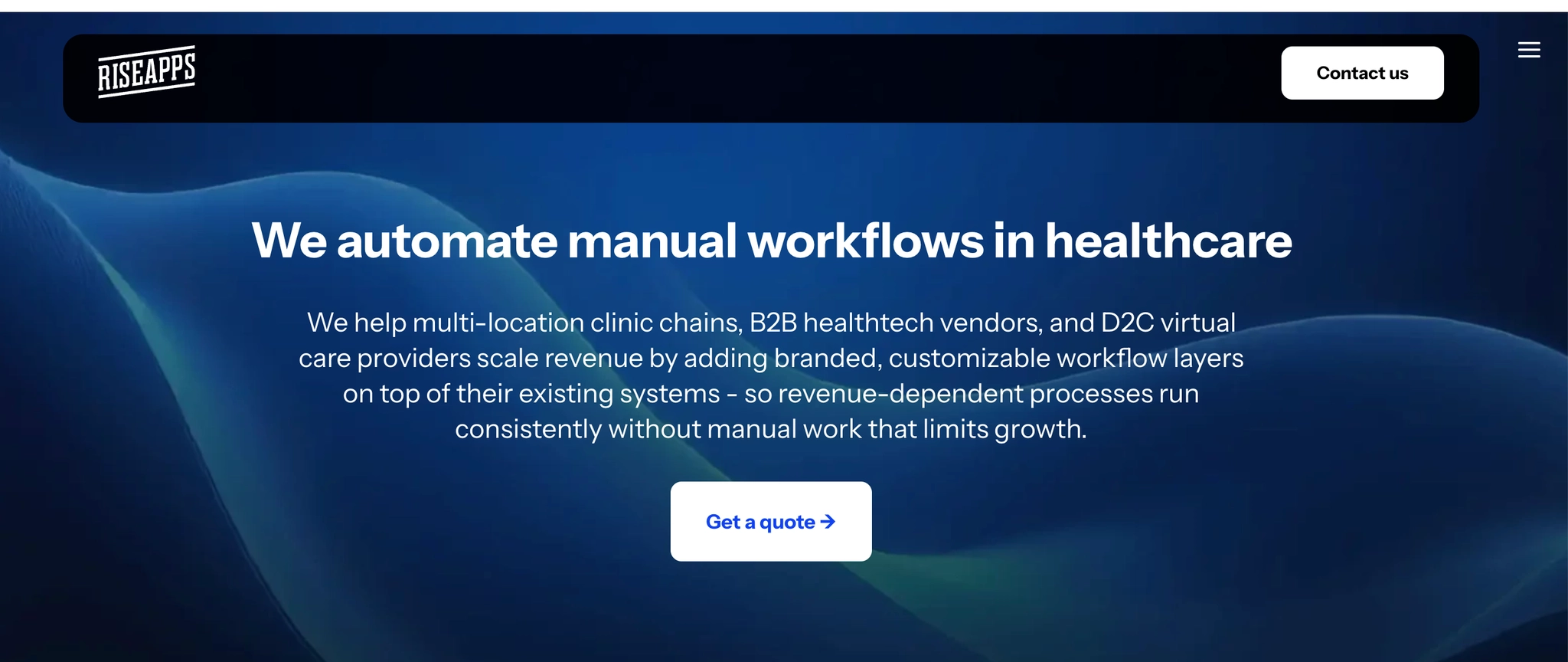
A product studio that builds custom learning management systems for edtech startups and B2B vendors.
Key capabilities
- Custom LMS development with a startup delivery cadence
- Marketplace style and Udemy style course platforms
- Product and monetisation focus alongside engineering
Numbers
They publish LMS work since 2016, delivery within roughly 2 months, and projects starting at 40,000 dollars.
Honest limitation: speed comes from scope discipline, so complex institutional integrations may push past that timeline.
Best for: funded startups that need a credible v1 in front of users fast.
7. IT Craft
A custom software company with a published eLearning portfolio and long delivery history.
Key capabilities
- Custom eLearning platforms and interactive learning modules
- Web and mobile learning app development
- Ongoing support and maintenance engagements
Numbers
A 4.9 out of 5 rating across more than 50 reviews per their own listing.
Honest limitation: eLearning is one vertical among many, so proof depth varies by project type.
Best for: buyers who want a generalist engineering partner with edtech experience on file.
8. HQSoftware
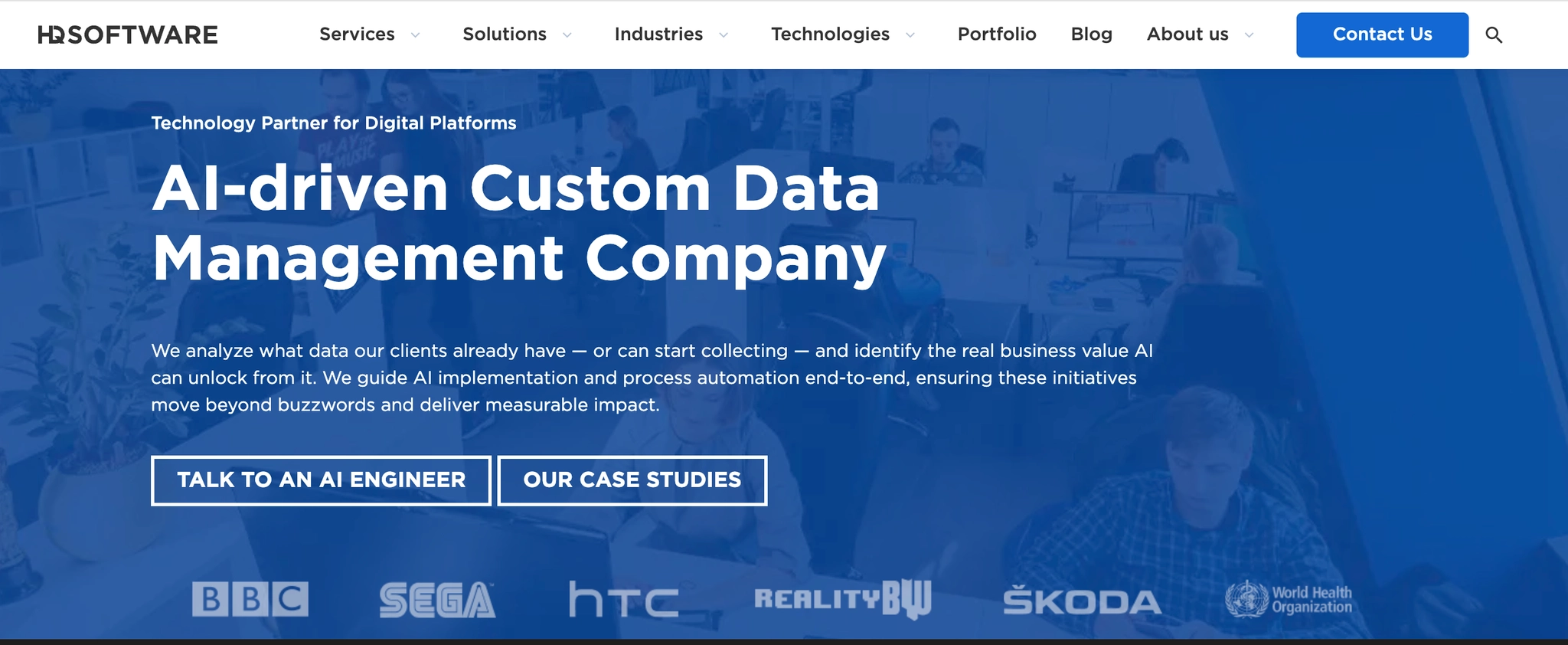
An eLearning software development provider serving corporates and education vendors.
Key capabilities
- Custom eLearning platforms and training portals
- IoT and emerging tech experience that carries into simulation heavy learning
- End to end delivery from discovery to support
Numbers
They publish 15 or more years in eLearning software and 40 or more eLearning projects.
Honest limitation: less visible K-12 and district specific work than the education specialists above.
Best for: corporate training platforms with technical or simulation content.
9. Damco Solutions
An enterprise IT services firm with a dedicated eLearning app development line.
Key capabilities
- Enterprise LMS platforms for institutions and corporates
- On demand learning apps with video streaming and live classes
- Integration work across enterprise systems
Numbers
Enterprise scale delivery footprint, with project scale disclosed during scoping rather than published.
Honest limitation: enterprise process and pricing, which is exactly wrong for a lean MVP.
Best for: large organisations rolling training out across business units.
10. Moodle US and Moodle Certified Partners
The official route for organisations that want to keep Moodle and make it work properly.
Key capabilities
- Moodle LMS and Moodle Workplace custom development
- Custom themes, custom reports, plugin development and integrations
- Hosting, implementation and learning design services
Numbers
Pricing is service based, and self hosted Moodle carries no licence fee, which is the whole appeal.
Honest limitation: you inherit Moodle's data model and its upgrade cycle, forever.
Best for: institutions with Moodle already embedded and no appetite to migrate.
Side by side comparison
Company
Model
Standards depth
Best fit
Watch out for
MindStack Labs
Custom build
SCORM, xAPI, LTI 1.3, Moodle and Canvas integration
Assessment and integration heavy platforms
Not a content authoring studio
Raccoon Gang
Platform specialist
SCORM, LTI, H5P on Open edX
Open edX and Canvas institutions
Platform boundaries
AnyforSoft
Custom and platform
SCORM, xAPI, LTI, AICC
Migration off legacy LMS
Open source leaning stack
Aristek Systems
Custom and pre built
Standards plus large scale delivery
K-12 and higher ed at scale
Process weight
MindK
Custom build
Certification and proctoring
Credentialing platforms
Practice sits inside a wider business
Riseapps
Product studio
Course delivery and payments
Startup MVP
Scope discipline required
IT Craft
Generalist custom
Project dependent
Mixed web and mobile learning
Variable edtech depth
HQSoftware
Custom build
Corporate training focus
Simulation heavy training
Thinner K-12 proof
Damco Solutions
Enterprise services
Enterprise integration
Multi business unit rollout
Enterprise pricing
Moodle US
Platform services
Native Moodle standards support
Existing Moodle estates
Moodle's own constraints
Pro tip: ask every shortlisted vendor to show you a staging environment before launch, because the ones who cannot are the ones who test in production.
How much does eLearning and LMS development cost in 2026?
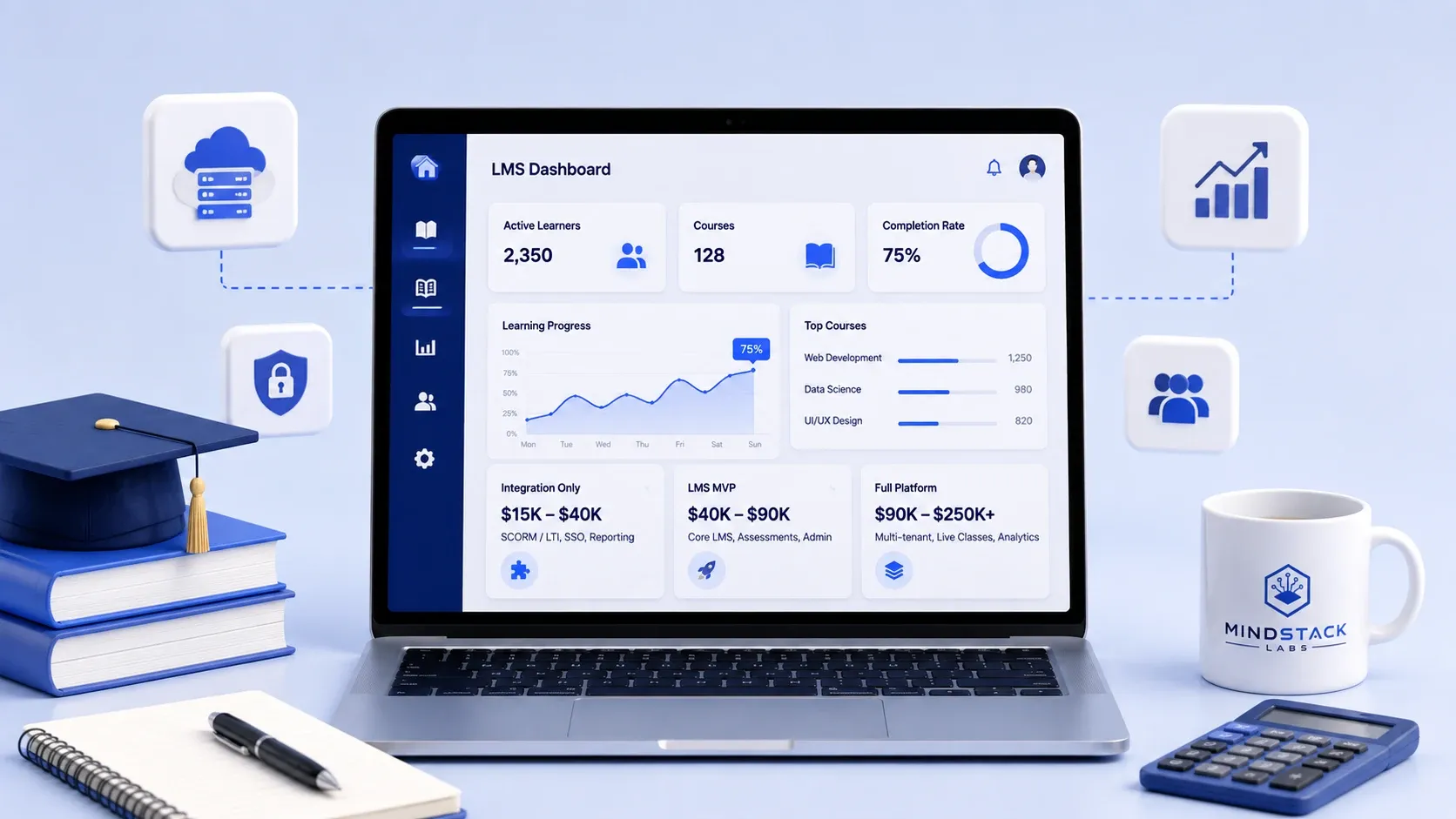
Expect a real custom LMS build to start in the mid five figures, with a full platform landing in six. Licence savings arrive later, not immediately.
Riseapps publishes 40,000 dollars as an entry point, which matches what I tend to see for a credible first release.
Scope tier
What it usually includes
Typical range I see
Integration only
SCORM or LTI layer, SSO, reporting on an existing platform
15,000 to 40,000 dollars
LMS MVP
Course delivery, enrolment, assessments, admin, one integration
40,000 to 90,000 dollars
Full platform
Multi tenant, live classes, proctoring, analytics, SIS or HRIS sync
90,000 to 250,000 dollars and up
What actually moves the number
- → Concurrent learners = infrastructure and video delivery cost
- → Integration count = the single biggest swing factor in my experience
- → Assessment complexity = proctoring and grading logic, not more screens
- → Compliance scope = accessibility and data handling work priced as its own module
The cost nobody scopes is content migration. Historical completions and certificates are a data project, not a copy paste.
Plan for 15 to 20 percent of build cost per year in maintenance. Learning platforms do not sit still after launch.
Get a real number, not a range
Want your eLearning or LMS build scoped module by module?
Send us your learner count, your content formats and the systems you already run. We map the integrations, flag the compliance scope, and come back with a phased module list and a realistic cost band before anyone talks contracts.
- Module level scope with a phase one you can actually approve
- Integration and migration risk list, written down
- You own the code and the learner data
No commitment required.
How long does a custom LMS take to build?
Measure time to first live cohort, not time to full launch, because that is the date your stakeholders actually care about.
- First live cohort on a focused MVP: roughly 8 to 14 weeks in my experience
- Full platform with integrations and proctoring: 4 to 8 months
- Migration from an existing LMS: add 3 to 6 weeks, more if grade history matters
One constraint the generic roundups always miss: the academic calendar. Miss a term start and you wait months, not weeks, so a district build gets scheduled backwards from enrolment week.
Custom LMS vs Moodle vs off the shelf: which one do you actually need?
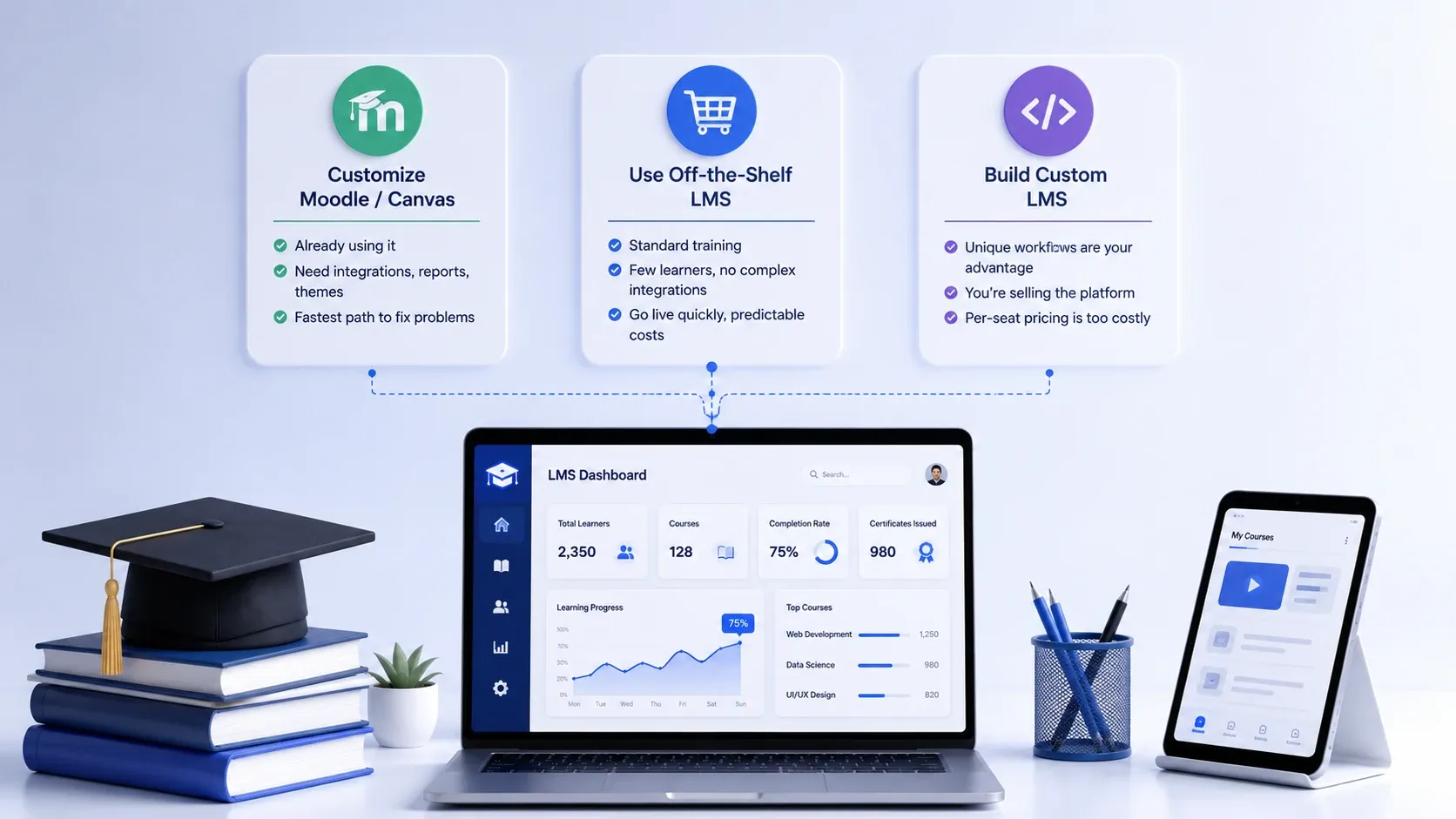
Pick custom only when your workflow is the product, otherwise customize what exists. Most buyers I talk to need less custom software than they assume, and better integration than they planned.
When Moodle or Canvas customization wins
- You already run it, staff are trained, and courses live there
- You need reports, themes and integrations, not a new data model
- → Moodle plus targeted plugin work = fastest path to a fixed problem
When off the shelf wins
- Standard compliance training, standard reporting, standard everything
- Under a few hundred learners with no unusual integrations
- → TalentLMS or Docebo = live this quarter, per seat cost forever
When custom is the only real option
- Your assessment, grading or scheduling logic is your differentiator
- You are selling the platform, not just using it
- Per seat pricing has become your second largest software line
Udemy clone scripts and white label LMS: what you are buying
A clone script buys you a demo, not a product. I have watched teams spend more unpicking someone else's undocumented codebase than a clean phase one would have cost.
If udemy clone app development is on your shortlist because of price, price the second year too.
Wait, you might be thinking: is custom LMS development overkill for us?
Often, yes. If your requirements fit inside a standard platform, a custom build is an expensive way to get the same outcome six months later.
My test is simple. Write down the three workflows that make your learning programme different. If a standard platform handles all three, stay where you are.
Compliance and accessibility: the part that gets retrofitted and should not be
Treat student data and accessibility as build requirements, because both now carry deadlines rather than opinions.
- Student data
- FERPA for education records, COPPA for under 13 users, GDPR for EU learners
- Each one becomes access control, retention rules and audit logging in the architecture
- Accessibility
- WCAG 2.2 reached W3C Recommendation status in October 2023
- The US Department of Justice published its ADA Title II web accessibility rule in April 2024, with compliance dates landing for public entities from 2026 onward
- If you serve a district or public university, this is procurement gating, not a nice to have
- Standards
- SCORM still carries legacy content
- xAPI and cmi5 carry modern tracking
- LTI 1.3 with LTI Advantage is the current tool integration baseline
Retrofitting accessibility after launch costs more than building it in. Every time, in my experience.
The 2026 question every board is asking: where does AI fit?
AI belongs in assessment support and content operations first, not in a chatbot bolted onto the homepage. That is where I see it actually reduce workload.
- Auto generated question banks reviewed by a human before publishing
- Adaptive sequencing based on assessment performance, not clicks
- Draft feedback on written answers, with the educator holding final say
- Content tagging and search across a large course library
The rule I hold to: AI drafts, humans approve. Grading without an override path is how institutions lose trust in a platform in one term.
What usually goes wrong in eLearning and LMS projects
Four failure modes cover almost everything I have seen, and none of them are about code quality.
- Completion collapse. The platform works, learners drift. Nobody scoped reminders, progress visibility or manager reporting.
- Grading built for administrators. Teachers get a spreadsheet export instead of a workflow, so they go back to spreadsheets.
- Integrations deferred to phase two. Know why projects stall at go live? The integration was never scoped.
- Video costs discovered late. Streaming, storage and offline access get priced after the budget is locked.
Why choose MindStack Labs over the other companies on this list
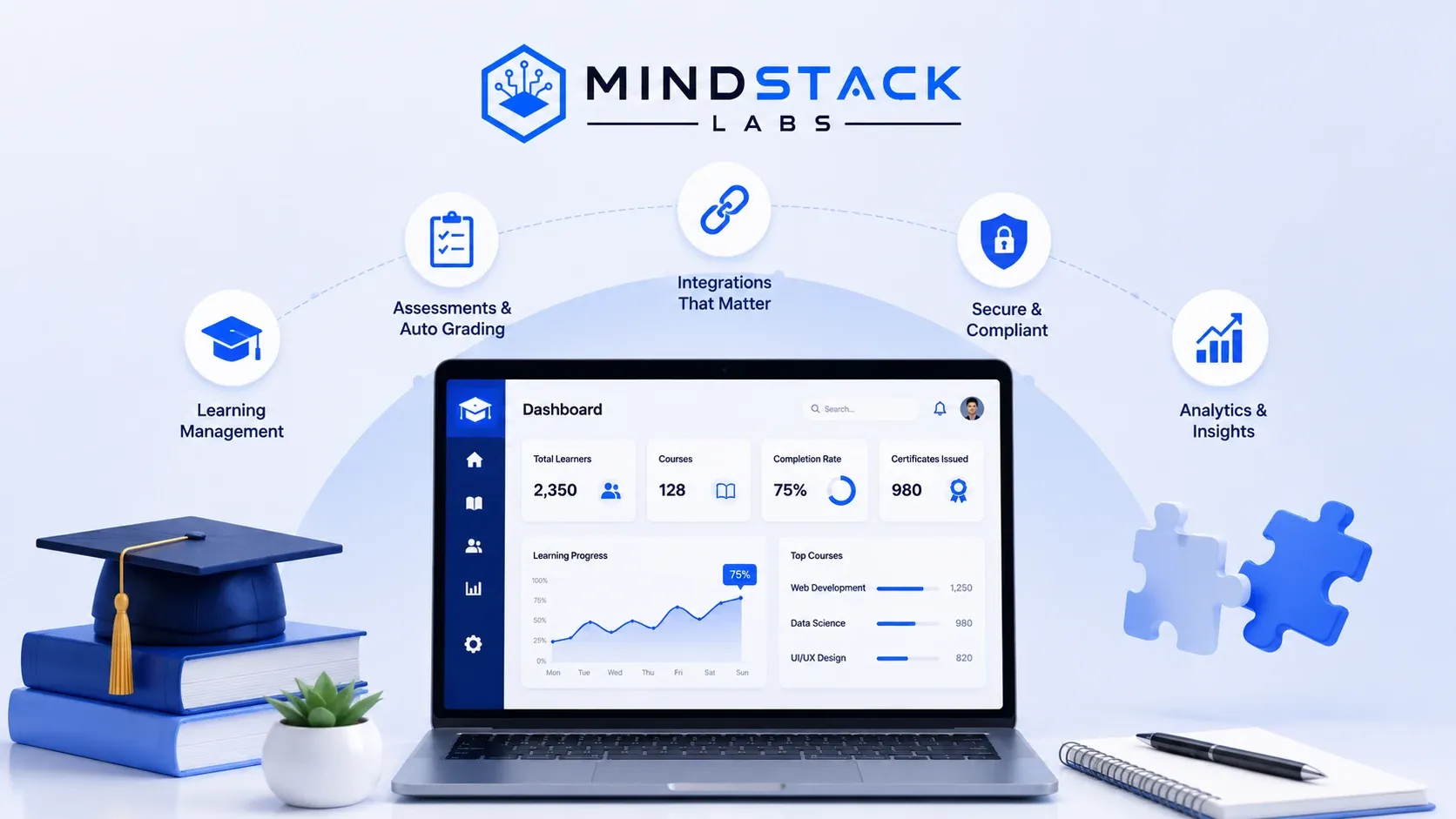
Choose us when the hard part of your build is assessment logic and integrations rather than course content. That is the narrow claim I am willing to defend.
- Standards handled in week one. SCORM, xAPI and LTI 1.3 get scoped during discovery, not deferred.
- Assessment engineering with human override. Smart OMR Evaluator exists because auto grading at scale is a real engineering problem, and educators still need the last word.
- Workflow mapped before scoping. We map how teachers and administrators actually work before anyone prices modules.
- Multi vertical discipline. We build in regulated verticals like healthcare, which is where access control and audit trails stop being theory.
- Clear commercials. Phased scope, module level pricing, and you own the code and the learner data.
Where we are the wrong call: pure content production, or a Moodle estate you have no intention of leaving. In that second case, hire a Moodle partner and keep your budget.
If you are X, go with Y
- If you run a K-12 district on Moodle, go with Moodle US or AnyforSoft for migration
- If assessment and proctoring are your product, go with MindStack Labs or MindK
- If you need a funded startup MVP this quarter, go with Riseapps
- If you are rolling training across a large enterprise, go with Damco Solutions or HQSoftware
- If Open edX is already your platform, go with Raccoon Gang
Six questions to ask before you sign
- Who owns the code and the learner data on day one after launch?
- Which integrations are in phase one, named, with the version of each standard?
- Can we see a staging environment that mirrors production before go live?
- How do you handle scope change, and is there a documented change order process?
- What does post launch support cover, and what does it cost per year?
- Show me one project where the grading or assessment workflow was the hard part.
Pro tip: ask question six first, because it separates engineering partners from configuration shops in about ninety seconds.
FAQs
1. Custom LMS vs Moodle: which is better?
Moodle is better when you need a working platform quickly and your requirements are conventional. Custom is better when your workflow is your differentiator or per seat licensing has become a major cost line.
2. How much does it cost to build a custom LMS?
In my experience a credible MVP starts around 40,000 dollars and a full platform runs from 90,000 upward. Integration count and assessment complexity move the number more than learner count does.
3. Do I need SCORM if I am building something new?
Only if you have legacy content or buy third party courses. If your content is new, xAPI or cmi5 gives you better tracking with less packaging pain.
4. Is offshore or hybrid LMS development risky?
The risk is accountability and overlap hours, not location. Ask for named owners, guaranteed overlap and documented handover before you compare hourly rates.
5. Can I migrate off Moodle without losing grade history?
Yes, but treat it as its own project. Course content moves fairly cleanly, while historical completions and certificates need mapping and validation.
My recommendation
Start with a paid discovery and scoping engagement before you commit to any build.
Choose a platform specialist over a custom partner if your three differentiating workflows already fit inside Moodle or Canvas.
If they do not fit, get the integrations and the assessment logic scoped in phase one. Everything else can wait.
Still deciding between a custom build and customizing what you already run?
Book a free 30 minute discovery call with MindStack Labs. We walk through your current setup, your integration list and your compliance scope, then tell you honestly whether a custom platform is the right call or whether customizing Moodle or an off the shelf tool gets you there faster.
- Workflow and integration mapping before any scoping
- Architecture and data protection review
- Phased scope with clear code ownership