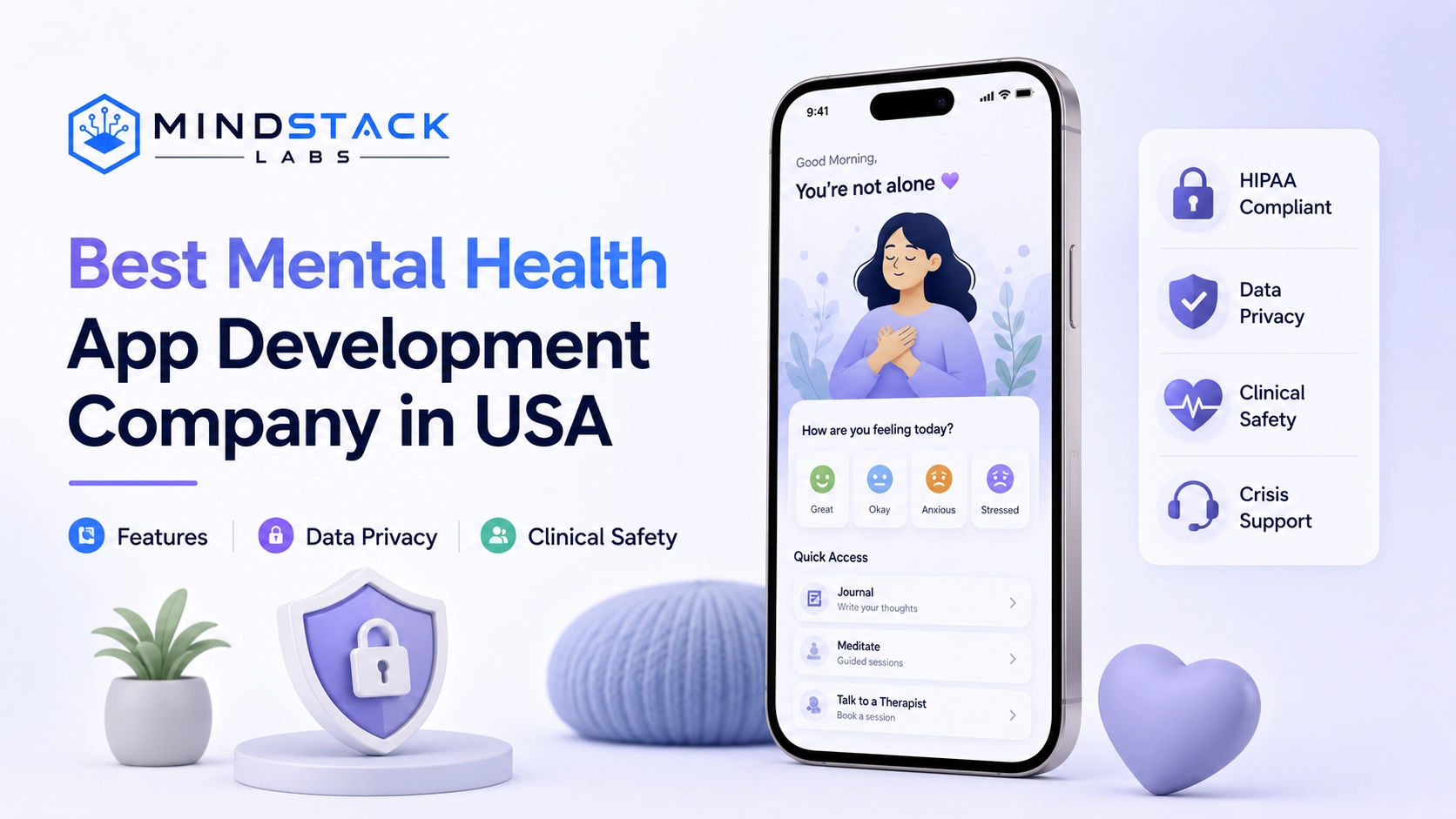
The best mental health app development company in the USA treats crisis escalation and PHI architecture as engineering requirements, not marketing lines.
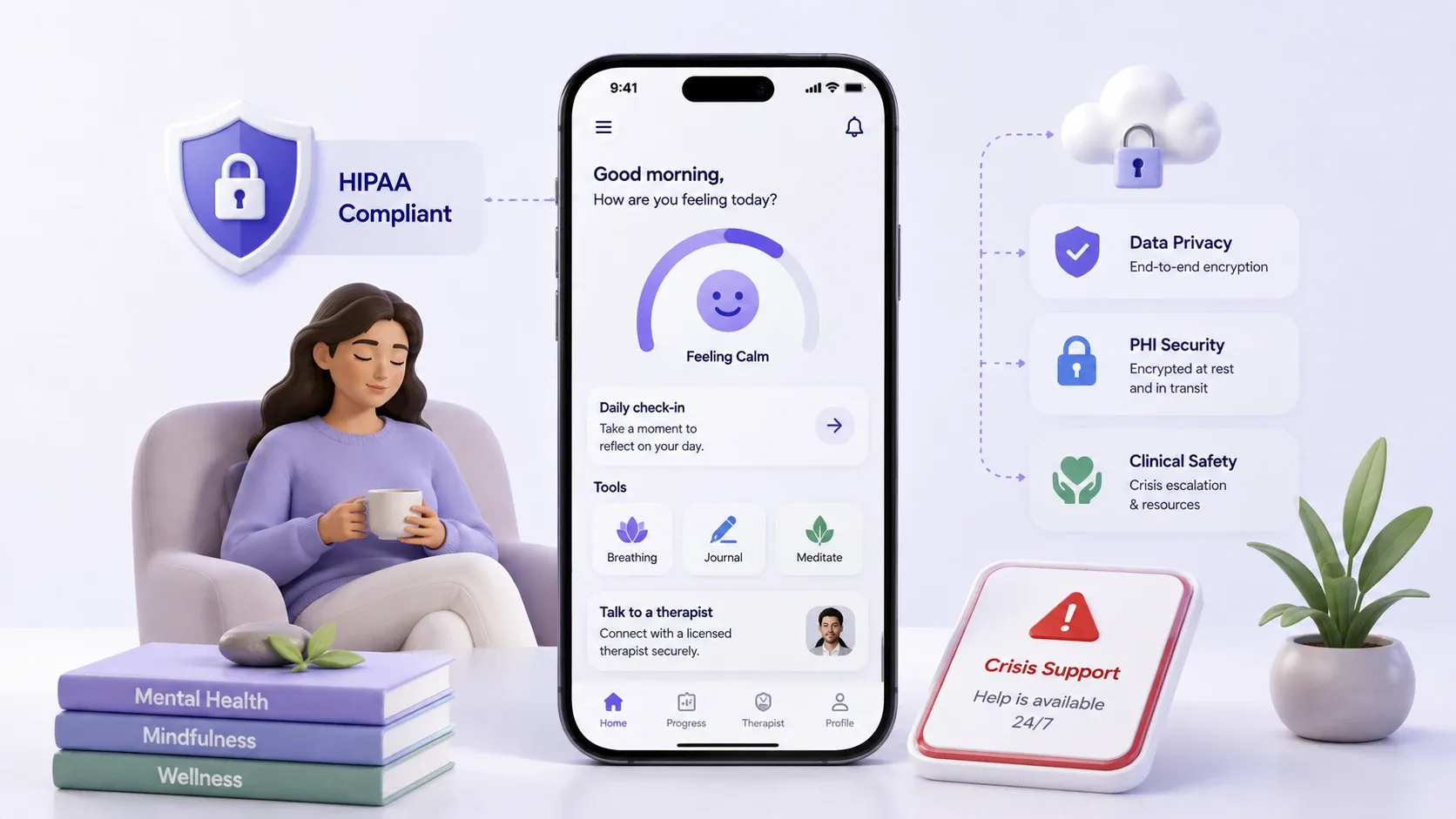
Based on how I evaluate partners, MindStack Labs is the strongest fit for behavioral health startups and multi-location therapy groups that need a HIPAA-architected, clinically safe build shipped in weeks, not quarters.
TL;DR
- → Clinical safety first = your vendor shows a crisis escalation flow before a design mockup
- → HIPAA is table stakes = ask for the data-flow diagram, the BAA, and the SDK audit
- → Realistic budget = clinical MVP in 6 to 10 weeks, full platform in 12 to 16 weeks
- → Biggest 2026 risk = an LLM near therapeutic dialogue without guardrails
- → My pick = MindStack Labs for custom builds, white-label only if you must launch in under 30 days
Ever read an agency page that said "we ensure HIPAA compliance" and felt reassured?
Me neither. Here is why.
I have scoped, reviewed, or audited healthcare and behavioral health builds more than 40 times since 2019. The pattern rarely changes. The pitch deck is polished. The data-flow diagram does not exist.
On one teletherapy scope, I sat through a 45-minute mood-tracking demo before anyone could tell me where journal entries were stored.
That is the gap this article closes.
What I Am Evaluating On
I score every mental health app development partner on five criteria, in this order.
- Clinical safety design. Can they describe a 988 handoff flow without improvising?
- PHI architecture. Encryption, role-based access, audit logs, separated analytics.
- Shipped healthcare proof. Live products in regulated workflows.
- Scope honesty. Will they tell you when white-label is smarter?
- Post-launch ownership. Who patches and re-audits after go-live.
Design awards are not on that list.
Why Generic App Development Fails in Behavioral Health
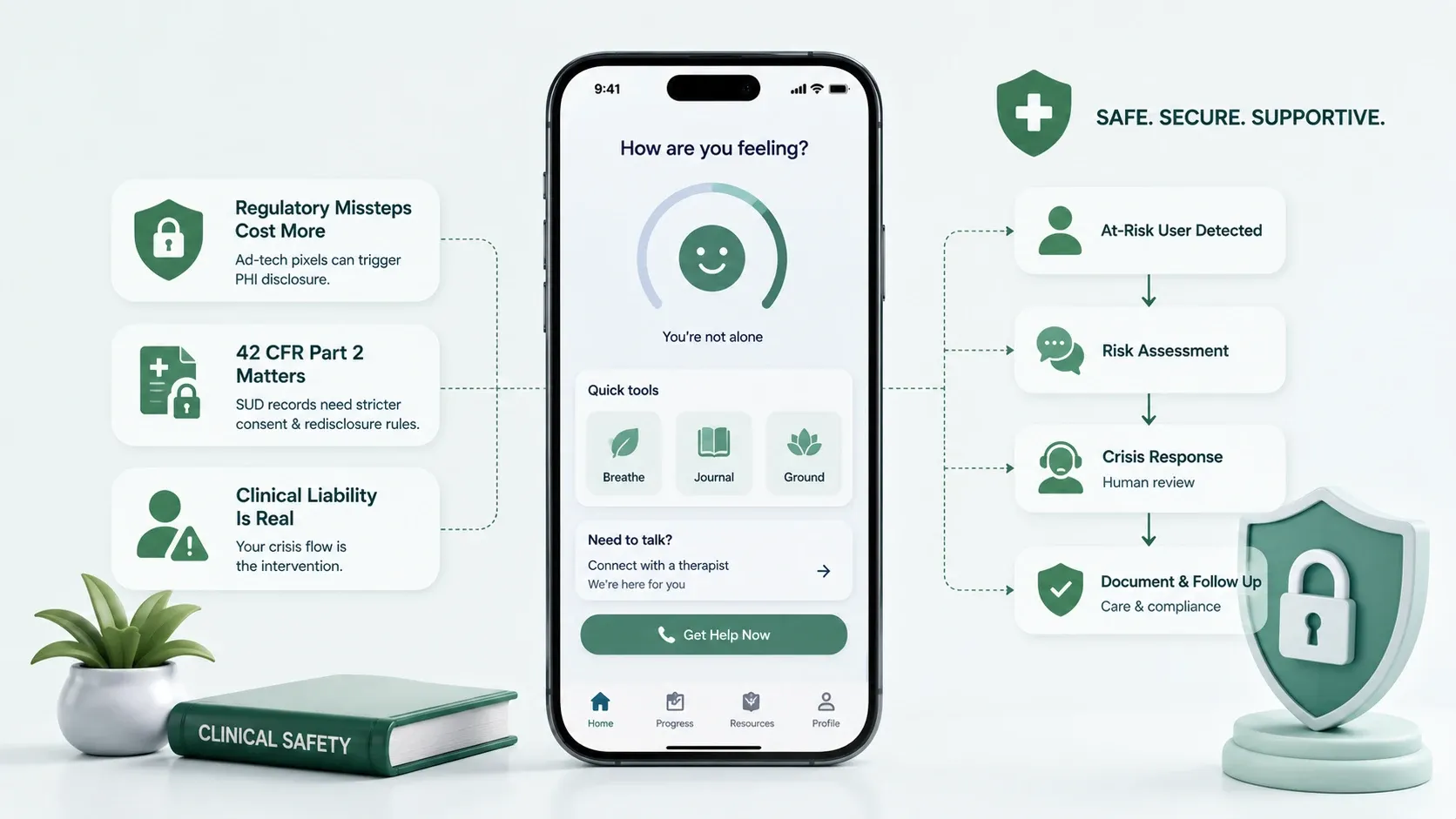
Generic agencies fail here because behavioral health punishes the shortcuts that work everywhere else.
Regulatory missteps cost more than the build
The expensive mistakes are boring ones.
- HHS OCR guidance on online tracking technologies, reissued in March 2024, treats ad-tech pixels on authenticated health pages as a possible PHI disclosure
- I have watched a wellness startup add a Meta Pixel to a logged-in symptom page for one growth test. That single tag triggered a breach review
- The FTC Health Breach Notification Rule amendments, effective July 2024, extended this risk to apps that are not even HIPAA-covered entities
Substance use records change your data model
42 CFR Part 2 governs SUD treatment records and is stricter than HIPAA on consent and redisclosure.
Retrofitting consent logic later is painful. Designing for it upfront costs one sprint.
Clinical liability sits with the product
When a user in crisis opens your app at 2 AM, your triage logic is the intervention.
Pro tip: Ask any vendor to whiteboard the at-risk user flow on the first call. Watch whether they reach for the clinical path or the notification service.
Wellness App or Regulated Digital Therapeutic? Decide This First
This fork changes your scope, timeline, and cost more than any single feature.
| Path | What you can claim | Scope impact |
|---|---|---|
| General wellness | Tracking, education, self-management | Baseline build |
| Clinical support tool | Clinician-supervised assessment, measurement based care | Adds validated instruments |
| Software as a Medical Device | Diagnosis, treatment, autonomous decisions | Often 2x to 3x cost |
Your App Store listing copy is part of your regulatory posture. I have watched one product get pulled toward the device line by the word "treatment" in a subtitle.
Write the claims before you write the code.
Essential Features for a Modern Mental Health Application
Build by user role, not by feature list. Liability lives in the handoffs between roles.
| Module | Core capabilities | Why it carries risk |
|---|---|---|
| Patient | Video, async messaging, mood and journal logging | Journals are unstructured PHI |
| Clinician | Caseload dashboard, notes, automated charting | Charting burden decides adoption |
| Interventions | CBT and DBT worksheets, guided audio | Content needs audit versioning |
| Measurement | PHQ-9, GAD-7, outcome trends | Scores are clinical signals |
| Admin | Scheduling, billing, multi-location roles | Least-privilege breaks here first |
| Crisis | Risk detection, 988 handoff, escalation log | Must never fail silently |
The measurement module is the one founders skip and clinical directors demand.
One detail worth stealing from MindStack Labs' CareBot AI appointment assistant: real-time slot verification prevents double-booking instead of surfacing the conflict after submission. The same principle applies to therapy scheduling, where a failed booking is a missed clinical touchpoint.
The patient module above also mirrors what Ashmi Health ships for consultations and wellness tracking: remote access to care plus secure, encrypted health data storage.
Scoping your build
Get your mental health app scoped against a HIPAA-ready architecture
Send your feature list and we will map the PHI flows, crisis escalation path, and integration requirements before quoting a number. Detailed proposal within 24 hours.
- Compliance mapping in week one, not before launch
- BAA-ready engagement with documented PHI handling
- You own the code and the patient data
No commitment required. Response within 24 hours.
HIPAA and Data Privacy Architecture: The Checklist I Use
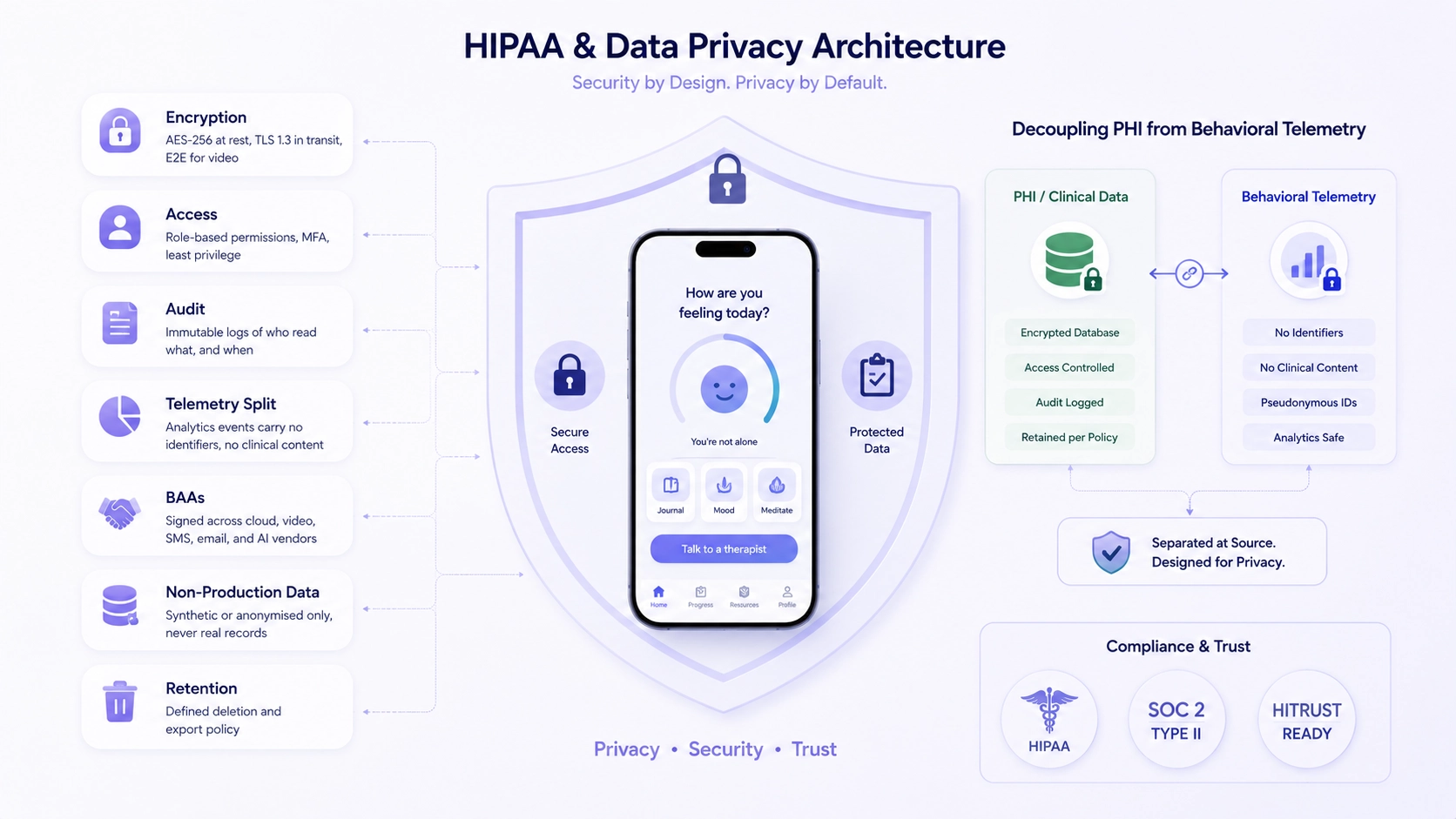
Compliance is an architecture artifact. Ask for the diagram.
- Encryption → AES-256 at rest, TLS 1.3 in transit, E2E for video
- Access → role-based permissions, MFA, least privilege enforced in QA
- Audit → immutable logs of who read what, and when
- Telemetry split → analytics events carry no identifiers, no clinical content
- BAAs → signed across cloud, video, SMS, email, and any AI vendor
- Non-production data → synthetic or anonymised only, never real records
- Retention → a defined deletion and export policy before launch
Decoupling PHI from behavioral telemetry
This is the highest-leverage architectural decision in a mental health build.
My rule: event names describe behavior, never content. "journal_entry_saved" is fine. Sending the entry text to your analytics vendor is not.
Wait, you might be thinking: is HIPAA compliance enough?
No. HIPAA has no government certification, so enterprise buyers ask for SOC 2 Type II or HITRUST instead.
If you plan to sell into health systems, put that attestation on the roadmap now. Retrofitting evidence collection is far worse than instrumenting it early.
Clinical Safety and Crisis Escalation Protocol Design
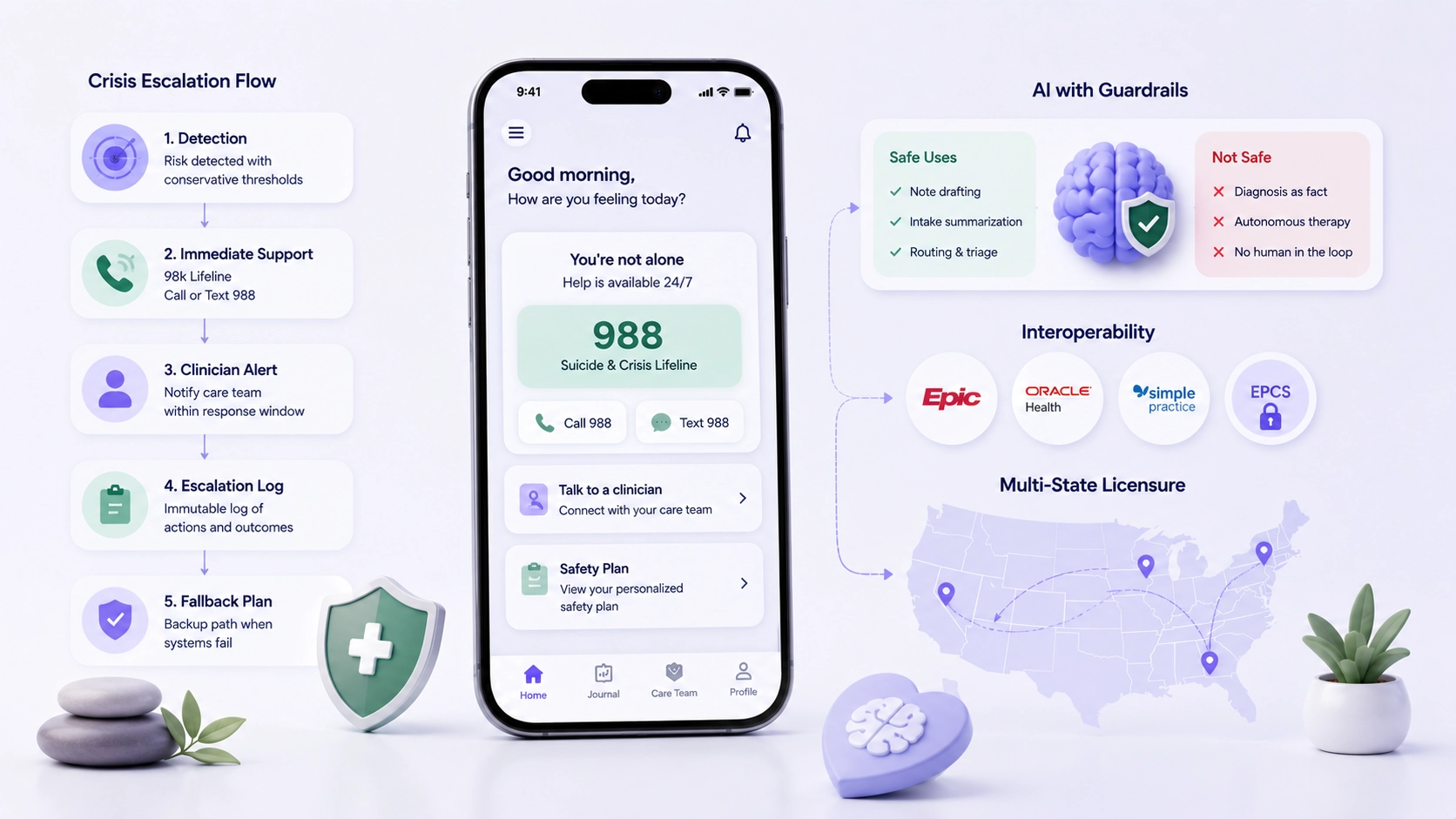
Design around false negatives. Over-triggering annoys users. Under-triggering ends careers.
A defensible escalation flow needs:
- A detection layer with conservative thresholds and no silent failures
- Immediate 988 Suicide and Crisis Lifeline surfacing, with one-tap dial and text
- Clinician notification with a defined response window
- An immutable escalation log: trigger, timestamp, action, outcome
- A fallback path when detection or notification fails
Safe messaging is a UI requirement
Apply safe messaging guidelines to copy, notifications, and empty states. Avoid method detail entirely, and always pair risk content with an immediate resource.
Accessibility is duty of care
WCAG 2.2, published October 2023, is the standard I scope against. Users in distress have reduced cognitive bandwidth, so contrast and tap targets are clinical usability, not polish.
Where AI Belongs, and Where It Does Not
Use AI for documentation and routing. Never for autonomous therapeutic dialogue.
Reasonably safe today:
- Clinical note drafting with clinician review
- Intake summarization and symptom-to-specialty routing
- Administrative triage and reminder personalization
Not safe without a regulatory strategy:
- Diagnosis or severity scoring presented as fact
- Autonomous crisis response with no human in the loop
- Unsupervised open-ended therapeutic conversation
The pattern I trust: AI narrows and escalates, a clinician decides. It is the same logic behind MindStack Labs' AI-driven image analysis work on TrueGlow AI, where the model flags and a human stays in the loop rather than the model acting alone.
An AI that confidently reassures a high-risk user is not a feature. It is an incident.
Interoperability and Multi-State Licensure
Scope interoperability during discovery. EHR depth is the biggest driver of timeline variance I see.
- Epic and Oracle Health → longer approval cycles, richer clinical data
- SimplePractice → faster for private practice, narrower data model
- E-prescribing → EPCS requirements apply for telepsychiatry
Clinician licensure is per state. Your product needs licensure-aware matching and cross-state session rules, or your rollout stalls at state line two.
The care-coordination logic behind MindStack Labs' AmbuTechPro platform, built for emergency crews managing patient handoffs across teams, is a useful reference point for this kind of role- and location-aware routing.
How Much Does Mental Health App Development Cost in 2026?
Budget by build tier, not feature count.
| Build tier | Timeline | Includes | Range |
|---|---|---|---|
| Clinical MVP | 6 to 10 weeks | Core flow, HIPAA-aligned architecture | $45k to $70k |
| Growth platform | 12 to 16 weeks | Multi-role access, AI intake | $70k to $120k |
| Enterprise telehealth | 16+ weeks | Deep EHR sync, multi-state logic | $120k+ |
Ongoing costs teams underestimate: video minutes, annual risk assessment, penetration testing, patching. I budget 15 to 20 percent of build cost per year for this.
Pro tip: Fund the crisis and consent modules in phase one, even if you cut a patient-facing feature to do it.
Budget and timeline
Book a 30-minute technical discovery and compliance call
Bring your clinical workflow. We will walk through crisis escalation design, EHR depth, and a phased timeline. You leave with a build tier and a fixed-scope estimate.
- Clinical MVP in 6 to 10 weeks, full platform in 12 to 16 weeks
- Security and privacy review at the architecture stage
- 30 days of post-launch engineering support included
Free consultation. No sales script.
Custom Build vs White-Label Telehealth Platforms
Choose white-label for speed, custom for ownership.
| Dimension | Custom build | White-label |
|---|---|---|
| Time to first patient | 6 to 16 weeks | Days to weeks |
| Crisis logic control | Full | Vendor-defined |
| IP ownership | Yours | Licensed |
| Investor optics | Defensible asset | Operational tooling |
White-label is genuinely right when you are validating demand or running a time-boxed pilot. Custom wins when your workflow is the product.
How to Evaluate a Mental Health App Development Partner
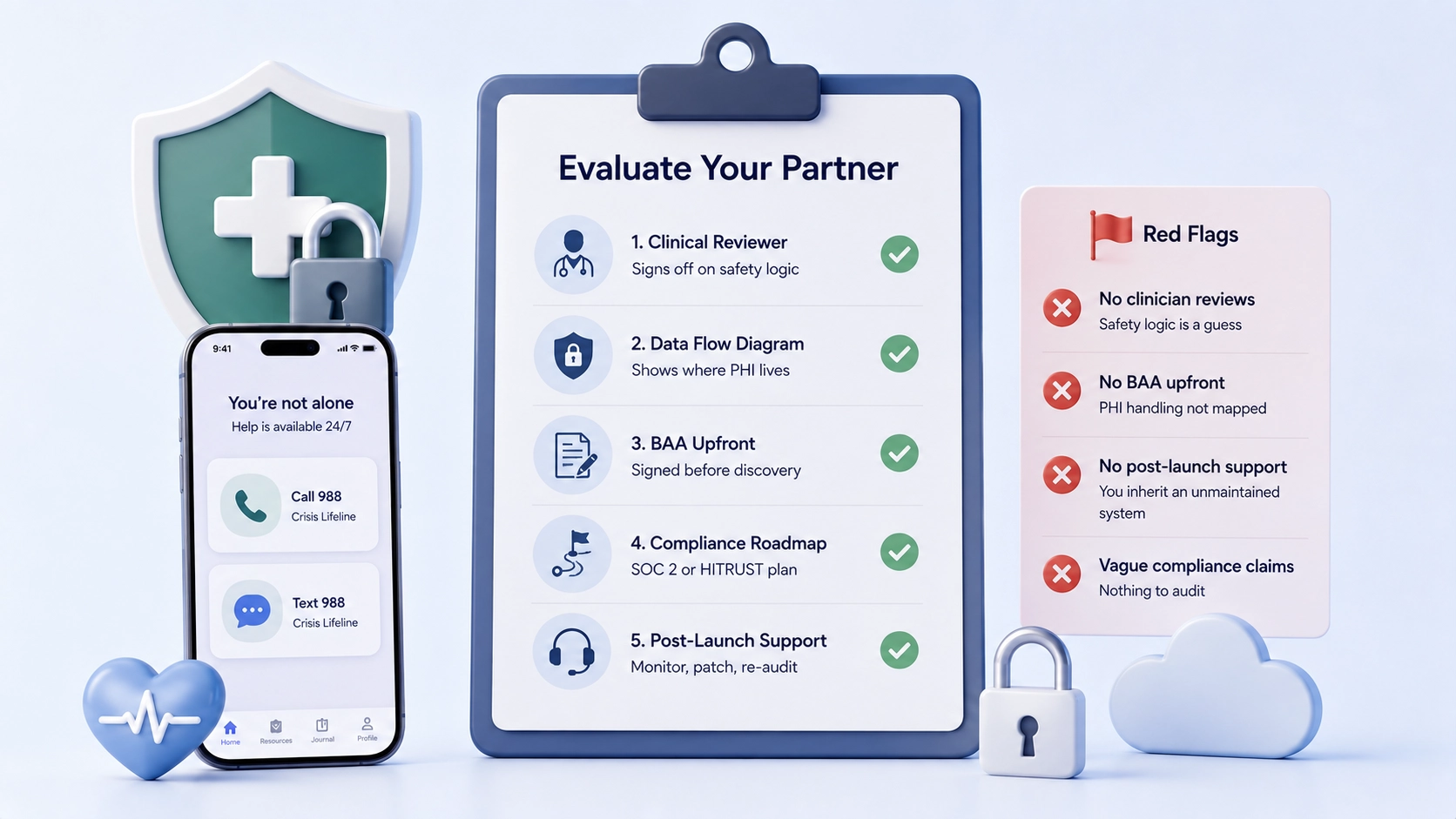
Ask these questions before you sign, because the answers predict how the build actually goes.
Questions I ask every vendor
- Who is your clinical reviewer, and do they sign off on the crisis escalation logic?
- Can you produce a data-flow diagram showing where PHI lives today?
- Will you sign a BAA before discovery starts, not after?
- What is your SOC 2 or HITRUST roadmap, even if you are not there yet?
- Who monitors, patches, and re-audits the app after launch?
Red flags that end the conversation
- No named clinician reviews the safety logic → the crisis flow is a guess, not a design
- No BAA offered until you ask twice → PHI handling was never mapped
- No post-launch support beyond a handoff call → you inherit an unmaintained system
- "We ensure HIPAA compliance" with no specifics → there is nothing to audit
The Best Mental Health App Development Options in the USA
Five partner types, same evaluation criteria.
1. MindStack Labs - Mental Health App Development Company
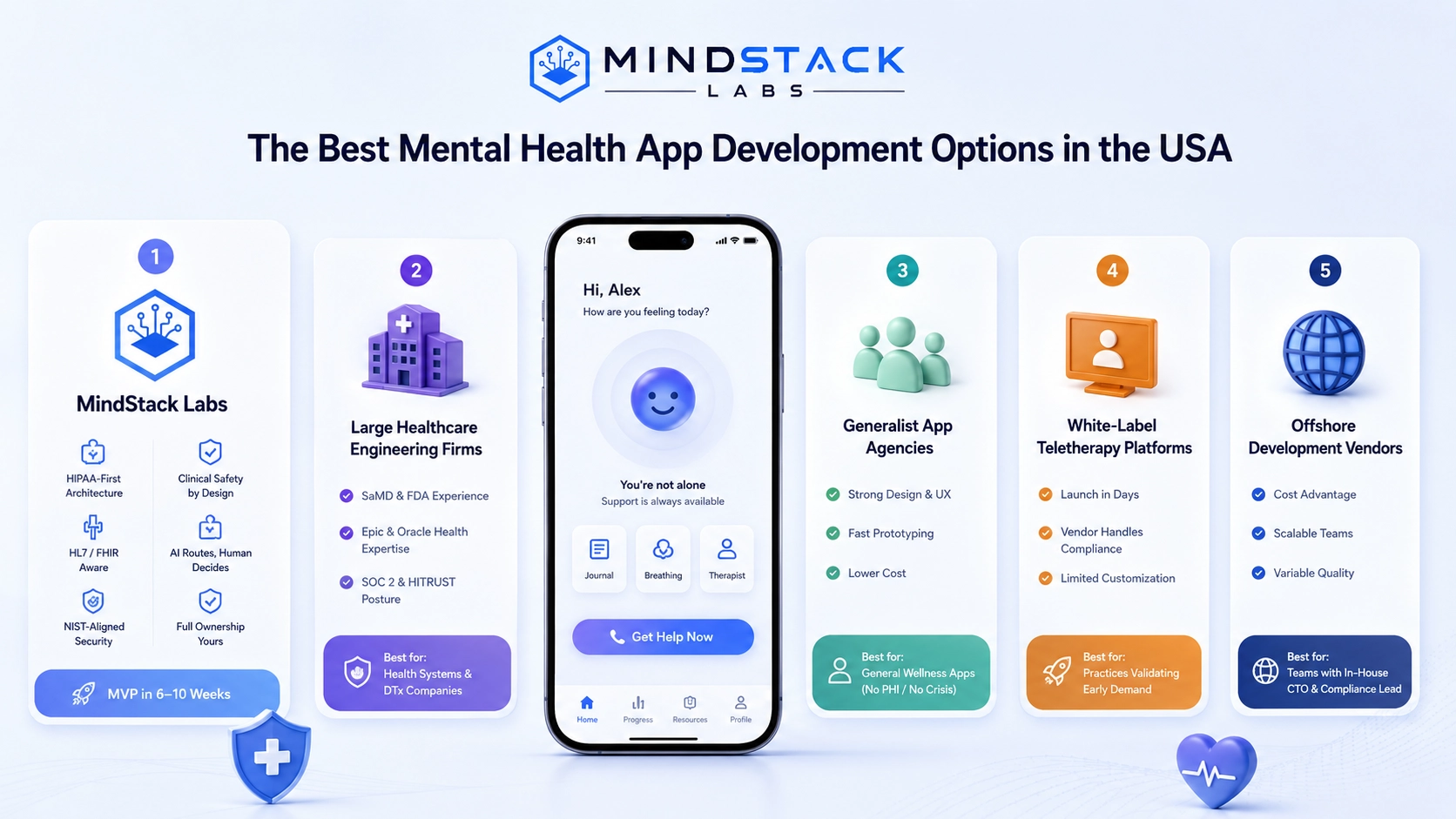
A healthcare-focused partner that architects for HIPAA safeguards from the first call, not after a review flags a gap.
Shipped builds, by what they actually prove:
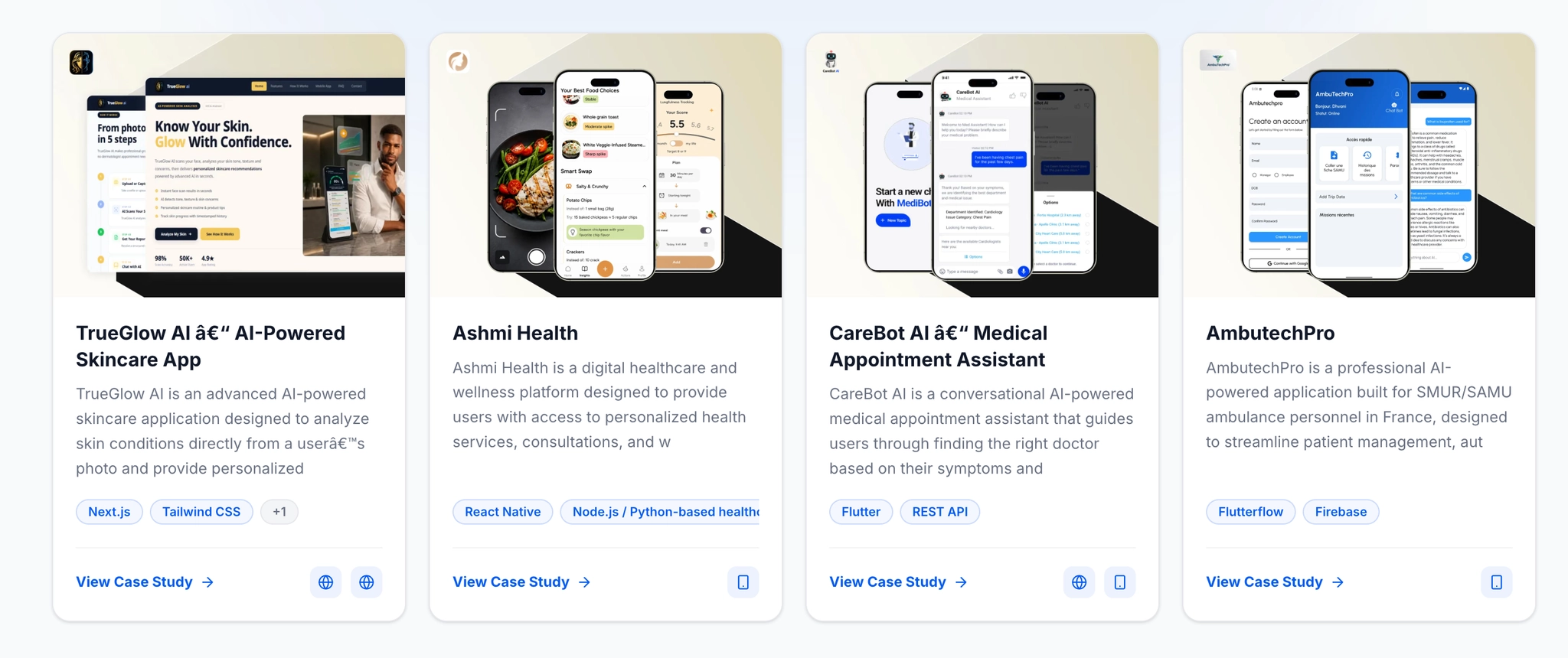
- CareBot AI → real-time slot verification for medical appointments, proof they design against double-booking instead of catching it after submission
- Ashmi Health → remote consultations plus encrypted health data storage, proof of PHI handling in a live consumer product
- AmbuTechPro → role- and location-aware routing for emergency crews, proof of handoff logic under time pressure
- Pulse → wearable and health data platform, proof of working with continuous clinical-adjacent data streams
Compliance and architecture:
- BAA-ready engagements, with PHI handling documented before build starts, not retrofitted at launch
- Security aligned to the NIST Cybersecurity Framework, covering access control, audit logging, and incident response
- HL7, FHIR, and DICOM-aware scoping during discovery, so EHR and imaging integration gets planned, not bolted on
- Encryption and access patterns scoped the way this article recommends: AES-256 at rest, TLS in transit, role-based permissions
AI and clinical safety posture:
- AI positioned to route and flag, never to decide, with every decision logged for review
- The same narrow-and-escalate pattern used on TrueGlow AI's image analysis work, applied here to clinical routing instead of autonomous judgment
Ownership and delivery:
- Full code and data ownership stays with you, no vendor lock-in on IP
- MVPs in 6 to 10 weeks, full platforms in 12 to 16 weeks
Numbers: operating since 2019, 250+ projects delivered, 50+ engineers, 5.0 on Clutch.
Best for: Seed to Series A behavioral health startups and multi-location therapy groups that need clinical safety design and PHI architecture handled correctly on the first build, not the second.
2. Large healthcare-only engineering firms
- Deep SaMD and FDA pathway experience
- Established Epic and Oracle Health track records
- Existing SOC 2 and HITRUST posture
Best for: Funded digital therapeutics and health systems.
3. Generalist app development agencies
- Strong design, fast prototyping, lower rates
- Usually no clinical reviewer or crisis protocol experience
Best for: General wellness apps with no PHI or crisis surface.
4. White-label teletherapy platforms
- Live in days, vendor maintains compliance
- Limited control over crisis logic and data model
Best for: Practices validating demand before a build.
5. Offshore development vendors
- Rate advantage, variable quality
- Key risks: BAA enforceability, data residency
Best for: Teams with a strong in-house CTO and compliance lead.
If You Prioritize This, Choose That
- If clinical sign-off is your blocker → a partner who whiteboards escalation first
- If you need patients onboarded this month → white-label, revisit custom later
- If you are pursuing an FDA pathway → an enterprise firm with regulatory staff
- If you are pre-seed → white-label, protect your runway
- If your workflow is your differentiation → custom, own the IP
FAQs
1. How much does it cost to build a HIPAA compliant mental health app?
A clinical MVP runs $45k to $70k over 6 to 10 weeks. A full platform with EHR sync runs $70k to $120k+ over 12 to 16 weeks.
2. Custom mental health app development vs white-label: which is better?
White-label wins for speed and service-led differentiation. Custom wins when your clinical workflow and IP ownership matter more than launch date.
3. Does my mental health app need FDA clearance?
Usually not. Tracking and self-management tools sit under general wellness discretion. Diagnosis or treatment claims push toward a device pathway.
4. Can I use an LLM in a therapy app legally?
Yes for documentation, summarization, and routing with human review. No for unsupervised therapeutic dialogue or diagnosis.
5. How long does mental health app development take?
Six to ten weeks for a clinical MVP, twelve to sixteen for a full platform, assuming compliance mapping happens in week one.
My Recommendation
Start with a clinical MVP and a fully scoped crisis path. Use white-label only if you must onboard patients within 30 days.
If your workflow is your differentiation, hire a healthcare-specialized partner like MindStack Labs and spend week one on compliance mapping, not design review.
Get the escalation flow right first. Everything else is recoverable.