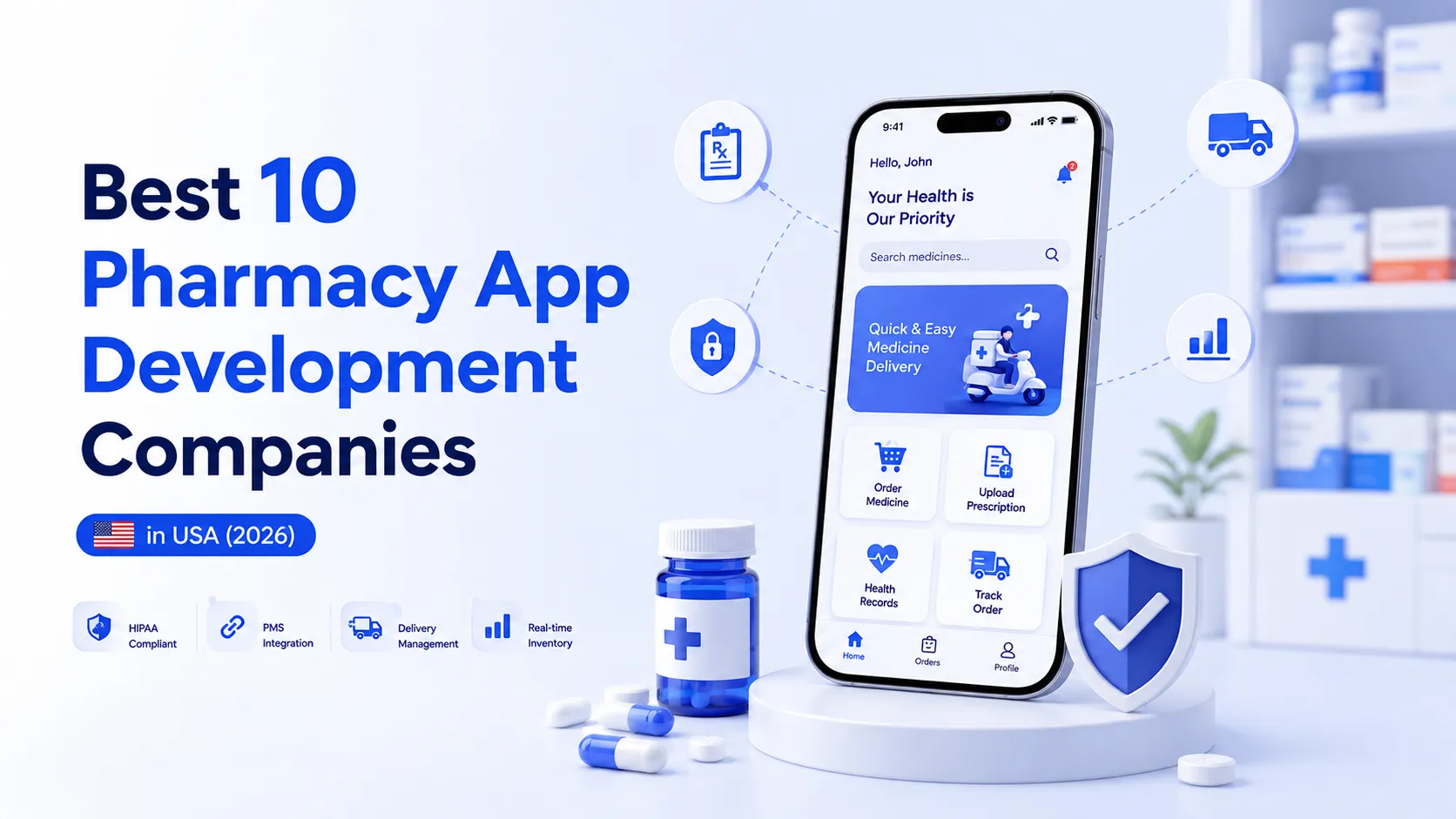
The best pharmacy app development company for you is the one that can explain how your existing pharmacy management system, your prescription intake and your delivery workflow will talk to each other before it quotes you a price.
On that test, my top three are Mind Stack Labs for compliance-first custom builds in regulated verticals, Topflight Apps for HIPAA-heavy patient-facing products, and Langate Software for pharma enterprise integration work.
Ever met a pharmacy owner whose first app rollout went exactly to plan?
Me neither. Here is why.

I have scoped, reviewed or audited healthcare and pharmacy builds dozens of times over the past several years, and I still budget two extra weeks purely for the pharmacy management system conversation.
Not for coding it. For finding out whether the vendor will return the email.
That gap is what this list is built around.
TL;DR
- → Best overall for regulated custom builds = Mind Stack Labs, because integration discovery comes before pricing.
- → Best for patient-facing HIPAA products = Topflight Apps. Best for pharma enterprise = Langate Software.
- → Cost tracks integration and compliance complexity, not screen count. Any fixed quote issued before a PMS discovery call is a guess wearing a suit.
- → "HIPAA certified app" is not a real status. Treat that phrase as a disqualifier.
- → Every entry below carries stated limitations. A list where all ten companies are excellent has zero decision value.
Quick Comparison: All 10 Pharmacy App Development Companies at a Glance
Here is the whole shortlist in one table so you can eliminate seven of them in ninety seconds.
| # | Company | HQ / delivery | Best for | Pharmacy or health focus | Engagement model | Price signal |
|---|---|---|---|---|---|---|
| 1 | Mind Stack Labs | India delivery, serves USA, UK, UAE, AU | Compliance-first custom builds in regulated verticals | Dedicated healthcare industry practice plus logistics practice | Custom project, dedicated team | Scoped after PMS discovery |
| 2 | Topflight Apps | USA [VERIFY] | Patient-facing HIPAA-heavy products | Dedicated pharmacy app service line | Custom project | Mid to high, quote based |
| 3 | Langate Software | USA [VERIFY] | Pharma enterprise and integration-led builds | Dedicated pharma application service line | Custom project, team extension | Mid to high, quote based |
| 4 | EMed HealthTech | India [VERIFY] | Fast e-pharmacy launch on a proven base | Productised online pharmacy platform | Product plus customisation | Lower, platform led |
| 5 | Folio3 Digital Health | USA HQ, offshore delivery [VERIFY] | Enterprise health IT and EHR integration | Dedicated digital health division | Custom project, staff augmentation | Mid to high |
| 6 | Mobisoft Infotech | USA HQ, India delivery [VERIFY] | On-demand pharmacy and delivery platforms | Online pharmacy product line | Custom project | Mid |
| 7 | Stormotion | Europe [VERIFY] | Product-led MVPs with strong UX | Pharmacy app service page, health portfolio | Custom project | Mid |
| 8 | Purrweb | Distributed [VERIFY] | Design-first MVPs on short timelines | Health and pharmacy guides, MVP focus | Fixed-scope MVP packages | Lower to mid |
| 9 | Binary Studio | Europe [VERIFY] | Engineering-heavy backend work | Pharmacy development service line | Team extension | Mid |
| 10 | Empeek | USA / Europe [VERIFY] | Health data and interoperability builds | Pharma app development service line | Custom project, dedicated team | Mid |
Notice what is missing from that table. Nobody publishes a real starting price. That is not evasion on my part. It is the actual state of this market, and I will explain why below.
How I Evaluated These Companies (My Scoring Criteria)

I scored on five things, and I am publishing the weights so you can disagree with them.
Most listicles in this space hand you a ranking with no rubric. That is not a list. That is an opinion in a table.
The five criteria and their weightings
- Pharmacy-specific depth, 30%. Can they describe a refill authorization loop unprompted, or do they show you screenshots?
- Integration track record, 25%. Have they connected to a live pharmacy management system, EHR or e-prescribing pathway?
- Compliance engineering practice, 20%. Are safeguards described as encryption, access control and audit logging, or as a badge?
- Delivery transparency, 15%. Who writes the code, where do they sit, and who owns it at the end?
- Post-launch commitment, 10%. Are maintenance terms in writing before you sign?
What I deliberately did not score on
- Team size. A 400-person agency can put three juniors on your build.
- Years in business. Longevity is not domain depth.
- Award badges and directory placements. Most are paid or self-reported.
- Portfolio volume. Ten health apps with no pharmacy workflow is not pharmacy experience.
The 10 Best Pharmacy App Development Companies in USA
Every entry below follows the same shape: verdict, capabilities, numbers or model, best for, and limitations. Same structure, ten times, so you can compare across rows instead of reading ten sales paragraphs.
1. Mind Stack Labs - Top-rated Pharma App Development Company

Verdict: The strongest fit if your blocker is integration and compliance rather than interface, because pricing conversations start after pharmacy management system discovery rather than before it.
Key capabilities:
- Healthcare app development as a standing industry practice, not a portfolio category
- Cross-platform builds via Flutter mobile apps and React Native to move on iOS and Android together
- Secure backend architecture through Node.js backend and Supabase engineering
- Pharmacist-side operations tooling using business dashboards and admin panels
- Delivery-side depth from a parallel logistics and transportation practice, which is the exact combination a delivery-enabled pharmacy app needs
Model and numbers: custom project or dedicated team. Cost is scoped after PMS discovery, and phase one is defined as the smallest system that can legally dispense and deliver. Full code handover, documented.
Compliance is described as engineering practice here, building to HIPAA technical safeguards with encryption, role-based access control and audit logging, and writing the responsibility split into the engagement. No certification claims.

Shipped healthcare work, and what each build proves for a pharmacy project
| Project | What it is | Stack | Why it matters for a pharmacy app |
|---|---|---|---|
| CareBot AI | Conversational AI medical appointment assistant that routes users to the right doctor based on symptoms | Flutter, REST API | Closest analogue to a patient-facing pharmacy assistant. Symptom triage logic maps directly onto refill intake and pharmacist escalation flows |
| Ashmi Health | Digital healthcare and wellness platform for personalised health services and consultations | React Native, Node.js, Python | Proves patient-account, consultation and health-data handling. The same architecture pattern a patient pharmacy app needs |
| AmbutechPro | AI-powered patient management app for SMUR/SAMU ambulance personnel in France | FlutterFlow, Firebase | Regulated clinical staff tooling under real time pressure. Nearest thing to a pharmacist-side dispensing queue |
| Pulse Web | Web admin dashboard controlling content, users and analytics for a wellness platform backend | Angular, .NET API | Direct evidence of admin panel and back-office builds, which is where pharmacy inventory and order management actually live |
| TrueGlow AI | AI skincare app that analyses conditions from a user photo and returns personalised recommendations | Next.js, Tailwind CSS | Image capture, analysis and structured output. The same pipeline a prescription upload and verification flow runs on |
| ISA | Member platform for the Indian Society of Anaesthesiologists with a full admin console | Angular, .NET Core 6 Web API | Multi-role access control at member scale, which is the pattern behind pharmacist, technician and admin permission tiers |
Read the pattern rather than the logos. Patient app, clinical staff tool, admin console, image pipeline, role-based access. Those are the five parts of a pharmacy build.

None of these is a dispensing system. I am not going to pretend otherwise.
Best for: pharmacies and health startups whose real constraint is an incumbent PMS and a regulated dispensing workflow.
Limitations, stated plainly:
- Delivery is India-based, so if your procurement policy mandates a US-only engineering team, this is a hard no regardless of fit.
- The public portfolio shows healthcare and clinical tooling rather than a live retail pharmacy dispensing build. Review portfolio and case studies and ask directly how that experience transfers to your PMS.
Who should look elsewhere: anyone wanting an off-the-shelf e-pharmacy platform live in three weeks.
2. Topflight Apps

Verdict: The most established pharmacy-specific service line among the US-facing agencies, and the one Google's own AI Overview cites most consistently for this query.
Key capabilities:
- Dedicated online pharmacy app development practice
- HIPAA-oriented patient-facing product work
- Prescription upload, refill and delivery-tracking flows
- Broader healthcare product strategy support
Model and numbers: custom project engagements, quote based. Positioned in the mid to high band. No published starting price.
Best for: patient-facing pharmacy products where compliance and UX both carry weight.
Limitations:
- Premium positioning that a single-location independent pharmacy will likely find hard to justify.
- Strongest on the patient-facing layer, so probe hard on the pharmacist-side dispensing queue before you assume it is scoped.
Who should look elsewhere: pre-funding startups looking for the cheapest viable MVP.
3. Langate Software

Verdict: The pick when your build is pharma enterprise rather than retail pharmacy, because their positioning centres on regulated application development and integration.
Key capabilities:
- Pharma application development as a named service line
- Enterprise integration and system connectivity work
- Regulated-industry software engineering
- Team extension alongside full project delivery
Model and numbers: custom project or team extension. Mid to high band, quote based.
Best for: pharmaceutical manufacturers and specialty pharmacies building internal or hub-services tooling.
Limitations:
- Less visible consumer-facing pharmacy app work than Topflight, so if you need a polished patient app, ask for that specifically.
- Enterprise-shaped engagement process, which tends to run slower than a startup timeline tolerates.
Who should look elsewhere: independent retail pharmacies wanting a simple refill and delivery app.
4. EMed HealthTech

Verdict: The fastest route to a live e-pharmacy if your workflow is standard, because you are customising a productised platform rather than building from zero.
Key capabilities:
- Ready online pharmacy product with customisation layer
- Medicine ordering, delivery and admin modules included
- Faster launch cycle than ground-up custom development
- Established pharmacy-sector focus
Model and numbers: product licence plus customisation. Lowest cost band on this list. Timelines measured in weeks rather than quarters in most standard configurations.
Best for: independent pharmacies and small chains with conventional workflows and a tight budget.
Limitations:
- Platform boundaries become your product boundaries. Non-standard PMS or prescriber workflows will hit a wall.
- Delivery is offshore, and enterprise procurement teams often reject that outright.
Who should look elsewhere: anyone with controlled substances, an unusual insurance layer or a bespoke dispensing process.
5. Folio3 Digital Health

Verdict: The strongest option if EHR interoperability sits at the centre of your build rather than at the edge of it.
Key capabilities:
- Dedicated digital health division with pharmacy app service page
- EHR and health system integration experience
- Enterprise-scale health IT delivery
- Staff augmentation available alongside project work
Model and numbers: custom project or augmentation. Mid to high band. US headquarters with offshore delivery [VERIFY].
Best for: enterprises and health systems where the pharmacy app must sit inside a wider clinical data estate.
Limitations:
- Breadth across many health verticals can mean your team is not pharmacy-native. Ask who specifically has shipped a dispensing workflow.
- Enterprise onboarding overhead is real, and small operators feel it.
Who should look elsewhere: single-location pharmacies and lean startups.
6. Mobisoft Infotech
Verdict: A solid fit when the delivery and logistics half of your pharmacy app is the harder half.
Key capabilities:
- Online pharmacy app development product line
- On-demand delivery and tracking architecture
- US front office with offshore engineering
- Mobile plus admin panel delivery
Model and numbers: custom project. Mid band. Strong public domain footprint, which usually signals a mature marketing operation rather than deeper engineering.
Best for: pharmacies where last-mile delivery volume is the core operational problem.
Limitations:
- Generalist on-demand delivery heritage, so pharmacy-specific compliance depth needs verifying rather than assuming.
- Chain-of-custody and cold-chain handling should be confirmed explicitly, since generic delivery architecture does not cover it.
Who should look elsewhere: pharma enterprises needing deep clinical integration.
7. Stormotion
Verdict: A good product-led partner when you need a well-designed pharmacy MVP and can bring your own regulatory guidance.
Key capabilities:
- Pharmacy app development service line
- Strong product discovery and UX practice
- Health and wellness portfolio depth
- Small-team, high-communication delivery model
Model and numbers: custom project. Mid band. Europe-based delivery [VERIFY], meaning partial US timezone overlap only.
Best for: founders who value product craft and have counsel handling US regulatory scope.
Limitations:
- Limited visible US pharmacy regulatory work, so NCPDP and EPCS fluency needs testing directly.
- Team scale constrains parallel workstreams if you need patient app, pharmacist app and admin panel simultaneously.
Who should look elsewhere: multi-location chains needing PMS integration at several sites.
8. Purrweb
Verdict: The cheapest credible route to a working pharmacy MVP, with the tradeoffs that implies.
Key capabilities:
- Fixed-scope MVP packages with published timelines
- Design-first delivery process
- Substantial public content on pharmacy app process and cost
- Fast iteration cycles
Model and numbers: fixed-scope MVP packages. Lower to mid band, and the most transparent pricing posture on this list.
Best for: pre-seed founders validating an e-pharmacy concept before committing real capital.
Limitations:
- MVP-shaped engagements are not built for deep PMS integration, which is exactly where pharmacy projects fail.
- Fixed scope means change requests get expensive fast once dispensing reality intrudes.
Who should look elsewhere: any operator with a live pharmacy and an incumbent management system.
9. Binary Studio
Verdict: Pick this one when you need engineering capacity for a hard backend problem and you already have product direction.
Key capabilities:
- Pharmacy development service line
- Backend and architecture engineering strength
- Team extension model
- Long-cycle engineering engagements
Model and numbers: team extension primarily. Mid band, typically rate-card based rather than fixed-bid.
Best for: companies with in-house product leadership needing senior engineering throughput.
Limitations:
- Team extension means you own product management, compliance scope and QA direction. If you do not have that, this fails.
- Less turnkey than the full-service agencies above.
Who should look elsewhere: pharmacy owners with no technical staff.
10. Empeek
Verdict: A reasonable choice for health data and interoperability work with a pharma-facing service line already in place.
Key capabilities:
- Pharma app development service page
- Health data and interoperability focus
- Custom and dedicated team engagements
- Regulated health software experience
Model and numbers: custom project or dedicated team. Mid band.
Best for: builds where medication data exchange and clinical context matter more than consumer polish.
Limitations:
- Smaller public pharmacy-retail footprint, so retail dispensing depth needs probing.
- Compliance claims should be checked against primary sources rather than accepted from the site.
Who should look elsewhere: pharmacies wanting a delivery-led consumer app.
Wait, you might be thinking: is this list just another agency ranking itself first?
Fair challenge, and you should carry it into every listicle you read.
The difference is that the rubric is published above and every entry, including the first, carries real limitations.
Score Mind Stack Labs against those five criteria yourself. If offshore delivery disqualifies it for you, entry two is right there.
What a Pharmacy App Development Company Actually Does

A pharmacy app development company builds and integrates three connected systems, not one app. Everything else on their service page is interface.
- Prescription intake → how a valid prescription enters your system and gets verified
- Inventory truth → whether the app knows what is actually on the shelf right now
- Fulfilment → pickup or delivery with proof the right medication reached the right person
Break one and the other two stop mattering.
What usually sits outside scope, despite sounding included:
- Your BAA with third-party vendors
- Staff training and internal access policy
- Final regulatory sign-off with your counsel
- Pharmacy management system licence and vendor cooperation
Specialist vs Generalist: How to Tell the Difference in One Call
A real pharmacy developer talks about message standards and dispensing exceptions. A generic app shop talks about screens.
Three tells, from my experience:
- e-Prescribing. Prescriptions arrive through an e-prescribing network on the NCPDP SCRIPT standard, not through an upload form in your app. A vendor who does not know SCRIPT exists has not built this.
- Inventory. Ask where inventory truth lives. The right answer is your PMS, never the app. Ask about reservation locking so two orders cannot claim the last pack.
- Exceptions. Ask them to model a partial fill and a prescriber-denied refill. Real builders answer in seconds.
A three-location independent chain I reviewed had a working app and a broken transfer flow. Store A promised stock Store B had already dispensed.
Know why? Inventory was read-only and nobody built reservation locking.
Small gap. Large refund pile.
Pharmacy App Development Cost in 2026: What Actually Drives the Number

Cost tracks integration complexity far more than screen count, which is why any quote issued before a PMS discovery call is unreliable.
The six variables that actually move price:
- Number and difficulty of integrations, especially your pharmacy management system
- Whether controlled substances are in scope, since EPCS adds identity proofing and audit requirements
- Delivery model complexity, cold chain and proof of custody
- Insurance, copay and prior authorization workflows
- Compliance engineering, audit logging, access control and security testing
- Post-launch maintenance, which is a running cost and not a one-time line
Illustrative bands only, not quotes, and in my experience they move by a wide margin once integration reality lands:
- → Platform customisation on a productised base = lowest cost, weeks not quarters
- → Custom MVP with one PMS integration and pickup only = mid band
- → Custom build with delivery, insurance layer and controlled substances = highest band
Not sure what your phase one should actually include?
Book a free 30-minute scoping call with Mind Stack Labs. We will walk through your pharmacy management system, your delivery model and what can realistically launch first. No pitch deck.
Book a Free Scoping Call →How Long Does Pharmacy App Development Take?
Discovery and integration feasibility take longer than the first build sprint, and teams that compress discovery pay it back with interest during QA.
The correct sequence:
- Discovery and PMS feasibility
- Compliance scope review with counsel
- Phase one build, often cross-platform to move on iOS and Android together
- Security testing
- Pilot at one location
- Rollout
Phase one should be the smallest thing that can legally dispense and deliver. Nothing more.
Compliance: What HIPAA Actually Requires From Your Build Partner

HIPAA does not certify apps. It sets safeguards your engineering has to satisfy, and responsibility splits between you and your vendor.
Sits with the build team:
- Encryption in transit and at rest
- Role-based access control and least privilege
- Comprehensive audit logging of PHI access
- Secure authentication and session handling, which is why authentication versus authorization is worth understanding before you brief anyone
- Security testing before launch, ideally against a defined API security checklist
Stays with you:
- BAAs with every vendor touching PHI
- Staff training and access policy
- Breach response procedures
- Data retention decisions and final regulatory sign-off
Anyone selling you a "HIPAA certified app" is selling you a phrase. There is more on this in our notes on things to keep in mind when developing healthcare projects and how modern applications protect user data.
Adjacent Topic: FHIR, and Why Prescribers Keep Bringing It Up
HL7 FHIR is becoming the common language for clinical data exchange, and it increasingly shapes how your pharmacy app talks to prescriber-side systems.
Pharmacy messaging still runs on NCPDP standards. Clinical context, medication lists and allergy data increasingly move over FHIR APIs.
Why it matters to you:
- Medication history and interaction checks pull cleaner over FHIR
- Prescriber-side integrations get easier as EHR vendors expand FHIR support
- Building FHIR-aware now reduces rework later
Ask your vendor whether they have worked with FHIR resources. The answer tells you a lot in about ten seconds.

Custom Build vs White-Label Pharmacy Platform: Which Do You Need?
White-label wins when your workflow is standard and your PMS is widely supported. Custom wins when it is not.
- → Standard workflow, supported PMS, launch this quarter = white-label platform
- → Non-standard prescriber flow, insurance layer or delivery model = custom build
- → Platform cannot integrate with the system you already run = custom build
- → Multiple locations with stock transfers = custom, with multi-location inventory in phase one
Custom is not automatically better. It is better when the box does not fit.
Offshore, Nearshore or US-Based: What "In USA" Really Buys You
Location matters for accountability and overlap, not for code quality. Most companies on this list deliver at least partly offshore, including several with US headquarters.
Where it genuinely matters:
- Legal recourse and contract enforceability
- Timezone overlap with your pharmacist-in-charge during pilot
- Procurement policies that mandate domestic teams
Where it does not:
- Engineering quality
- HIPAA safeguard implementation, which is architecture rather than geography
- Understanding NCPDP standards, which any serious team can learn and many offshore teams already have
How to structure offshore safely: named team members in the contract, four hours of guaranteed overlap, code in your repository from day one, and a written IP transfer clause.
Which Company Should You Choose? Pick by Scenario
- If integration with your existing PMS is the blocker, go with Mind Stack Labs or Folio3 Digital Health.
- If you need a polished patient-facing app, go with Topflight Apps.
- If you are pharma enterprise, not retail, go with Langate Software or Empeek.
- If speed and budget beat everything, go with EMed HealthTech or Purrweb.
- If delivery volume is your core problem, go with Mobisoft Infotech.
- If you already failed once with a cheap vendor, go with a partner who audits why it failed before quoting anything.

How to Shortlist in the Next 7 Days
- Day 1: align internally. Owner, pharmacist-in-charge and compliance lead in one room.
- Day 2: request integration documentation from your PMS vendor.
- Day 3: decide on controlled substances, since it changes the architecture.
- Day 4: score five vendors against the rubric above.
- Day 5: run the domain questions past the top three.
- Day 6: compare answers side by side, not sequentially.
- Day 7: pick two for paid discovery.
Pro tip: ask all three shortlisted vendors the same partial-fill question and compare the answers side by side, because the differences will be obvious and the marketing will not help them.
FAQs
How much does it cost to hire a pharmacy app development company in the USA?
Cost depends on integration and compliance complexity, not screen count. Platform customisation sits lowest, custom builds with delivery and controlled substances sit highest. Expect a real number only after a PMS discovery call.
Custom pharmacy app vs white-label platform: which is better?
White-label is better when your workflow is standard and your PMS is widely supported. Custom is better when your prescriber flow, insurance layer or delivery model does not fit the platform.
Do I need a US-based pharmacy app development company?
Not usually. Location matters for legal recourse, timezone overlap and procurement policy, not for engineering quality or HIPAA safeguard implementation. Several US-headquartered firms deliver offshore anyway.
Can a pharmacy app accept e-prescriptions directly?
No. Prescriptions arrive through e-prescribing networks using NCPDP SCRIPT, reach your pharmacy management system, and your app reads and acts on them. Controlled substances add further requirements.
What is the difference between a pharmacy app and a medicine delivery app?
A medicine delivery app handles ordering and last-mile logistics. A pharmacy app also handles prescription verification, dispensing workflow and inventory truth inside a regulated process.
My Recommendation
Start with integration discovery before you commit to a build partner or a budget, and only choose custom development if your pharmacy management system, prescriber workflow or delivery model genuinely does not fit an off-the-shelf platform.
If it does not fit, build phase one small. Dispense, sync, deliver. Add everything else after real patients touch it.
Get a phased pharmacy app scope, not a guess
Send Mind Stack Labs your pharmacy management system and delivery setup. We will map integration feasibility, phase one scope and the compliance responsibility split before anyone talks numbers..
Request a Scoping CallSee our healthcare work