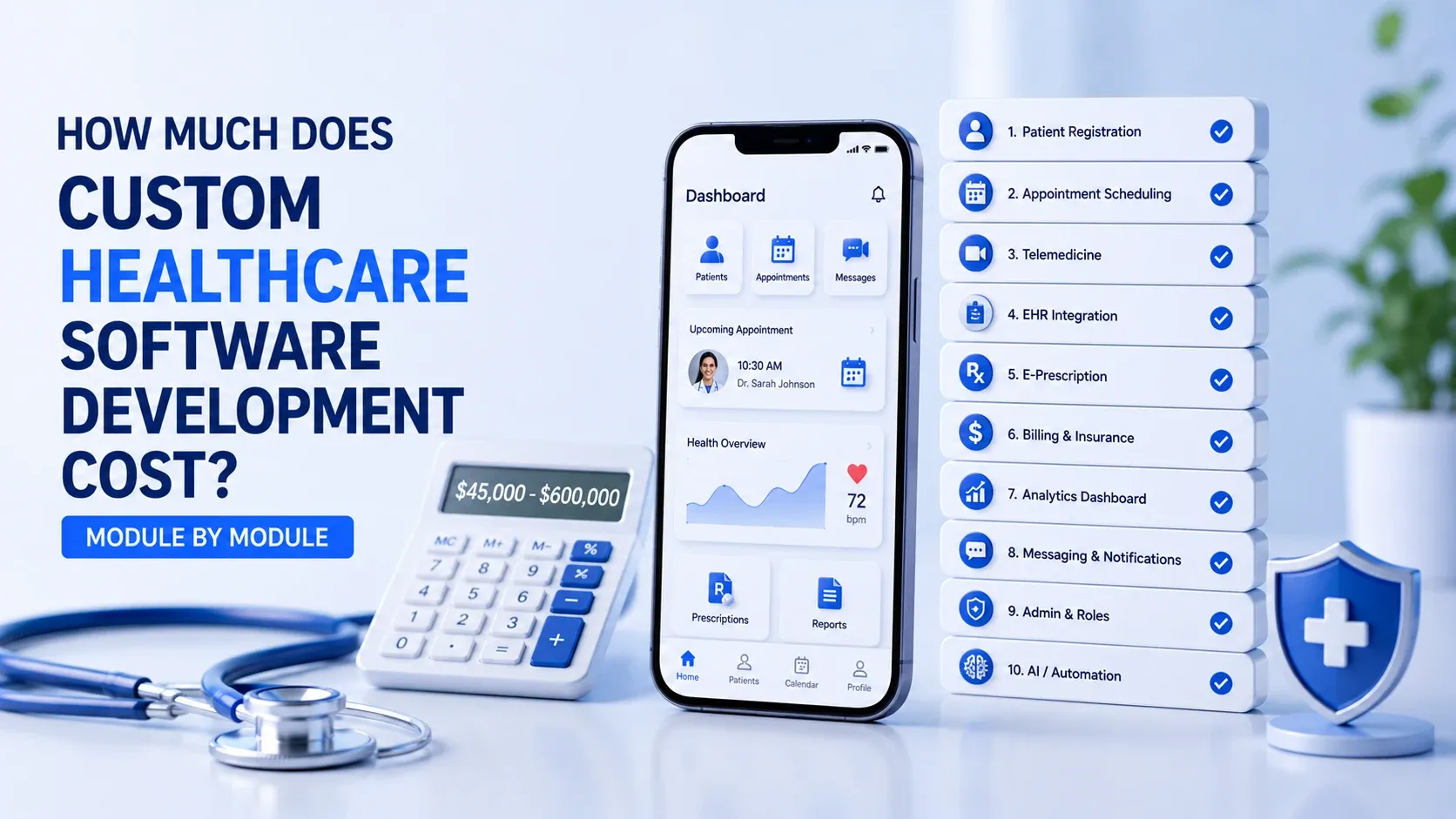
Most custom healthcare software development projects I have worked on land between $45,000 and $600,000, and the number moves almost entirely with how many modules you scope, not with how many hours a vendor bills.
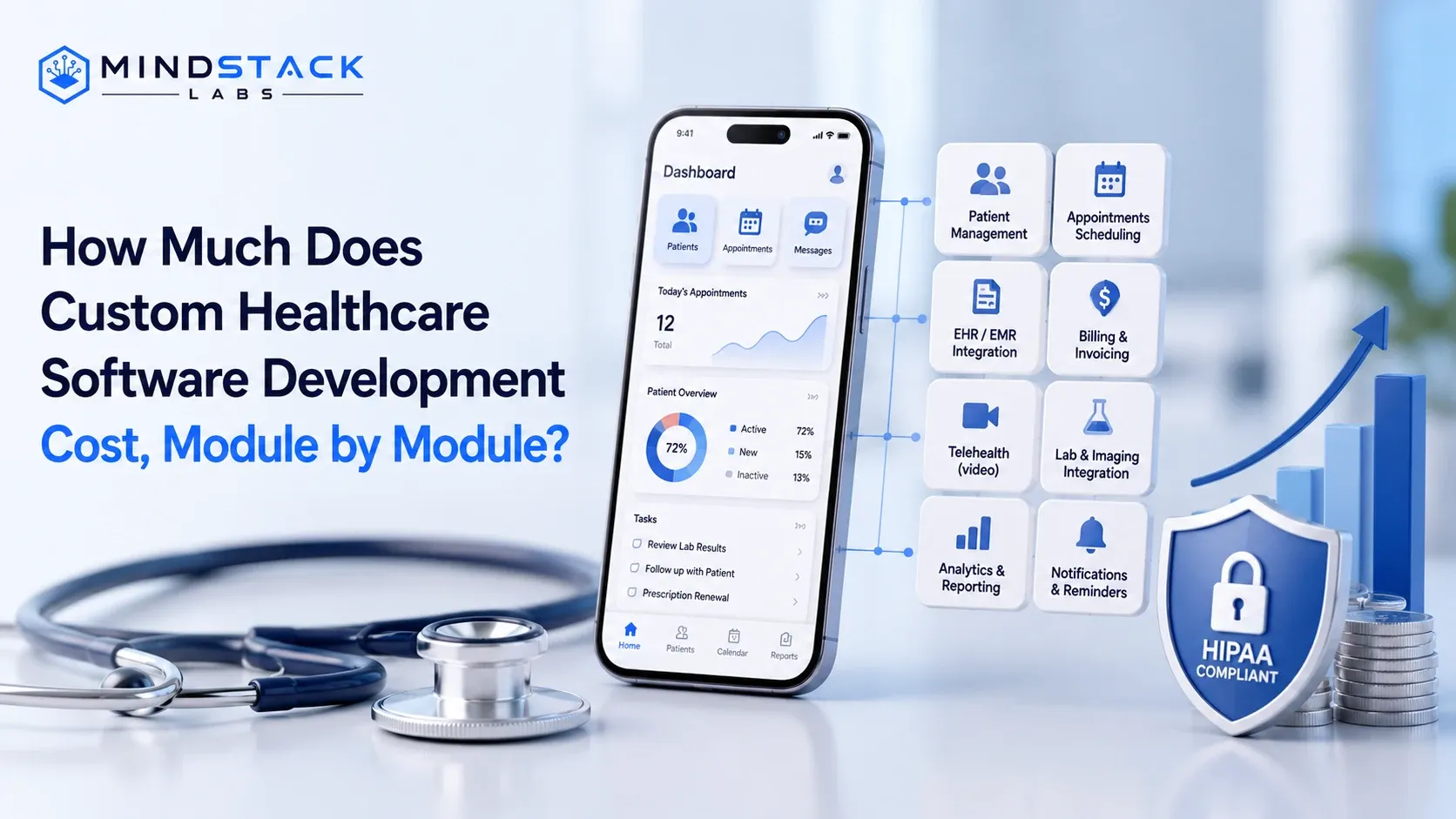
If you want a defensible figure, price the modules, not the project.
That single shift is why I wrote this. Healthcare builds get quoted as one lump sum, and lump sums hide everything that matters.
TL;DR
- → Lean patient-facing app = $45k to $90k in the builds I have seen
- → Clinic operations platform = $110k to $220k
- → Enterprise or multi-site system = $250k to $600k and up
- → Three cost drivers dominate: module count, integration depth, compliance engineering
- → HIPAA-grade security tends to add 10 to 20 percent on top of feature work, not a separate project
- → Ongoing costs run roughly 15 to 20 percent of build cost per year in my experience
Every number here is an observed range from real scoping work, not an industry statistic. Treat them as sanity-check bands, not quotes.
Have you ever received two healthcare software quotes that were $200,000 apart for the same brief?
Me neither, until I started sitting on the vendor side of those conversations. Then I saw it constantly.
The gap is almost never greed. It is scope interpretation. One vendor read "appointment booking" as a calendar. The other read it as multi-provider availability, insurance eligibility checks, and waitlist automation.
Same two words. Four times the build.
What Actually Drives Custom Healthcare Software Development Cost?
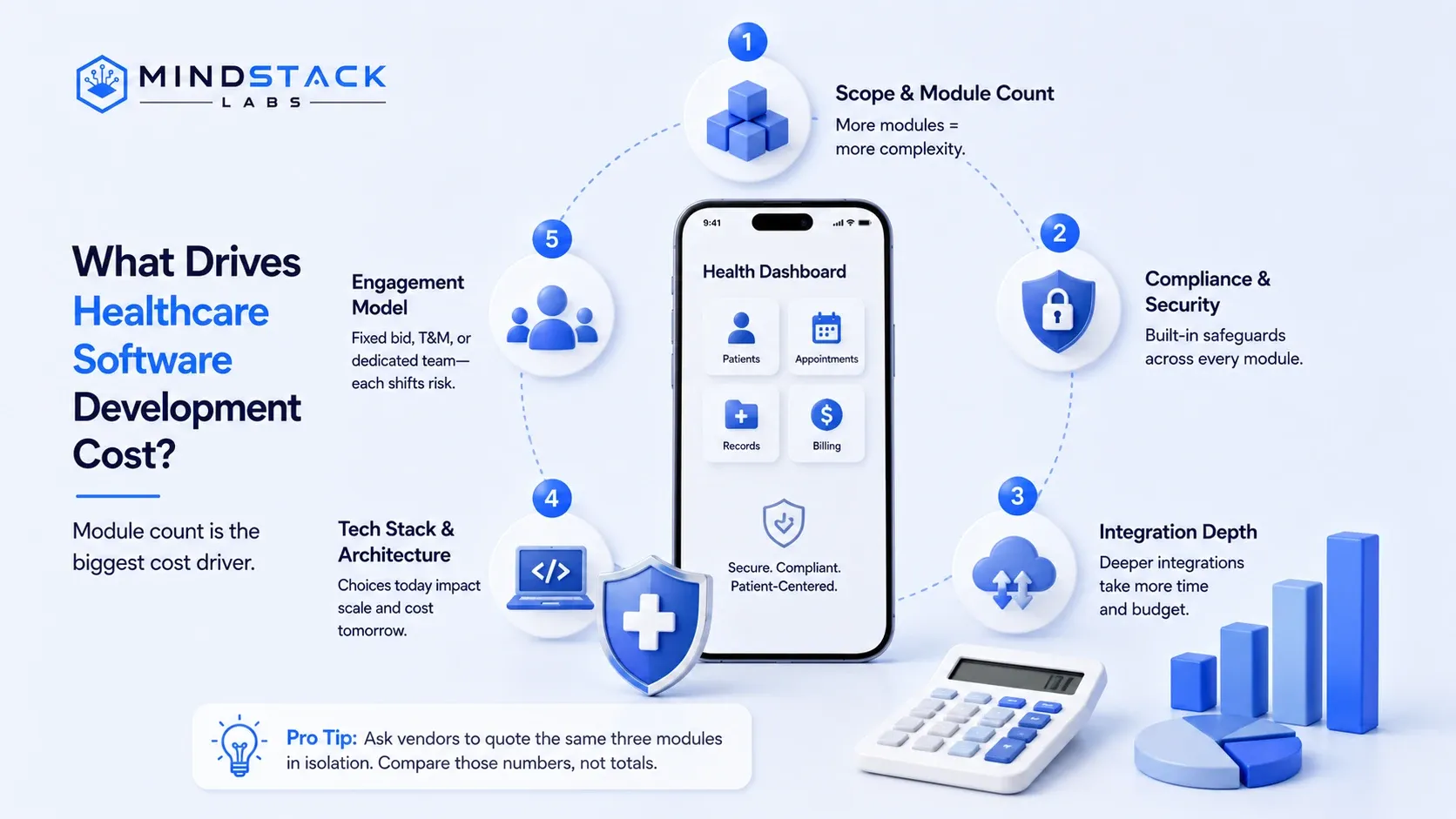
Five variables explain most of the spread between quotes, and module count is the biggest one.
1. Scope and module count
Each module carries its own design, build, test, and compliance overhead. Ten modules is not ten times one module, but it is rarely less than six times.
Watch for these silent multipliers:
- User roles → patient, clinician, admin, biller, auditor each need their own screens and permissions
- Clinical workflows → exceptions and escalation paths cost more than the happy path
- Data volume and history → longitudinal records need indexing, archiving, retention logic
2. Compliance and security engineering
HIPAA technical safeguards touch every module you build. They are not a checkbox at the end.
Encryption, audit logging, and access control get built into each feature. That is why compliance shows up as a percentage rather than a single line item.
3. Integration depth
Integration is where budgets go to die. Know why? The integration was never scoped.
A read-only FHIR pull takes a few weeks. A bidirectional sync with a legacy on-premise system, custom field mapping, and conflict resolution can take a quarter of your budget.
4. Tech stack and architecture
Stack choice changes cost more than most buyers expect.
| Choice | Cheaper path | More expensive path | Why it matters |
|---|---|---|---|
| Frontend | Cross-platform (Flutter, React Native) | Fully native iOS plus Android | One codebase versus two |
| Backend | Managed backend (Supabase, Firebase) | Custom microservices | Infra work you skip early |
| Architecture | Modular monolith | Microservices from day one | Ops overhead before scale exists |
| Hosting | HIPAA-eligible cloud services | Self-managed compliant infra | Audit and maintenance burden |
If you are weighing frontend approaches, our Flutter mobile app development and Node.js backend pages cover the tradeoffs in practical terms.
5. Engagement model
Fixed-bid buys certainty and adds a risk premium. Time and materials buys flexibility and shifts risk to you. Dedicated teams sit in between and win on long roadmaps.
Pro tip: ask every vendor to quote the same three modules in isolation, then compare those three numbers instead of the totals.
Module by Module Cost Breakdown for Custom Healthcare Software
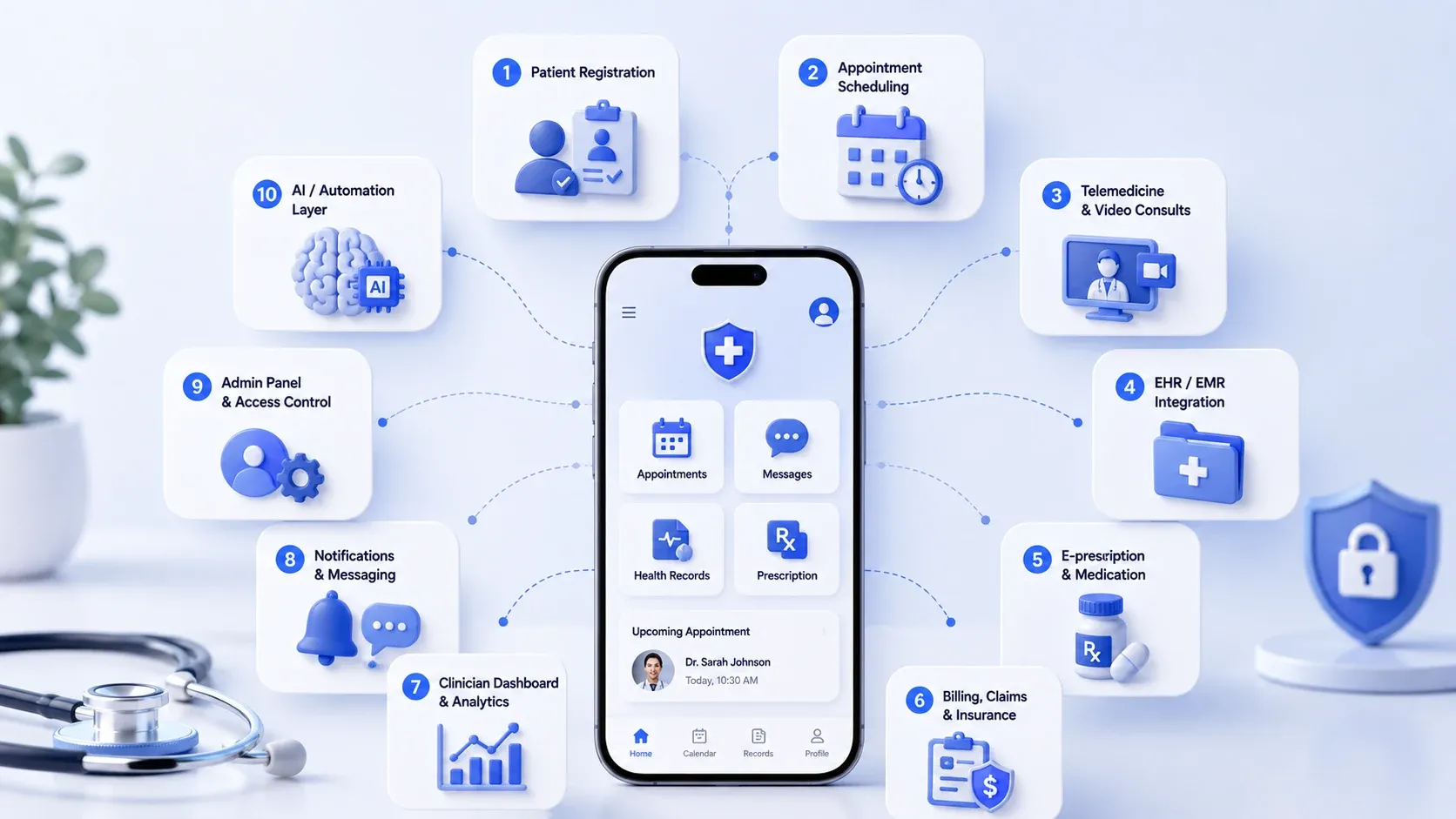
Here is the table most competitors refuse to publish, followed by what sits inside each range.
| Module | Typical range (observed) | Build time | Main cost driver |
|---|---|---|---|
| Patient registration and onboarding | $8k to $18k | 3 to 5 weeks | Identity verification, consent capture |
| Appointment scheduling | $12k to $28k | 4 to 6 weeks | Multi-provider availability logic |
| Telemedicine and video consults | $18k to $45k | 5 to 8 weeks | Call reliability, recording, storage |
| EHR or EMR integration | $20k to $60k plus | 6 to 12 weeks | Standards used, legacy access |
| E-prescription and medication | $15k to $35k | 4 to 8 weeks | Third-party network integration |
| Billing, claims, insurance | $25k to $70k | 8 to 14 weeks | Payer rules, eligibility, denials |
| Clinician dashboard and analytics | $12k to $30k | 4 to 7 weeks | Query complexity, real-time needs |
| Notifications and messaging | $6k to $15k | 2 to 4 weeks | Secure messaging versus plain push |
| Admin panel, roles, permissions | $10k to $22k | 3 to 5 weeks | Number of roles and audit depth |
| AI or automation layer | $15k to $50k | 5 to 10 weeks | Model choice, human review loops |
1. Patient registration and onboarding
This module is cheap to build and expensive to get wrong.
- Key capabilities: signup, identity verification, consent forms, insurance capture, document upload
- Typical range: $8k to $18k, 3 to 5 weeks in my experience
- Best for: every build, and the first module I would ship in an MVP
Secure document handling is where I see corners cut. Our secure file upload checklist covers the failure modes.
2. Appointment scheduling and calendar logic
Scheduling costs scale with how many humans and rooms you coordinate.
- Key capabilities: provider availability, multi-location routing, rescheduling, waitlists, reminders
- Typical range: $12k to $28k, 4 to 6 weeks
- Best for: clinics and multi-provider groups where no-shows drive revenue loss
3. Telemedicine and video consultation
Video is a solved problem technically and an unsolved problem operationally.
- Key capabilities: WebRTC or vendor SDK calls, waiting rooms, in-call notes, recording and retention
- Typical range: $18k to $45k, 5 to 8 weeks
- Best for: providers with distributed patients or specialty follow-up visits
We documented the engineering path in building a real-time video app with Flutter, WebRTC, and Firebase.
4. EHR or EMR integration
This is the most volatile line in any healthcare quote.
- Key capabilities: HL7 v2 or FHIR APIs, field mapping, sync scheduling, error queues, sandbox testing
- Typical range: $20k to $60k and higher, 6 to 12 weeks
- Best for: any product that must live inside an existing clinical workflow
The range width is not vagueness. It reflects whether the incumbent system exposes a modern API or a nightly file drop.
5. E-prescription and medication management
Prescribing pulls you into third-party networks and strict validation.
- Key capabilities: medication lists, interaction checks, refill workflows, prescriber verification
- Typical range: $15k to $35k, 4 to 8 weeks
- Best for: builds serving prescribing clinicians, not care coordination only
6. Billing, claims, and insurance workflows
Billing is the most underestimated module I encounter.
- Key capabilities: eligibility checks, claim generation, denial handling, patient payments, reporting
- Typical range: $25k to $70k, 8 to 14 weeks
- Best for: provider organizations where revenue cycle sits inside the product
7. Clinician dashboard and analytics
Dashboards stay cheap until someone says "real time."
- Key capabilities: patient panels, task queues, outcome tracking, exportable reports
- Typical range: $12k to $30k, 4 to 7 weeks
- Best for: care teams managing panels rather than one-off encounters
See how we approach business dashboards for reporting patterns that hold up at scale.
8. Notifications, messaging, and patient engagement
Push notifications are inexpensive. Secure clinical messaging is not.
- Key capabilities: push, SMS, email, in-app secure threads, delivery tracking
- Typical range: $6k to $15k, 2 to 4 weeks
- Best for: adherence, reminders, and reducing inbound call volume
Implementation details live in our guide to Flutter push notifications.
9. Admin panel, roles, and permissions
Role design is a compliance decision disguised as a UI task.
- Key capabilities: role-based access control, audit trails, user provisioning, configuration screens
- Typical range: $10k to $22k, 3 to 5 weeks
- Best for: any system where more than two user types touch PHI
If your team blurs the two concepts, read authentication versus authorization before scoping this.
10. AI or automation layer
AI adds real value in healthcare when a human stays in the loop.
- Key capabilities: intake triage, note summarization, documentation assistance, workflow routing
- Typical range: $15k to $50k, 5 to 10 weeks
- Best for: teams drowning in documentation or repetitive coordination work
Our AI workflow automation work usually starts with one narrow, auditable task rather than a broad assistant.
Want these ranges applied to your actual module list?
Send us your feature brief or an existing quote. We will map it module by module and tell you where the numbers look padded, thin, or missing.
Request a module-level scoping reviewWhat Do HIPAA and Security Compliance Add to the Budget?

Compliance engineering tends to add 10 to 20 percent on top of feature work in the builds I have priced, and it never arrives as one invoice line.
Technical safeguards that become real work
- Encryption at rest and in transit across every data path
- Audit logging on every PHI read and write, not just writes
- Role-based access control with least-privilege defaults
- Session management, timeouts, and device-level protections
- HIPAA-eligible hosting plus signed agreements with every subprocessor
We treat this as engineering practice: we build to HIPAA technical safeguards. That is a design commitment, not a certification claim, and you should expect any vendor to draw that line clearly.
Documentation and assessment work
Risk assessments, policy documentation, and third-party penetration testing usually sit outside the build budget. Get those quoted separately and early.
Our notes on how modern applications protect user data and the API security checklist for startups show the baseline we start from.
Regulatory scope beyond HIPAA
Some products pick up obligations most buyers never budget for:
- Software-as-a-medical-device classification if you make clinical claims
- Interoperability and information-blocking rules that shape your API surface
- State-level privacy law, which can be stricter than the federal baseline
These are legal determinations, not engineering opinions. Get counsel involved before you finalize scope.
Wait, you might be thinking: is a low offshore quote just cheaper, or is it riskier?
Both, and the risk is specific. Rate cards differ by region, but the real variable is whether the team has shipped regulated healthcare software before.
I would rather pay a higher rate to a team that already knows what an audit log must capture than pay less and rebuild it after a security review.
Custom Build vs Off-the-Shelf vs Configurable Platform
Off-the-shelf wins on speed and loses on fit. Custom wins the moment your workflow is your differentiator.
| Factor | Off-the-shelf | Configurable platform | Custom build |
|---|---|---|---|
| Upfront cost | Lowest | Low to moderate | Highest |
| Ongoing licensing | Per seat, forever | Per seat plus config | Hosting and maintenance only |
| Workflow fit | You adapt to it | Partial fit | Exact fit |
| Integration ceiling | Vendor decides | Limited by platform | No hard ceiling |
| Compliance ownership | Vendor plus you | Shared | Yours, with full visibility |
| Best for | Standard admin needs | Fast pilots | Differentiated clinical workflows |
Honest read: if your workflow matches a mature product, buy it. Custom development earns its cost when the workflow itself is the value.
In-House Team vs Outsourced Product Team
In-house looks cheaper on a rate card and rarely is on a twelve-month view.
| Consideration | In-house team | Outsourced product team |
|---|---|---|
| Time to start | 2 to 4 months hiring | 2 to 4 weeks |
| Cost shape | Salaries, benefits, tooling, overhead | Contracted, scope-linked |
| Healthcare experience | You train it | You buy it |
| Scaling down | Hard | Contractual |
| Long-term ownership | Strongest | Needs handover planning |
My rule: outsource the first build, hire in-house once the roadmap is predictable and the product has users.
How Do I Tell a Fair Quote From a Padded One?
A fair quote is auditable at the module level. A padded quote is not.
Red flags I look for
- One total with no module breakdown
- "Integration" as a single line with no named systems or standards
- No QA, security, or discovery line items
- Compliance mentioned as a feature rather than an engineering practice
- No assumptions section, so every clarification becomes billable
Questions to ask before signing
- Which specific systems will you integrate with, using which standard?
- What is explicitly out of scope?
- Who owns the code, repositories, and infrastructure accounts at the end?
- What is your change-request process and rate?
- What does handover include if we bring this in-house later?
IP, code ownership, and exit terms
Ask this in writing. You want full ownership of source code and infrastructure on final payment, with documentation included. If a vendor hesitates, that is your answer.
Pro tip: require every quote to include an assumptions list, because assumptions are where scope creep is born.
What Does It Cost After Launch?
Budget roughly 15 to 20 percent of build cost per year for ongoing work, based on what I have seen post-launch.
- Hosting and monitoring → scales with users and data retention
- Compliance upkeep → access reviews, log retention, dependency patching
- Support and SLAs → response-time commitments cost real money
- Feature iteration → the roadmap does not stop at launch
- OS and SDK upgrades → mobile platforms force annual work
Our website and app maintenance services page outlines how these engagements are usually structured.
Which Approach Fits You? A Quick Decision Map
- If you need clinical validation fast, go with a two-module MVP: registration plus the one workflow that proves value.
- If you already have an EHR you must live inside, go with integration-first scoping before any UI work.
- If your budget is fixed and board-approved, go with fixed-bid on a tightly defined module set.
- If your roadmap is still moving, go with a dedicated team on time and materials.
- If compliance is your biggest fear, go with a vendor who quotes security engineering as a visible line item.
What Should You Look For in a Custom Healthcare Software Development Company in the USA?
The strongest predictor of delivery is regulated-domain experience, not company size.
Use this rubric when you compare vendors:
- Has shipped healthcare products where PHI was in scope
- Names the integration standards it has worked with, not just "EHR integration"
- Quotes module by module with assumptions stated
- Treats compliance as engineering practice and says so precisely
- Gives you full code and infrastructure ownership
- Has a documented handover path
Any vendor that clears all six belongs on a shortlist. Anyone who clears three does not.
Why Choose MindStack Labs for Custom Healthcare Software Development?
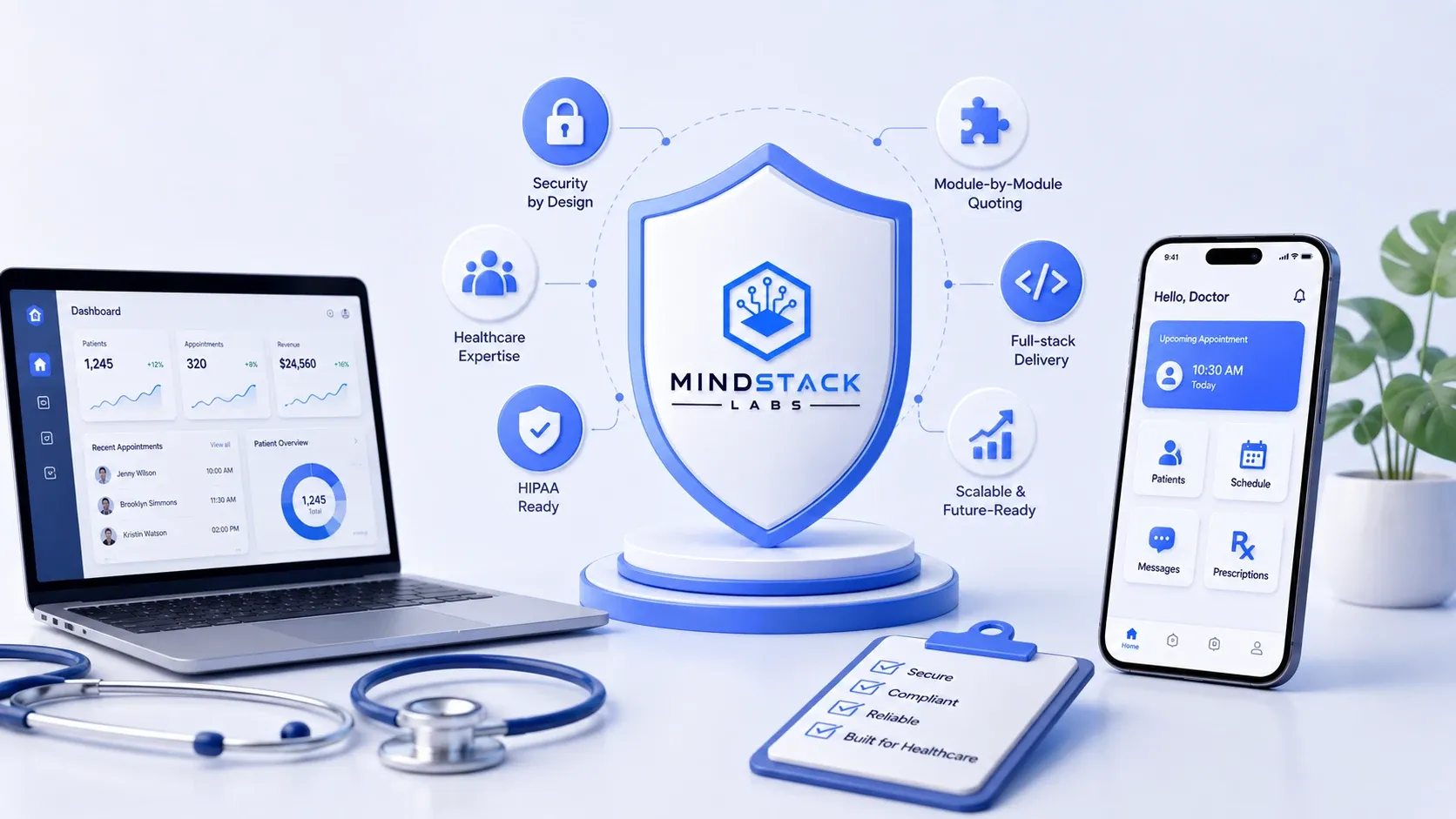
We are worth shortlisting for one specific reason: we quote healthcare builds module by module, with assumptions written down, so you can audit our number instead of trusting it.
That is the same rubric I just handed you, applied to ourselves.
How we score against the six criteria
| Criterion | Where we stand |
|---|---|
| Healthcare products with PHI in scope | Core vertical, delivered through our healthcare app development practice |
| Names integration standards | We scope HL7 v2 and FHIR work explicitly, including sandbox access and error handling |
| Module-level quoting | Standard practice, with per-module ranges and assumptions attached |
| Compliance honesty | We build to HIPAA technical safeguards. We do not claim certifications we have not been audited for |
| Code and infrastructure ownership | Yours in full on final payment, repositories and accounts included |
| Documented handover | Included, so bringing the product in-house later stays a decision, not a rebuild |
What that looks like in practice
- Industry-specific, not generalist → we build for healthcare, logistics, restaurant, education, and fitness verticals rather than treating every brief as the same app
- Integration-first scoping → we investigate your existing clinical systems before quoting UI work, because that is where budgets actually break
- Security as engineering practice → encryption, audit logging, and least-privilege access get built into each module, not bolted on before launch. Our API security checklist and notes on how modern applications protect user data show the baseline
- Phased delivery → we ship a two or three module MVP first so you validate the workflow before committing the full budget
- Full-stack in one team → Flutter mobile apps, Node.js backends, business dashboards, and AI workflow automation under one scope, so integration points do not become vendor arguments
Healthcare work in our portfolio
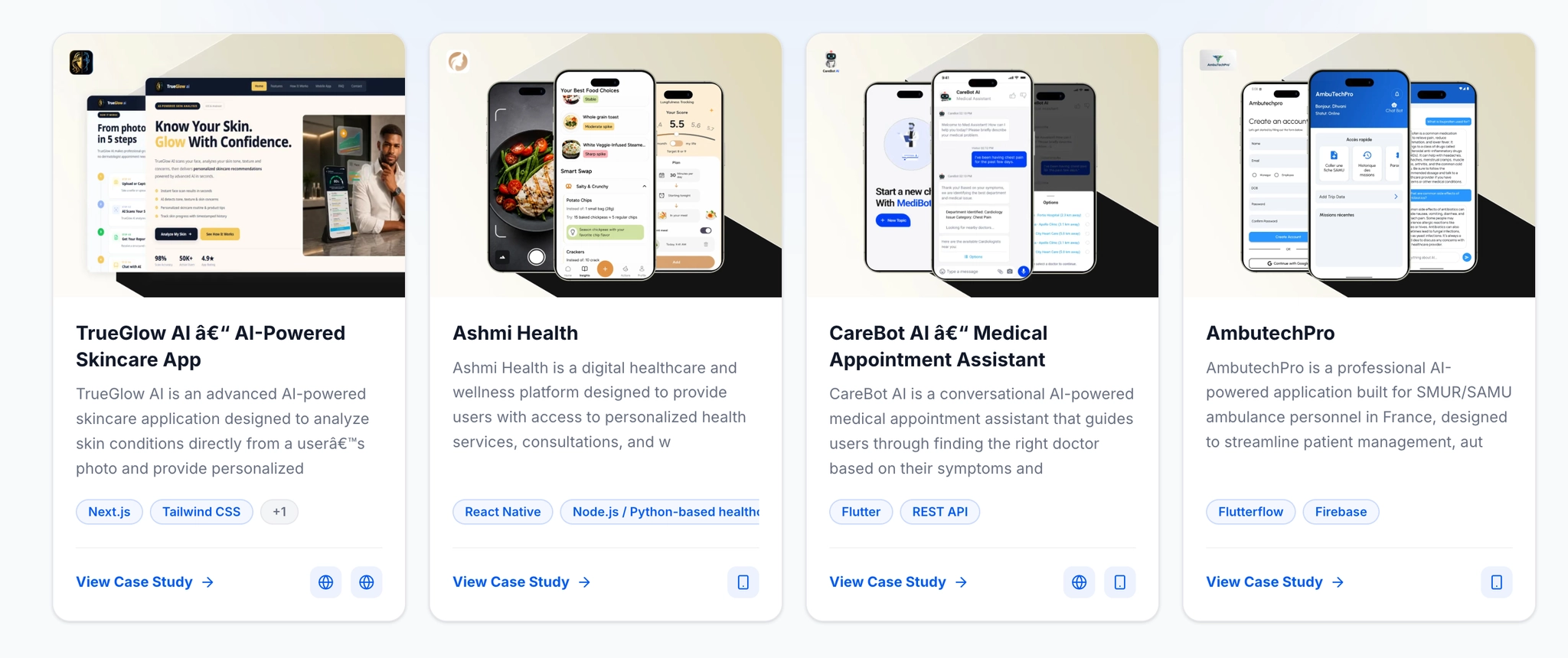
CareBot AI, Ashmi Health, and CareCheck are healthcare products in our portfolio.
Our engineering write-up on things to keep in mind when developing healthcare projects shows how we think before we build, and you can review delivery history on our case studies and portfolio pages.
Judge us against the rubric, not the pitch. That is the whole point of publishing it.
Adjacent Cost Question: What Does an AI Layer Really Add?
AI is the fastest-growing line item in healthcare quotes I review, and the most misquoted.
A narrow, auditable AI feature is affordable. An open-ended assistant is not, because the cost sits in evaluation, guardrails, and human review, not the model call.
- Documentation summarization with clinician review → $15k to $30k in my experience
- Intake triage with rules plus model fallback → $20k to $40k
- Open-ended patient-facing assistant → budget for continuous evaluation, not a one-time build
If you are exploring this, start with one internal task before anything patient-facing.
Adjacent Cost Question: What About Data Migration?
Migration is the quote-buster nobody scopes. I have watched it consume a month that no one planned for.
Ask three questions early:
- How clean is the source data, really?
- Is there a mapping document, or does one need to be created?
- Who signs off that migrated records are clinically accurate?
Budget it as its own module. Not a task.
Get a written, module-level estimate for your healthcare build
Book a 30-minute scoping call with MindStack Labs. You will leave with a module list, a realistic range per module, and the assumptions behind every number.
Book a free 30-minute scoping callFAQs
1. How much does custom healthcare software development cost?
In the builds I have priced, a lean patient app runs $45k to $90k, a clinic platform $110k to $220k, and enterprise systems $250k and up. Module count drives the number more than anything else.
2. How much does HIPAA compliance add to development cost?
Usually 10 to 20 percent on top of feature work, spread across every module rather than billed once. Risk assessments and penetration testing are typically quoted separately.
3. Custom healthcare software vs off-the-shelf: which is better?
Off-the-shelf is better when your workflow is standard and speed matters most. Custom is better when the workflow is your differentiator or integration needs exceed what a vendor allows.
4. How long does custom healthcare software take to build?
A focused two or three module MVP tends to take 3 to 5 months. Full multi-module platforms usually run 8 to 14 months when integrations and compliance work are scoped honestly.
5. Who owns the code in a custom healthcare build?
You should, in full, on final payment, including repositories, infrastructure accounts, and documentation. Get it written into the contract rather than assumed.
My Recommendation
Start with a two-module MVP plus integration discovery, then expand module by module once real users validate the workflow. Use fixed-bid if your budget is board-approved and scope is genuinely stable, and a dedicated team on time and materials if it is not.
Price modules. Not projects.
If you want your current quote pressure-tested against the ranges on this page, talk to our team or read more about our healthcare app development approach.