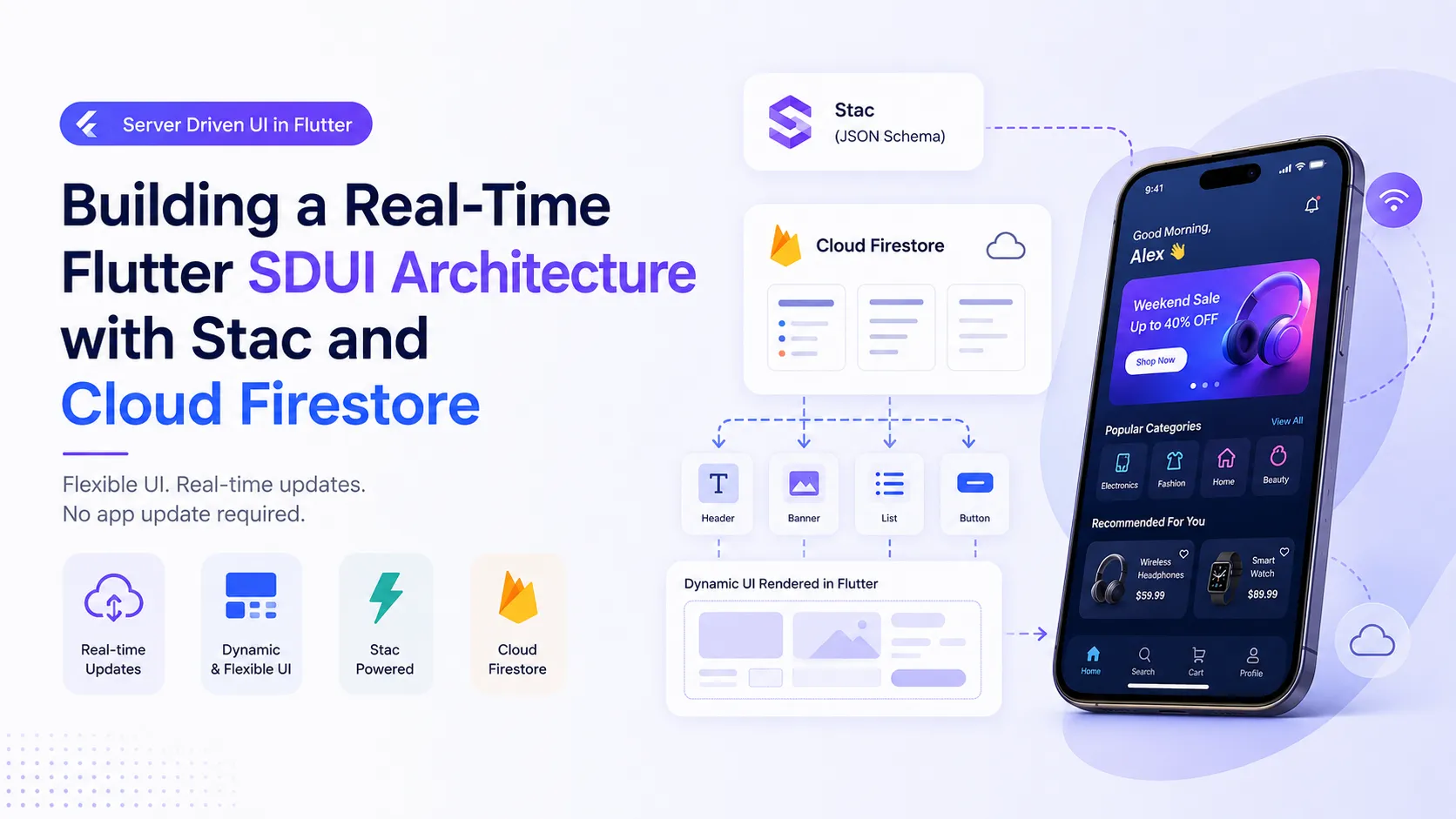
Building a Real-Time Flutter SDUI Architecture
Imagine shipping a major UI redesign, fixing a broken layout, or launching an A/B test on your mobile application instantly—without waiting for App Store or Play Store approvals. In traditional mobile development, the presentation layer is tightly coupled with the client application. If you need to change a button color, adjust padding, or reorganize a screen, you must modify the codebase, compile a new binary, submit it to the stores, and wait for approval.
Server-Driven UI (SDUI) flips this paradigm completely. By moving the presentation structure to the cloud, the backend dictates what to render, while the client app simply focuses on how to render it natively. Combining Stac with the real-time capabilities of Cloud Firestore creates a powerful, reactive rendering pipeline.
Overview: The Architecture of SDUI
Server-Driven UI is not web-view wrapping. When implemented correctly, it leverages native components driven entirely by lightweight configuration files like JSON. Stac bridges the gap by allowing you to define your layout using intuitive JSON schemas that map directly to native Flutter widgets like scaffolds, columns, list views, and buttons.
While Stac manages the transformation from JSON data to native widgets, it needs a fast delivery mechanism. Cloud Firestore is uniquely suited for this role because its real-time synchronization streams layout updates via active snapshots, its document-based structure maps perfectly to JSON configurations, and its built-in offline caching ensures structural availability on unstable networks.
Real-Time Integration Flow
The production implementation functions as a linear, continuous data translation stream:
- Schema Mapping — You define your layout maps using Stac-compliant properties inside a Firestore document collection.
- Framework Bootstrapping — You initialize both the core Firebase framework and the Stac configuration engines cleanly at the application entry point.
- Stream Building — The mobile UI layer establishes a continuous listener stream directed at the specific Firestore document path.
- Native Compiling — Whenever the cloud map changes, the stream captures the new document snapshot and delivers it straight to Stac's parsing logic, inflating the structural map into fully native widgets on the fly.
Production Best Practices
Deploying a backend-driven layout layer introduces architectural shifts that require strict safeguards:
- Local Asset Fallbacks — Always bundle a static, local fallback JSON schema inside your app bundle. If a user boots the application entirely offline without prior network cache history, you can catch the error and load the default layout seamlessly.
- Strict Schema Versioning — As your application code updates across multiple store releases, newer JSON components might break older client builds. Isolate your payloads by appending version suffixes to your document schemas to remain backward compatible.
- Strategic Hybrid Boundaries — Limit server-driven layouts to dynamic application scopes like banners, landing hubs, promotions, or settings configurations. Keep heavy, process-intensive native tasks like camera streams, deep cryptography, or custom animations hardcoded locally.
Final Thoughts
Combining the declarative layout-parsing strengths of Stac with the real-time data sync pipeline of Cloud Firestore removes the barrier of deployment reviews. By updating a structured map inside a database dashboard, your entire active user base receives design modifications instantly, providing an exceptionally responsive framework for modern mobile apps.