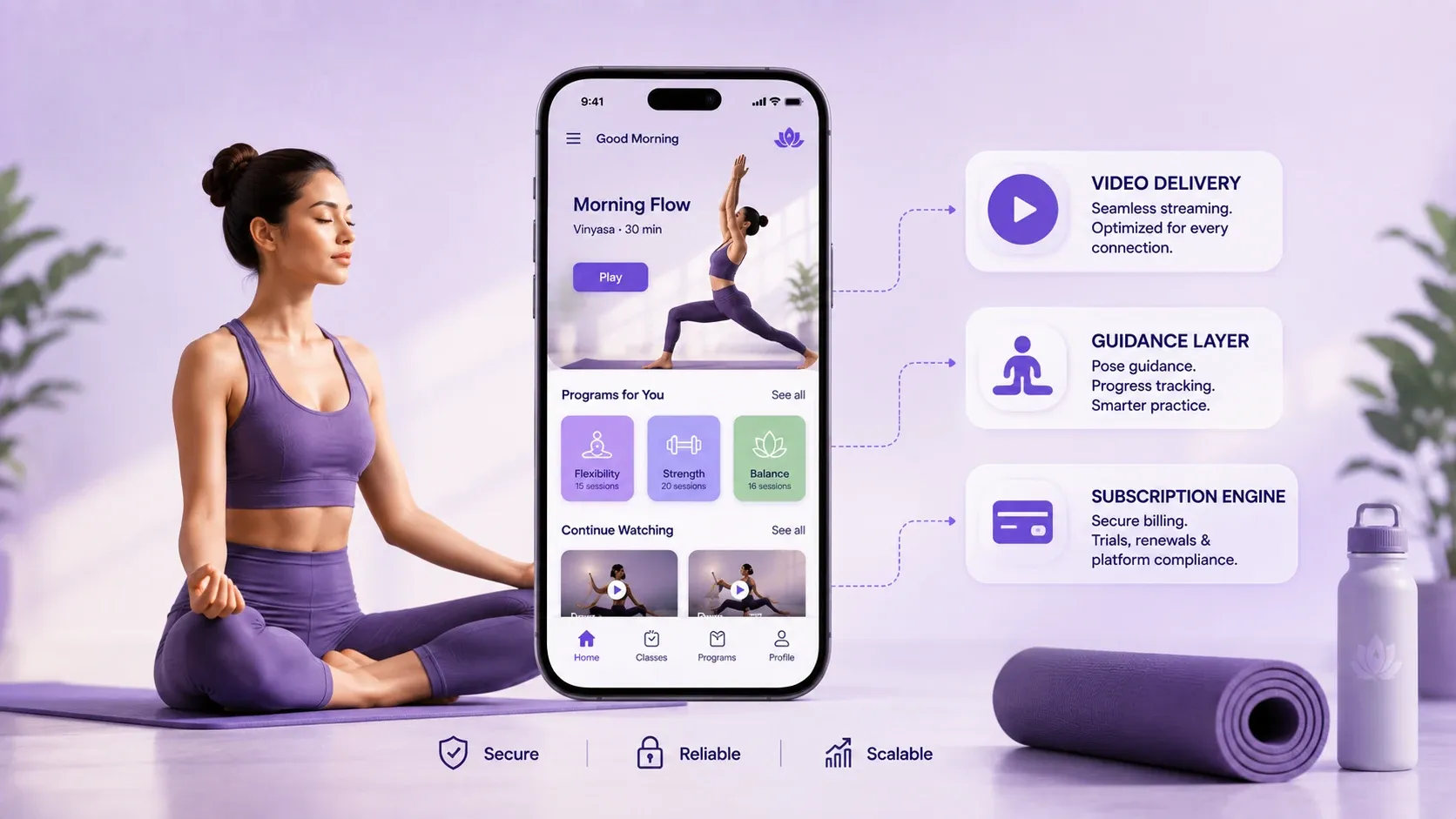
Yoga app development means building three products at once: a video delivery pipeline, a guidance layer and a subscription billing engine.

The right partner is the one who can explain how all three affect your monthly costs before they send you a quote.
The player is the easy part.
TL;DR
- Yoga app development succeeds or fails on three systems → video delivery, pose guidance, subscription billing.
- → Ignore streaming economics = your margins shrink as you grow. I have watched it happen.
- Subscription billing is a platform policy problem, not just a payment integration.
- Phase one should be the smallest app that streams a class and charges for it.
- Judge vendors on streaming and billing questions, not portfolio screenshots.
The 30-second version of why this is harder than it looks
I have scoped and reviewed video-first fitness builds many times over the past several years, and I still spend the first week arguing about bitrate ladders instead of design.
Not glamorous. Extremely necessary.
Ever met a studio owner whose first app launch had zero surprise bills?
Me neither. Here is why.
Your app has a cost that grows every time someone presses play. Most quotes price the screens and ignore the pipe. That gap is where budgets die.
This guide closes it.
What a yoga app has to do before it earns its first subscription

A yoga app is not a video library with a login, it is a content operation with billing attached.
In the builds I have worked on, the architecture reduces to three systems.
The three systems every yoga app runs on
- Video delivery → getting a class onto a phone quickly, at acceptable quality, at controllable cost.
- Guidance → helping a student do the pose correctly without an instructor in the room.
- Billing → charging reliably, recovering failed payments, and surviving app store policy.
Break the billing and the other two stop mattering.
What the student sees versus what your studio runs
Students see classes, programs, downloads and a paywall. Your team runs uploads, tagging, scheduling, instructor management and refunds.
Two products. One build. Price both.
The content operations nobody scopes in version one
- Here is the failure mode I see most: a beautiful app with no way for a non-technical person to publish Tuesday's class.
- Someone ends up emailing files to a developer. Every week.
- Scope the admin side properly. A studio manager should upload, tag, schedule and publish without opening anything technical.
Video delivery: the part that decides your margins

Streaming cost scales with your success, so the video architecture you pick in month one sets your unit economics for years.
This is the section that separates real fitness app development work from generic app work.
How video actually reaches a student's phone
- You upload a source file.
- A transcoder creates multiple renditions at different resolutions and bitrates.
- A CDN caches those renditions near the viewer.
- The app player picks a rendition based on current network speed.
That last step is adaptive bitrate streaming, usually over HLS. Without it, students on weak connections buffer and churn.
Why one video file is never enough
- Single file → cheap storage, terrible experience on mobile data.
- Ladder of renditions → higher storage and transcoding cost, far better retention.
- Audio-only rendition → underrated for yoga, tiny bandwidth, works for repeat students.
From my experience, the audio-only tier is the highest return item nobody asks for.
Where the money actually goes
Three separate line items, and vendors often quote only the first:
- Storage → charged per gigabyte stored, grows with your back catalogue.
- Transcoding → charged per minute processed, a one-time hit per video.
- Bandwidth and CDN delivery → charged per gigabyte served, grows with every play.
Delivery is the one that surprises people. Storage costs stay flat. Delivery does not.
Live classes versus on-demand
They are two different builds. Not one feature with a toggle.
- On-demand → transcode once, serve many times, simple failure modes.
- Live → real-time ingest, low-latency delivery, chat, and a plan for when a stream drops mid-class.
- Live then archived → most studios want this, and it needs both pipelines plus a recording workflow.
Pro tip: launch on-demand first and add live only after you know which class times actually fill.
Offline downloads and content protection
Students want classes on planes and in basements. Studios want their library protected.
- Encrypted downloads with expiry windows
- Device limits per account
- DRM if you license third-party content
Full DRM adds real cost and complexity. In my experience, most independent studios do not need it in phase one, while licensed content libraries do.
Pose guidance: from simple cues to AI pose detection
Pose guidance works in three tiers, and most yoga apps get more value from tier two than from camera-based AI.
I set out to evaluate this properly on a build where the founder wanted real-time correction on day one.
Tier one: structured cues and timers
- Voice cues timed to the sequence
- Countdown and hold timers
- Breath pacing audio
- Chapter markers inside the class video
Best for: any app shipping phase one. Low cost, immediate perceived value.
Tier two: pose libraries and sequencing logic
- A structured pose database with alignment notes and contraindications
- Modifications for beginners, injuries and pregnancy
- Sequence builder so instructors assemble classes from poses
- Deep links from a class into the pose reference
Best for: studios that want differentiation without an AI budget. This is where I would spend the money.
Tier three: camera-based pose detection
- On-device skeletal tracking through the phone camera
- Joint angle comparison against a reference pose
- Real-time feedback such as "lift your front knee"
- Session scoring and progress tracking
Best for: funded startups targeting a tech-forward audience.
Where pose detection genuinely fails
It is impressive in a demo. It is fragile in a living room.
- Phone placement changes everything, and students place it badly
- Loose clothing confuses joint detection
- Floor poses often fall outside the camera frame
- Poor lighting degrades accuracy fast
Camera-based guidance is worth building. Just not before your billing works.
Subscriptions and monetization: how the app actually makes money

Yoga app subscription revenue depends less on your price and more on how cleanly you handle trials, renewals and failed payments.
This is the module clients underestimate most.
Models that work for yoga
- Monthly and annual tiers → annual improves cash flow, monthly improves conversion.
- Free trial, seven or fourteen days → shorter trials tend to convert better in my experience.
- Freemium with a few open classes → strong for discovery, weak for revenue without a hard paywall.
- Class packs or credits → useful for hybrid studios selling in-person and digital together.
In-app purchase versus web checkout
- In-app purchase → required for digital content on iOS and Android, platform commission applies, best conversion.
- Web checkout → lower processing fees through a card processor, requires driving users off the app.
- Hybrid → sell web subscriptions to existing students, in-app purchase for new app installs.
Apple's rules changed in the US market during 2025 after the Epic ruling, and external purchase links became far more workable. Policies keep shifting, so confirm current App Store and Google Play billing rules with your developer before you design the paywall.
The plumbing nobody enjoys
- Upgrades, downgrades and proration
- Grace periods on failed payments
- Refunds and chargeback handling
- Restoring purchases across devices
- Server-side receipt validation, non-negotiable
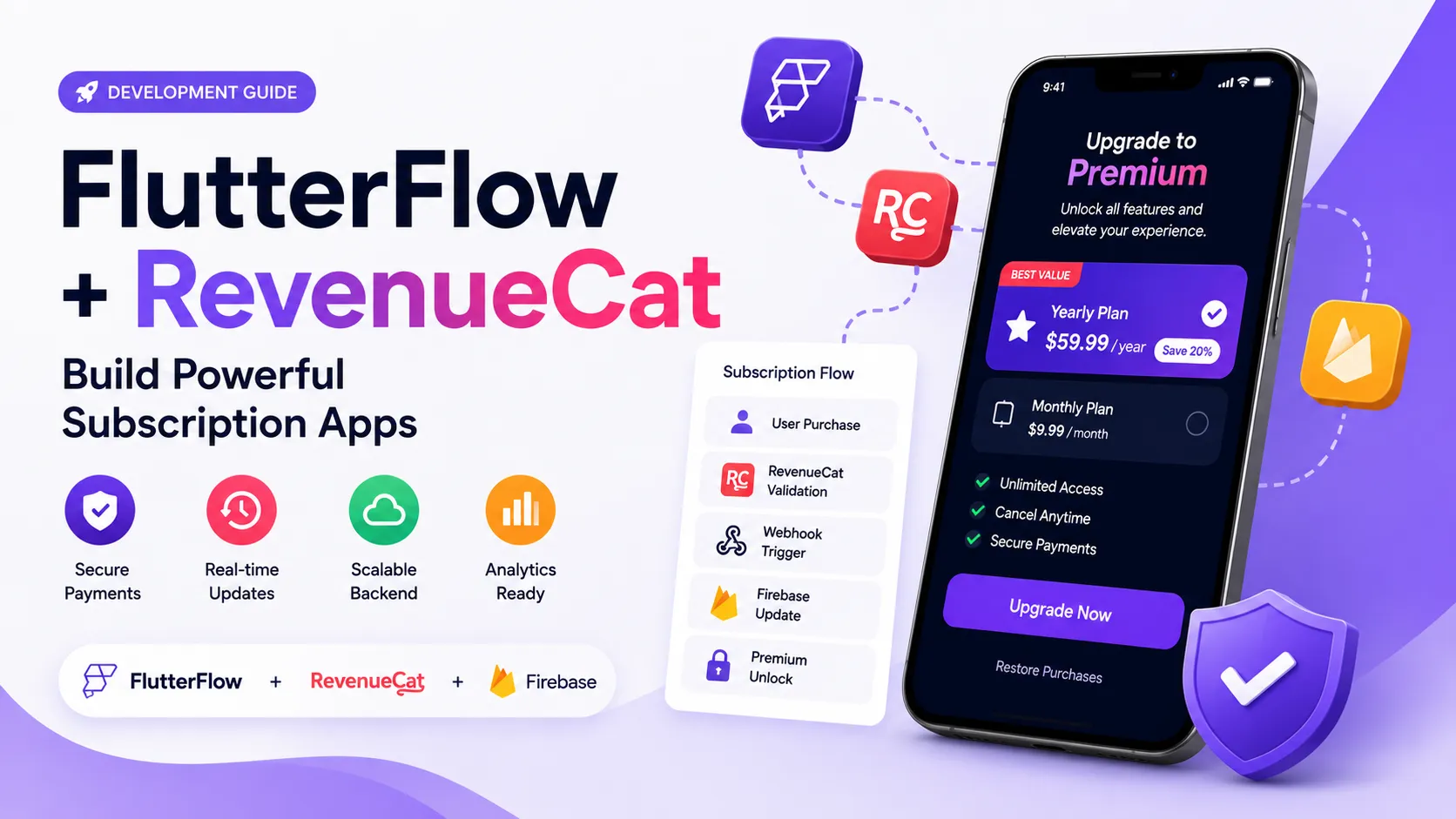
We handle this layer through subscription infrastructure rather than hand-rolled billing, which is why Mind Stack Labs works as a RevenueCat technology partner on recurring-revenue builds.
Retention is a build decision
Churn is not a marketing problem you fix later.
- Streaks and weekly goals
- Programs with a start and an end
- Smart reminders based on actual class times
- Progress history a student does not want to lose
→ No retention mechanics = your paid acquisition funds someone else's churn report.
Not sure what your phase one should include?
Book a free 30-minute scoping call with Mind Stack Labs. We will map your video delivery model, subscription setup and what can realistically launch first. No pitch deck.
Book a Free Scoping Call →Wait, you might be thinking: can I just use Uscreen, Playbook or Mindbody?
Sometimes, yes. Genuinely.
If your content is standard, your brand can live inside someone else's shell and you need to launch this quarter, a platform is the rational choice.
Custom wins when you need your own retention mechanics, deeper integrations, or when per-subscriber platform fees start exceeding what a build would have cost you.
Custom is not automatically better. It is better when the box does not fit.
Integrations: booking, wearables and studio systems
Your app has to fit the systems your studio already runs, and that reality sets your timeline more than your feature list does.
- Studio and booking systems → check API access before you scope anything. Some expose full APIs, some expose almost nothing.
- Apple Health and Google Fit → write workout sessions back so students see yoga in their rings and daily totals.
- Wearables → heart rate during class is a nice-to-have, not a phase one item.
- Payments, CRM and email → subscription events should trigger lifecycle emails automatically.
Run a feasibility check before you sign anything. Ask each vendor for API documentation, then have a developer read it. One afternoon of reading saves a month of rework.
Yoga app development cost and timeline: how to think about the number
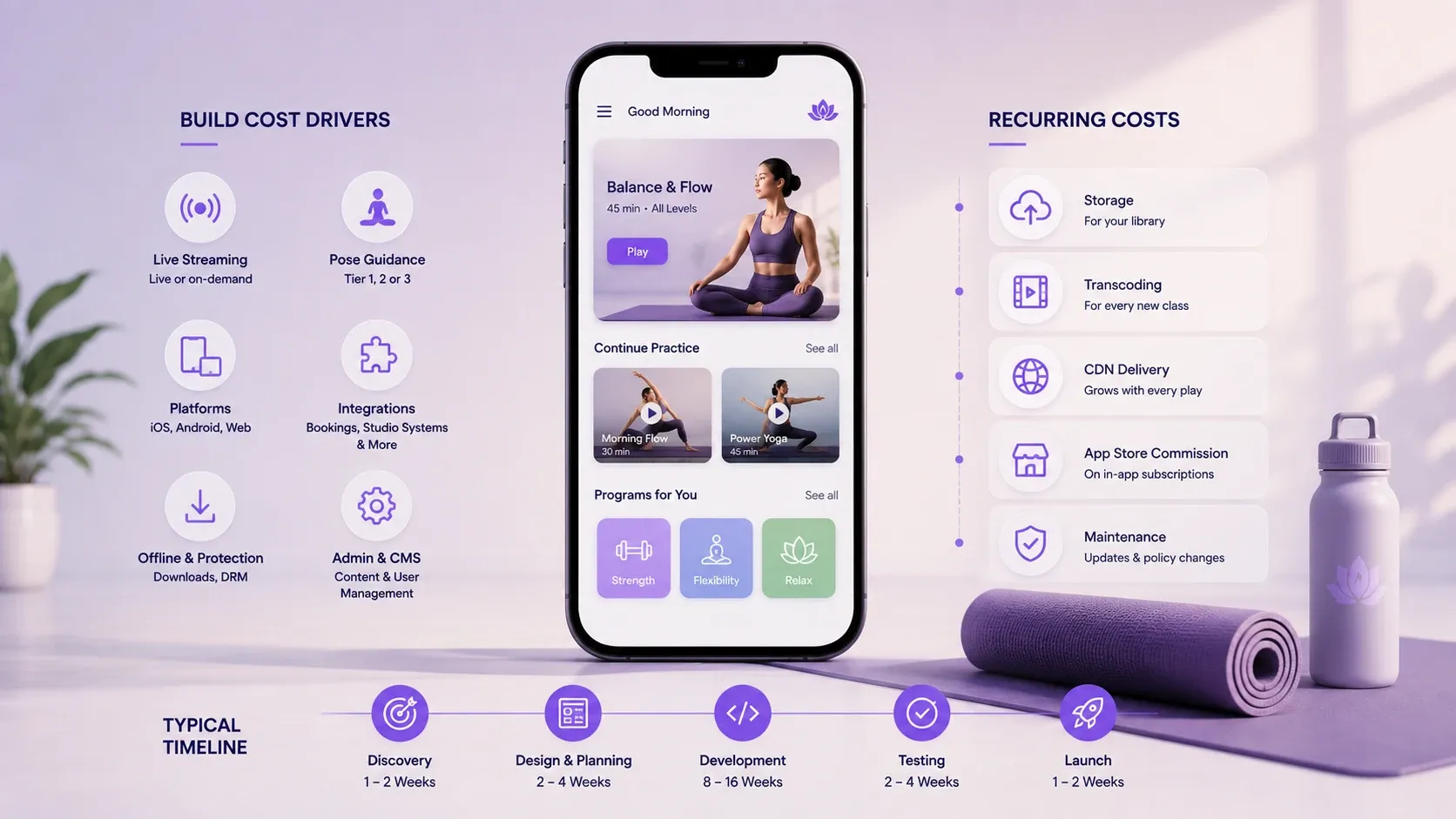
Cost tracks your video strategy and integration complexity far more than your screen count, and recurring streaming costs matter as much as the build price.
What drives the build cost
- Live streaming in scope or on-demand only
- Pose guidance tier one, two or three
- Number of platforms, iOS, Android and web
- Booking and studio system integrations
- Offline downloads and content protection
- Admin and content management depth
The recurring costs nobody quotes you
- Storage for your library
- Transcoding for every new class
- CDN delivery, which grows with every play
- App store commission on in-app subscriptions
- Maintenance, OS updates and platform policy changes
At Mind Stack Labs, we model these running costs during discovery rather than after launch, because a build price without a delivery cost model is only half an answer.
The timeline reality
In my experience, video pipeline setup and billing take longer than the interface, and teams that rush discovery pay for it in QA.
A sequence that works:
- Discovery, content audit and integration feasibility
- Video pipeline and player proof of concept
- Phase one build, often as a cross-platform Flutter app to cover iOS and Android together
- Subscription and paywall implementation
- Beta with real students on real networks
- Store submission and launch
Adjacent topic: migrating a library you already have

If you already have hundreds of recorded classes, migration is a real project, not a checkbox.
Most studios arrive with a back catalogue on Vimeo, YouTube or a shared drive.
What migration actually involves:
- Bulk export and ingest
- Transcoding every file into your rendition ladder
- Metadata cleanup, level, style, duration, instructor, focus area
- Thumbnail generation
- Redirects or access continuity for existing members
Pro tip: clean your metadata before migration, because a searchable library converts better than a large one.
How I evaluate a yoga app development company
Before any shortlist, I score on five plain criteria:
- Streaming depth → can they explain a bitrate ladder without hedging?
- Subscription track record → have they shipped recurring billing across both stores?
- Content operations thinking → do they ask who uploads Tuesday's class?
- Ownership terms → who owns the code and the infrastructure accounts?
- Post-launch commitment → maintenance terms in writing.
The questions generalist agencies cannot answer
- How will you handle a student on a weak connection mid-class?
- What happens to a subscription when a payment fails on day two?
- Where does transcoding run, and who pays for it?
- How does an instructor publish a class without a developer?
- What is our monthly delivery cost at one thousand active students?
Red flags in a yoga app proposal
- A fixed quote with no questions about your video library
- No mention of storage, transcoding or CDN anywhere
- Subscription treated as "we will add Stripe"
- Portfolio full of screens, empty of streaming work
Working with Mind Stack Labs on fitness and yoga app development

MindStack Labs builds custom mobile products for content-driven and subscription-driven businesses, and fitness is one of the verticals we work in consistently.
Three builds from our portfolio sit closest to a yoga app.
Pilates Workout

A guided workout app built around structured exercise sessions.
- Session and program structure
- Guided exercise flow
- Progress-oriented user experience
Best for: understanding how we structure guided class content.
Women's Fat Burning

A workout app built around targeted training programs.
- Program-based content organization
- Workout scheduling and progression
- Consumer-grade fitness interface
Best for: understanding how we handle programs and progression.
Plank

A focused training app built around timed exercise routines.
- Timer-driven session logic
- Simple, repeatable daily use
- Habit-forming interaction design
Best for: understanding how we build habit mechanics.
How we approach a yoga app build
- Discovery first. We start with your content library and delivery model, not a feature list.
- Costs modelled early. We estimate storage, transcoding and delivery alongside the build.
- Phased delivery. Phase one is the smallest app that streams a class and charges for it.
- You own everything. Code, infrastructure accounts and documentation, handed over in full.
Our fitness work sits alongside healthcare app development, which matters the moment your app starts storing body metrics.
You can see more delivery detail in our case studies, and teams hiring locally can start from our USA app development page.
Which route should you take? Pick by priority
- If speed to market is the priority, go with a white-label platform and revisit custom in year two.
- If your margins matter most, go with a custom build and control your own delivery pipeline.
- If you are a solo instructor, go with a platform until you clear a reliable subscriber base.
- If you run multiple studios, go with custom and prioritize instructor and multi-location admin.
- If a platform already failed you, go with a custom partner and start by auditing why it failed.
Your next 30 days
- Week one: audit your library. Count videos, total hours and current hosting cost.
- Week two: request API documentation from your booking or studio system.
- Week three: decide your monetization model and target price point.
- Week four: shortlist two or three vendors and run the question list above.
FAQs
1. How much does it take to develop a yoga app?
Cost depends on live streaming, pose guidance depth and integrations rather than screen count. Ask any vendor to quote the build and the monthly streaming costs separately before you compare numbers.
2. How long does it take to build a yoga app?
Video pipeline and billing usually take longer than the interface. Plan discovery and a streaming proof of concept before you commit to a public launch date.
3. Custom yoga app vs Uscreen: which is better?
Uscreen wins on speed and low upfront cost when your content is standard. Custom wins when you need your own retention mechanics, deeper integrations or control over per-subscriber costs at scale.
4. Do I need AI pose detection in my yoga app?
Usually not in phase one. Structured cues and a strong pose library deliver more student value per dollar, and camera-based detection struggles with floor poses and poor lighting.
5. How do subscriptions work with Apple's in-app purchase rules?
Digital subscriptions sold inside an app go through store billing and carry platform commission. Rules on external purchase links keep changing, so confirm the current policy before finalising your paywall design.
My recommendation
Start with an on-demand app, tier two pose guidance and clean subscription billing. Add live classes once you know which time slots fill, and add camera-based pose detection only after retention is stable.
Build phase one small. Stream, guide, charge. Everything else earns its place later.
Get a phased yoga app scope, not a guess
Send Mind Stack Labs your class library size and subscription plan. We will map your streaming costs, phase one scope and launch sequence before anyone talks numbers.
Request a Scoping CallSee our fitness app work