
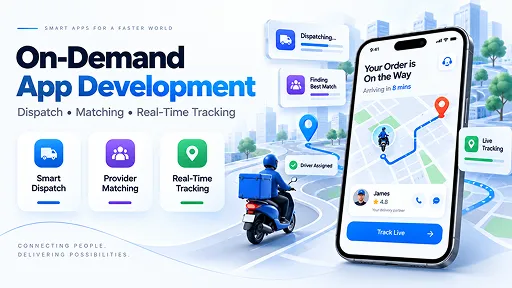
On-demand app development succeeds or fails on three systems:
dispatch engine that decides who receives a request,
Matching algorithm that scores which provider is genuinely best
Real-time tracking pipeline that keeps customer, provider and admin looking at the same live truth. Get those three right and the rest of the product is replaceable plumbing.
Ever seen a founder get excited about a dispatch state machine?
Me neither. Here is why that is a problem: the state machine is the exact thing that decides whether your app survives its first busy Friday night.
TL;DR
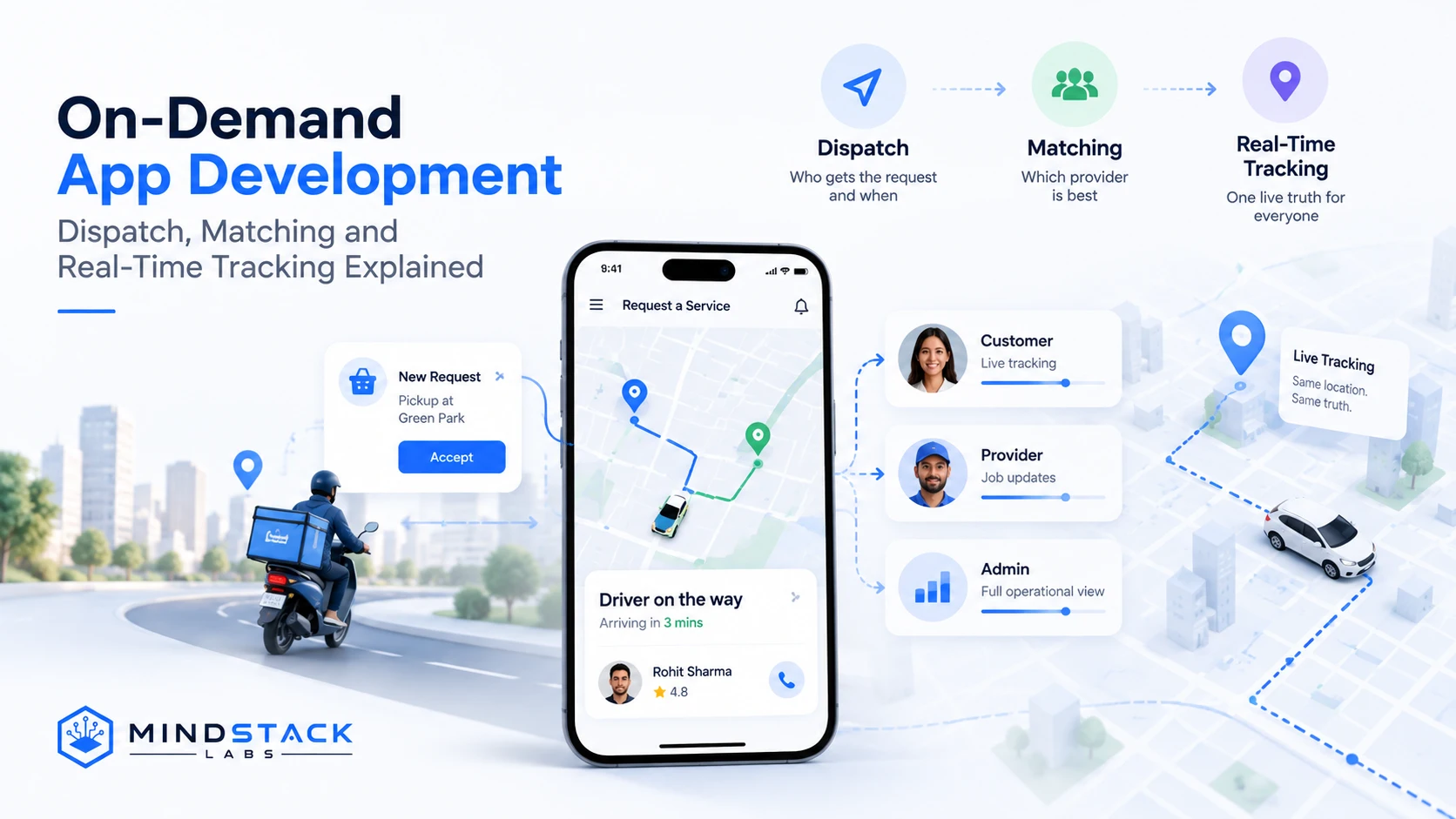
Dispatch → decides who gets the request and when
Matching → decides which provider is best, not merely closest
Real-time tracking → keeps three screens in sync with one source of truth
Skip these three → cancellations, idle providers, refund tickets, churn
Same architecture spine works across taxi, grocery, medicine, laundry and home services. Only the dispatch rules change.
What On-Demand App Development Actually Involves
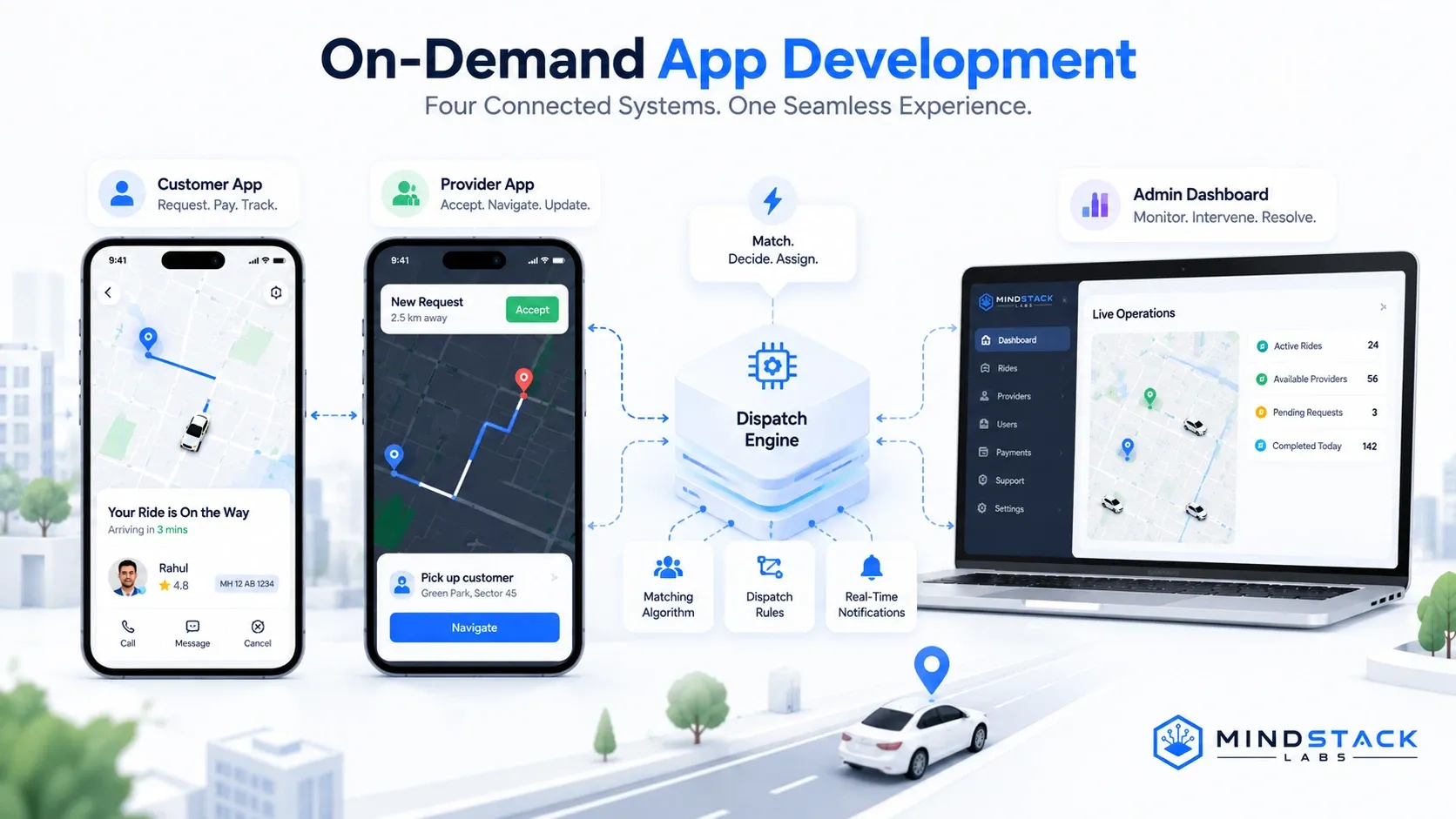
On-demand app development is not one app, it is four connected systems that must stay in agreement in real time. Most feature lists hide this completely.
In the builds I have worked on, the scope always breaks down like this:
Component | What It Does | Where Founders Underestimate It |
|---|---|---|
Customer app | Request, pay, track | Edge cases in cancellation and refunds |
Provider app | Accept, navigate, update status | Background location and battery drain |
Admin dashboard | Monitor, intervene, resolve | Manual override tooling gets skipped |
Dispatch engine | Decide and assign | Treated as a feature, not a system |
Three of those four are screens. One is a decision engine.
Guess which one gets 10% of the budget and causes 80% of the post-launch fires.
From my experience, the single architecture choice that drives the most cost is your dispatch model. It determines your database design, your real-time layer, your notification volume and your infrastructure bill. Choose it in week one, not month four.
How the Dispatch Engine Decides Who Gets the Request
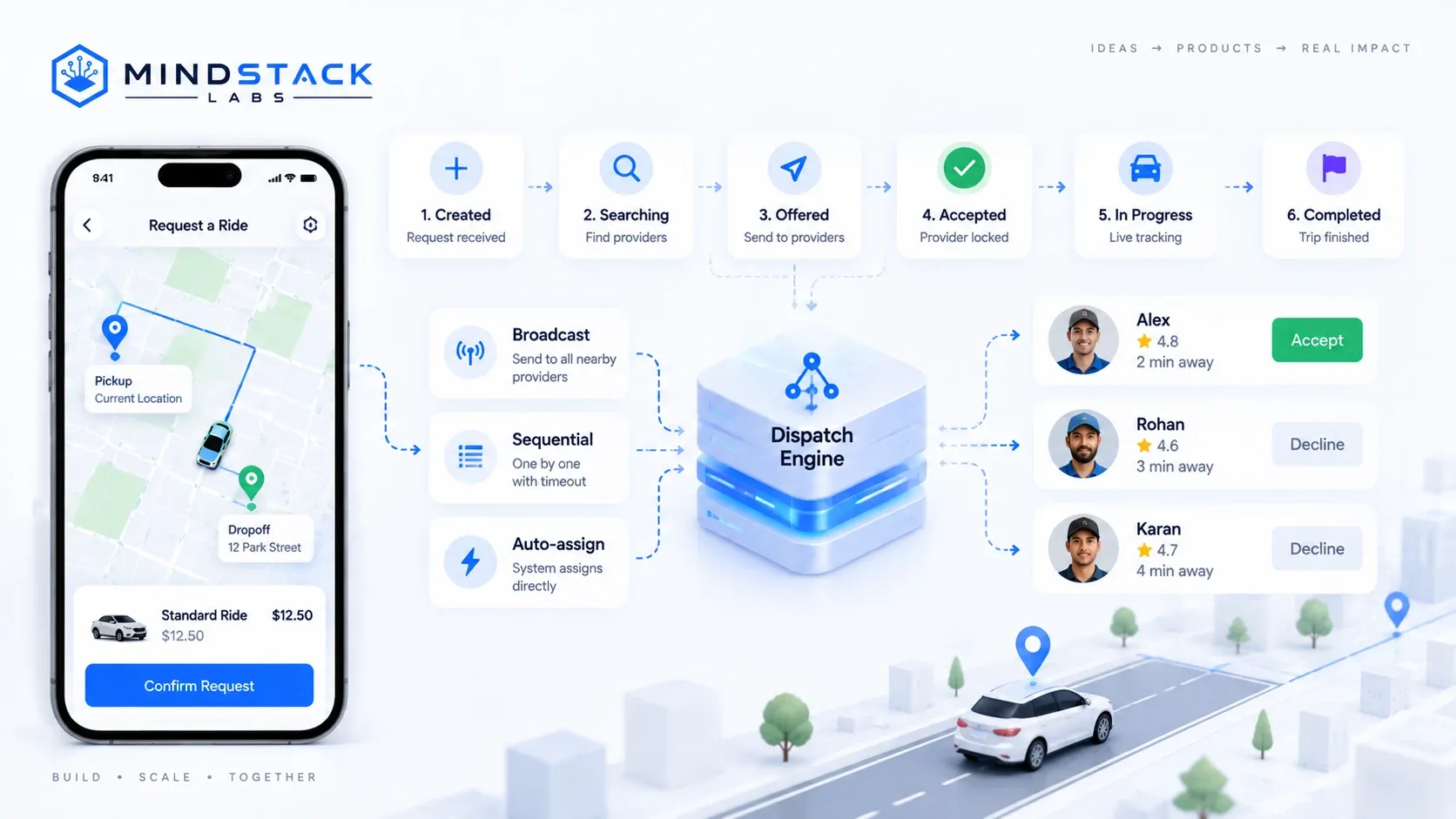
Dispatch is a state machine with a timer attached, and every serious on-demand product needs both parts. The states matter more than the algorithm.
A realistic order lifecycle looks like this:
created→ request accepted by systemsearching→ candidate providers scored and queuedoffered→ offer sent to one or more providersaccepted→ provider locked, others releasedin_progress→ live tracking activecompletedorcancelled→ settlement triggered
Every one of those transitions needs a timeout rule. Without timeouts, a driver who opens the app and walks away holds a customer hostage.
The Three Dispatch Models, Compared
You have three real options, and the right one depends on supply density, not on preference.
Model | How It Works | Best For | Trade-Off |
|---|---|---|---|
Broadcast | Offer goes to all nearby providers, first accept wins | Low supply density, early-stage marketplaces | Race conditions, provider fatigue, unfair distribution |
Sequential | Offer goes to one provider, timeout, then next | Taxi, medicine delivery, quality-sensitive services | Slower assignment, needs tight timeout tuning |
Auto-assign | System assigns directly, no acceptance step | Employed fleets, logistics, scheduled services | Zero provider choice, needs strong reassignment logic |
In one taxi build, we launched sequential with a 15-second timeout. Acceptance felt slow at low supply. We moved to a hybrid: sequential for the top-scored provider, then broadcast to the next three if the first declined. Assignment time dropped noticeably without wrecking fairness.
→ Low supply + slow acceptance = hybrid dispatch
→ Dense supply + quality focus = pure sequential
→ Owned fleet = auto-assign with reassignment fallback
Rejections, Timeouts and Re-Dispatch Loops
Re-dispatch handling is the most skipped part of on-demand app development, and the most common cause of "the app feels broken" complaints. Rejection is normal. Silence is the killer.
Rules I now apply by default:
Cap re-dispatch attempts, usually 3 to 5, then surface a clear "no providers available" state
Widen the search radius on each attempt instead of retrying the same pool
Expire offers server-side, never client-side
Log every rejection reason so you can spot provider gaming early
Client-side timers lie. Server-side timers do not.
Pro tip: log every dispatch attempt with timestamp, candidate list, score and outcome from day one, because you cannot tune matching later without that history.
Wait, You Might Be Thinking: Can I Just Buy a Dispatch API?
You can, and for some products you should. Third-party dispatch and routing APIs work well when your rules are standard and your margins tolerate per-request pricing.
They stop working when your matching logic becomes your differentiator or your volume makes per-request fees painful. In the builds I have worked on, custom dispatch pays for itself once unit economics depend on assignment quality.
How Matching Algorithms Pick the Right Provider
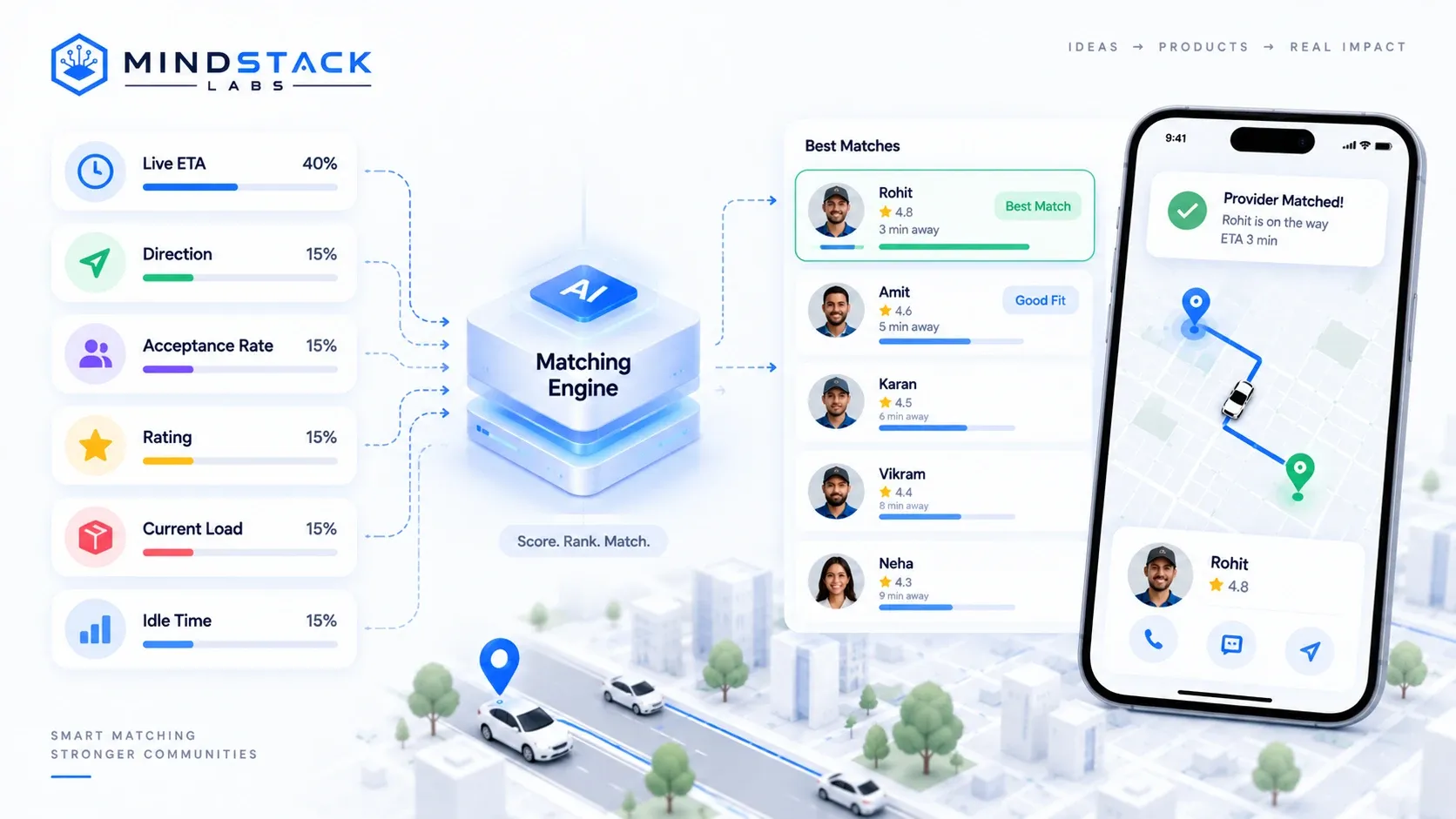
Nearest provider is the wrong answer, and it is the default answer in almost every clone app. Distance is one input among several.
A workable scoring model weights these signals:
Live ETA, not straight-line distance, because a river or a one-way street changes everything
Heading and direction of travel relative to pickup
Acceptance rate over a rolling window
Rating and recent complaint flags
Current load for batched models like grocery and food
Idle time, to keep distribution fair
Realistic weighting starting point: ETA 40%, direction 15%, acceptance rate 15%, rating 15%, idle time 15%. Then tune with real data.
Making Nearest-Provider Queries Fast
Geospatial queries must return in milliseconds, which means indexing, not scanning. A full table scan of driver locations dies at a few thousand active providers.
What works in practice:
Store live locations in an in-memory geospatial store with radius query support
Keep historical location traces in a separate append-only store
Use geohash or grid bucketing to shrink the candidate pool before scoring
Cap candidates before scoring, usually the nearest 20 to 50
→ Index first, score second = predictable latency
Batching, Pooling and Multi-Drop
Batching changes matching from "who is closest" to "whose route can absorb this stop cheaply." This is where grocery, food and pickup-and-delivery models diverge sharply from taxi.
In a delivery build, we scored insertion cost: how many extra minutes does adding this drop cost the existing route? Orders that added under a set threshold were batched. Everything else dispatched fresh.
Surge Pricing and the Fairness Trade-Off
Surge is a matching input, not just a pricing feature. When demand outpaces supply in a zone, price signals pull supply toward it, which then feeds back into candidate availability.
The trade-off nobody warns founders about: pure efficiency starves low-rated or newer providers, they churn, and your supply thins in exactly the zones you were optimizing. I always reserve part of the score for fairness. It costs a little efficiency and saves your supply base.
How Real-Time Tracking Reaches Three Screens at Once
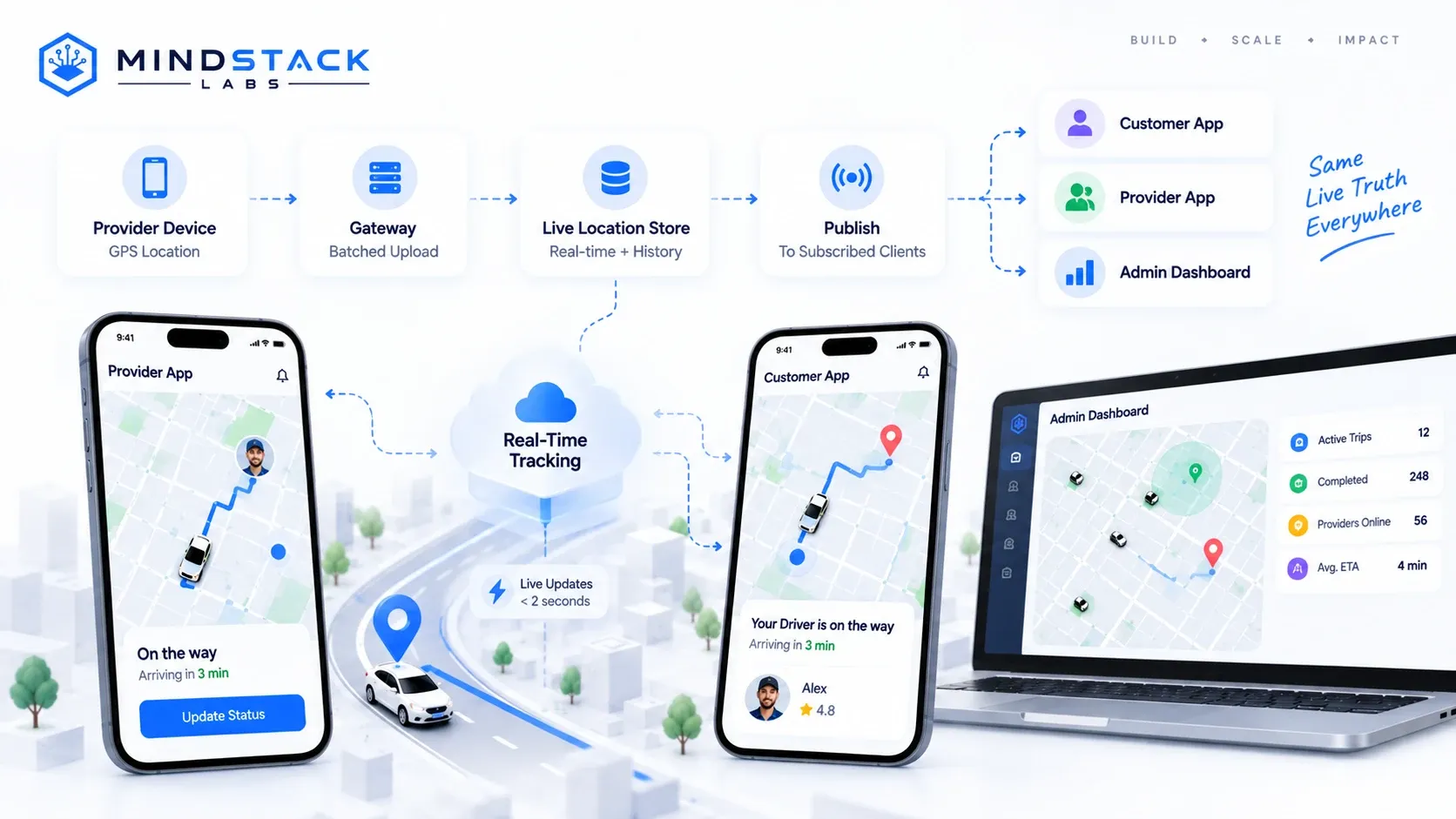
Real-time tracking is a pipeline, not a map widget. Location has to travel from a device to a gateway to a store to every subscribed screen, in under a couple of seconds.
The pipeline looks like this:
→ Provider device GPS
→ Batched upload to gateway
→ Live location store, plus append-only history
→ Publish to subscribed customer and admin clients
→ Map render with interpolation
Interpolation matters more than raw frequency. Smoothed movement at 5-second updates looks better than jumpy pins at 2-second updates.
Sockets, Polling and Push, Compared
Method | Latency | Battery Cost | Best Use |
|---|---|---|---|
WebSockets | Lowest | Moderate on provider side | Active trip tracking |
Polling | Higher | Low if intervals are wide | Admin dashboards, low-urgency states |
Push notifications | Event-based | Lowest | State changes, offers, completion |
From my experience, the winning pattern is mixed: sockets only while a job is active, push for state transitions, and polling for everything cool. Sockets that stay open all day drain batteries, and provider battery complaints turn into provider churn.
GPS Drift, Dead Zones and Offline Recovery
Assume the network will drop, because it will. A provider entering a basement parking lot is a certainty, not an edge case.
What handles it cleanly:
Buffer location points on the device and replay them on reconnect
Snap tracks to road geometry to remove drift
Discard points with poor accuracy readings instead of plotting them
Show a clear "last updated at" state rather than a frozen pin pretending to be live
Frozen pins generate support tickets. Honest staleness labels do not.
Geofencing for Pickup, Drop and Zones
Geofencing turns location into automation. Instead of asking providers to tap "arrived," the system detects arrival and moves the state itself.
Practical uses: auto-arrival detection, zone-based pricing, service area validation at request time, and wait-time billing triggers.
See how this architecture looks in a shipped product
We have mapped this dispatch, matching and tracking spine across 8 taxi and delivery builds. Walk through the architecture with the team that shipped it.
Request the architecture walkthrough
Proof: What 8 Taxi and Delivery Builds Taught Us
Theory is cheap, so here is what changed in practice. These are the patterns that repeated across the taxi and delivery products my team has shipped.
Taxi and Ride-Hailing
Sequential dispatch with tight timeouts won, but only after we added a hybrid broadcast fallback for low-supply hours. Cancellation rates track assignment latency far more closely than they track price.
Delivery and Pickup
Insertion-cost batching beat radius-based batching every time. Multi-drop routes need re-optimization on every new assignment, not just at route creation.
What We Changed After Load Testing
Load testing exposed problems that no amount of design review caught. Three fixes recurred:
Moved offer expiry fully server-side after duplicate acceptances appeared under concurrency
Added distributed locking on assignment to kill double-assignment
Cut location write volume by batching device uploads, which reduced infrastructure cost sharply without hurting perceived smoothness
Mistakes We Now Design Against By Default
No timeout on offers
Client-authoritative state transitions
Storing live and historical location in the same hot table
No admin override tooling for stuck jobs
Matching on raw distance only
6. How Dispatch Changes by Vertical
The architecture spine stays the same across verticals, only the dispatch rules and constraints change. This is why one platform investment can serve very different products.
Vertical | Dispatch Style | Defining Constraint |
|---|---|---|
Real-time sequential or hybrid | Assignment latency, live ETA accuracy | |
Slot-based plus batched | Basket size, slot capacity, substitutions | |
Priority sequential | Prescription validation, compliance, cold chain | |
On demand laundry and pickup and delivery app development | Two-leg scheduling | Pickup and return legs linked to one order |
On demand home services, beauty, massage and car wash app development | Appointment-first matching | Skill match, duration blocks, travel buffers |
Auto-assign with route optimization | Vehicle capacity, load type, multi-stop routing | |
On demand tutor and hotel booking app development | Calendar and inventory matching | Availability windows, no live location need |
Notice the last row: some on-demand products barely need live tracking at all. Paying for a real-time pipeline you do not use is a common and expensive mistake.
Where Clone App Development Falls Short
Clone apps ship screens fast and hide the dispatch logic you actually need to change. They are a reasonable way to validate demand and a poor foundation for scale.
The failure pattern is consistent: the clone works at 50 requests a day, breaks at 500, and the dispatch logic is either undocumented or unmodifiable. Rebuild cost then exceeds the original build cost.
On-Demand App Development Cost: What Actually Drives It
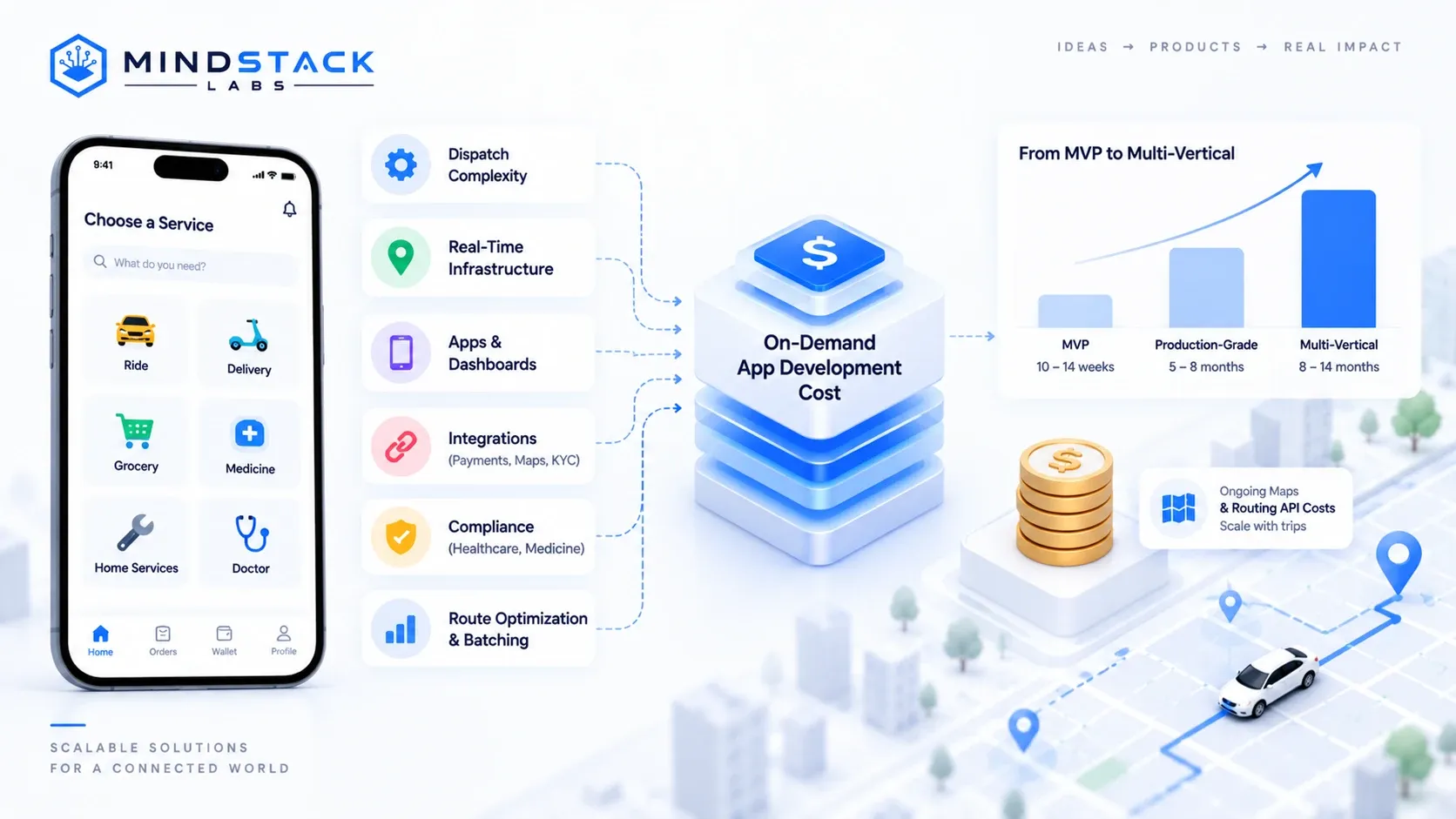
Cost is driven by dispatch complexity and real-time infrastructure, not by screen count. Two apps with identical designs can differ by a large multiple in price.
Cost drivers, ranked by impact:
Dispatch model complexity and re-dispatch logic
Real-time tracking depth, update frequency and history retention
Number of apps and dashboards in scope
Integrations: payments, KYC, maps, invoicing, CRM
Compliance requirements, heaviest in medicine and healthcare
Route optimization and batching sophistication
Scope | What You Get | Realistic Timeline |
|---|---|---|
MVP dispatch | Single vertical, one dispatch model, basic live tracking, one city | 10 to 14 weeks |
Production-grade | Hybrid dispatch, scored matching, batching, admin override, monitoring | 5 to 8 months |
Multi-vertical platform | Configurable dispatch rules, multi-city, multi-role, analytics | 8 to 14 months |
The line item founders forget: ongoing maps, geocoding and routing API cost. Live tracking makes constant routing calls, and that bill scales with trips, not with users.
From my experience, "doctor on demand app development cost" runs higher than an equivalent taxi build for one reason: compliance, consent, records handling and verification workflows add real engineering, even though the dispatch logic is simpler.
Get a scoped estimate for your vertical
Share your model and we will map the dispatch, matching and tracking requirements into a realistic scope, timeline and infrastructure cost view.
Book a free 30-minute scoping call
Recommended Tech Stack for On-Demand Apps
Pick a stack for location handling and real-time reliability, not for trend value.
Layer | Practical Choices | Why |
|---|---|---|
Mobile | Flutter, React Native, native where background location is critical | Cross-platform is fine for customer apps, provider apps need careful background handling |
Backend | Strong real-time and async ecosystems | |
Real-time layer | WebSockets plus a message queue | Decouples dispatch decisions from delivery |
Live location store | In-memory store with geospatial queries | Millisecond radius lookups |
Persistent data | Postgres with geospatial extensions, Firebase or Supabase for faster MVPs | Depends on scale and team |
Maps and routing | Evaluate two providers on ETA accuracy in your actual cities | Accuracy varies significantly by region |
For on demand android app development services, the platform-specific work is background location permissions, battery optimization exemptions and OEM-specific process killing. Budget real time for it.
9. Scaling and Failure Modes After Launch
Most on-demand products do not break on traffic, they break on supply and concurrency.
Empty dispatch → requests with no available provider. Fix with supply forecasting, incentives and honest availability messaging, not more retries.
Race conditions → two providers accept the same job. Fix with distributed locks and server-authoritative state.
Location cost blowout → write volume grows faster than revenue. Fix with batching, retention tiers and sampling.
Silent staleness → tracking looks live but is not. Fix with heartbeat monitoring and visible last-updated states.
Monitoring signals to instrument on day one:
→ Time to assignment
→ Offer acceptance rate by provider cohort
→ Re-dispatch attempts per order
→ Location update lag, 95th percentile
→ Cancellation rate split by pre-assignment and post-assignment
Why Trust Mind Stack Labs for On-Demand App Development
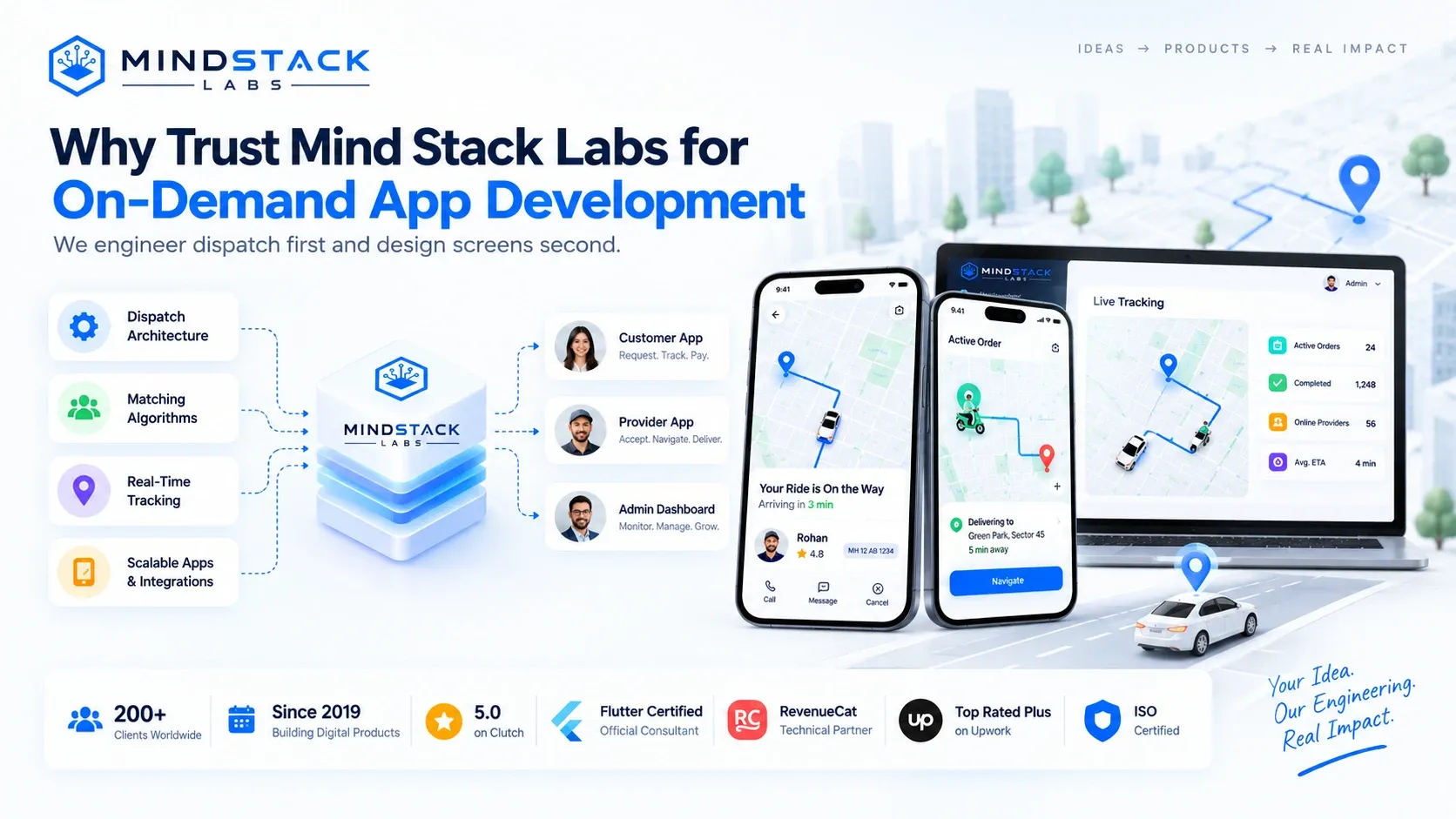
We engineer dispatch first and design screens second, which is the opposite of how most on-demand projects run.
What backs that up:
Founded in 2019, now a full-stack product and AI automation team serving clients worldwide
200 clients delivered across industries including taxi, food delivery, logistics and transportation, travel, healthcare and fitness
Flutter Certified official consultant, RevenueCat technical partner, ISO certified, and Top Rated Plus on Upwork
5.0 rating on Clutch
Deep stack coverage: Flutter, FlutterFlow, React Native, Next.js, Node.js, Python with FastAPI, Firebase, Supabase, plus n8n and LangChain automation for operational workflows
Automation-first and transparency-led delivery, so you always know project status and exactly how your system works
8 Shipped Taxi and Delivery Products
We have mapped the dispatch, matching and tracking architecture described above across 8 taxi and delivery builds, including the load-testing fixes in section 5. The architecture diagram is not a template, it is the one we run.
What You Own
You own the code, the infrastructure accounts and the architecture documentation. No hidden dispatch logic, no locked black box.
How We Scope
We run an architecture workshop before any screen gets designed. Dispatch model, matching signals, tracking depth and failure handling get decided first, because those are the decisions that are expensive to reverse.
How to Evaluate Any On-Demand App Development Company, Including Us
Ask these five questions and template shops reveal themselves quickly:
Which dispatch model do you recommend for my supply density, and why?
How do you handle offer timeouts and re-dispatch?
What are your load-test results for concurrent assignment?
How do you index and query live provider locations?
Who owns the code and infrastructure after launch?
Red flags: fixed feature-list quotes with no architecture discussion, no answer on concurrency, and demos that only ever show one driver and one rider.
FAQs
1. How does dispatch decide which driver gets the request?
The engine scores nearby providers on live ETA, direction, acceptance rate, rating and current load, then offers the job in sequence or by broadcast. Timeouts and re-dispatch rules handle rejections automatically.
2. Can I build an on-demand app without building my own dispatch engine?
Yes, third-party dispatch and routing APIs work well for standard rules and early volume. Build custom once assignment quality becomes your differentiator or per-request fees hurt margins.
3. How much does on-demand app development cost?
Cost tracks dispatch complexity and real-time infrastructure more than screen count. An MVP with one dispatch model typically takes 10 to 14 weeks, while a production-grade platform runs 5 to 8 months.
4. Is a clone app a good starting point?
It is fine for validating demand and poor for scaling. Clone dispatch logic is usually undocumented and hard to modify, so the rebuild often costs more than the original build.
5. Can one architecture serve grocery, medicine and home services?
Yes. The dispatch, matching and tracking spine stays constant, and only the rules change: slot-based batching for grocery, priority and compliance for medicine, appointment-first matching for home services.
Key Takeaways
Dispatch, matching and real-time tracking decide whether your on-demand product survives contact with real demand
Your dispatch model is an architecture decision, so make it in week one
Match on scored signals, never on raw distance alone
Treat tracking as a pipeline with offline recovery, not a map component
The same spine flexes across verticals, so scope the rules, not just the screens
If you are scoping an on-demand build and want a straight answer on dispatch model, timeline and infrastructure cost, book a scoping call with Mind Stack Labs and we will map it with you before anyone talks about screens.