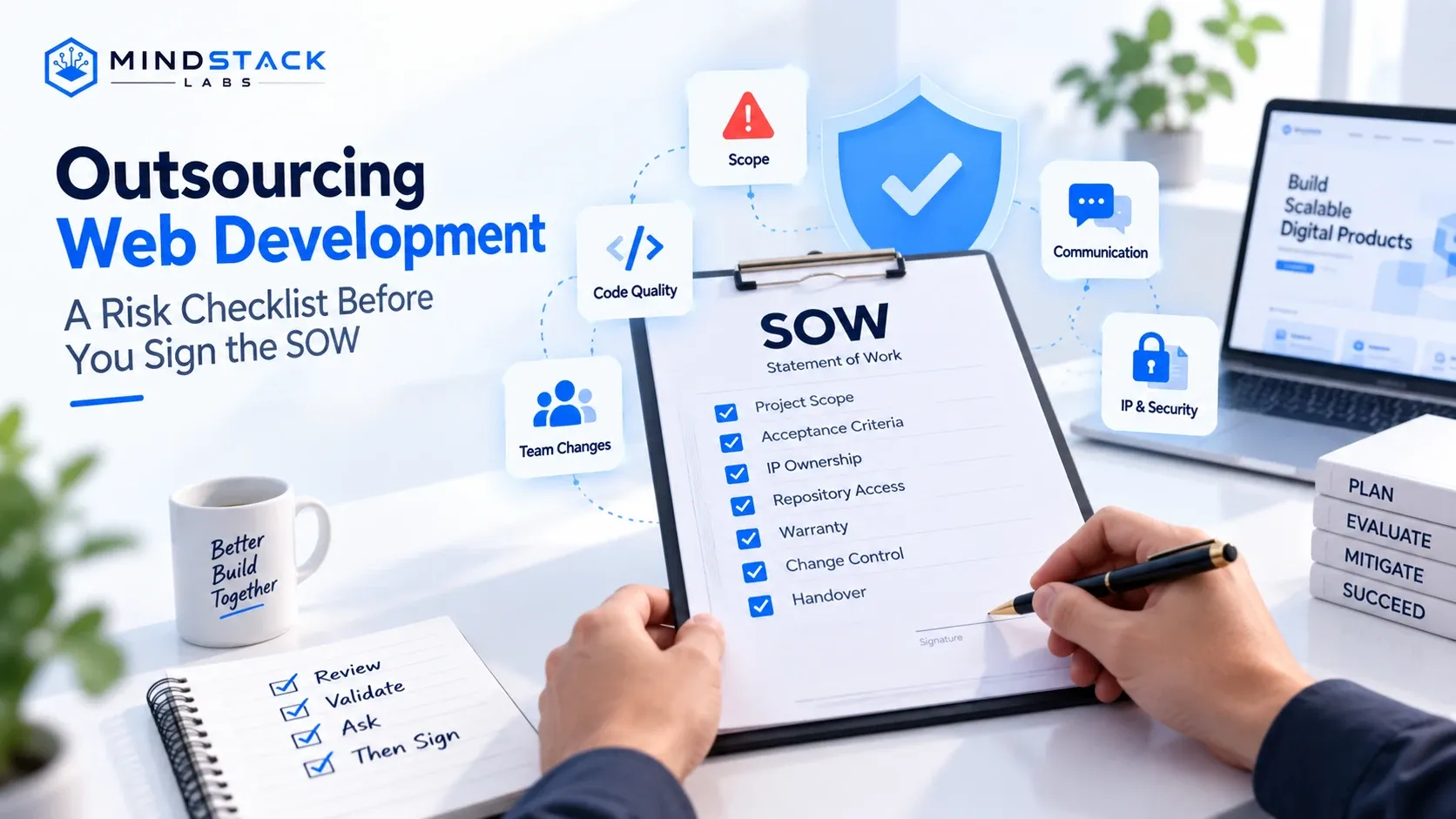
Ever signed a web development SOW that felt airtight, then watched the project double in cost by month three?
Me neither. Here is why.
Outsourcing web development goes wrong in the contract, not in the code.
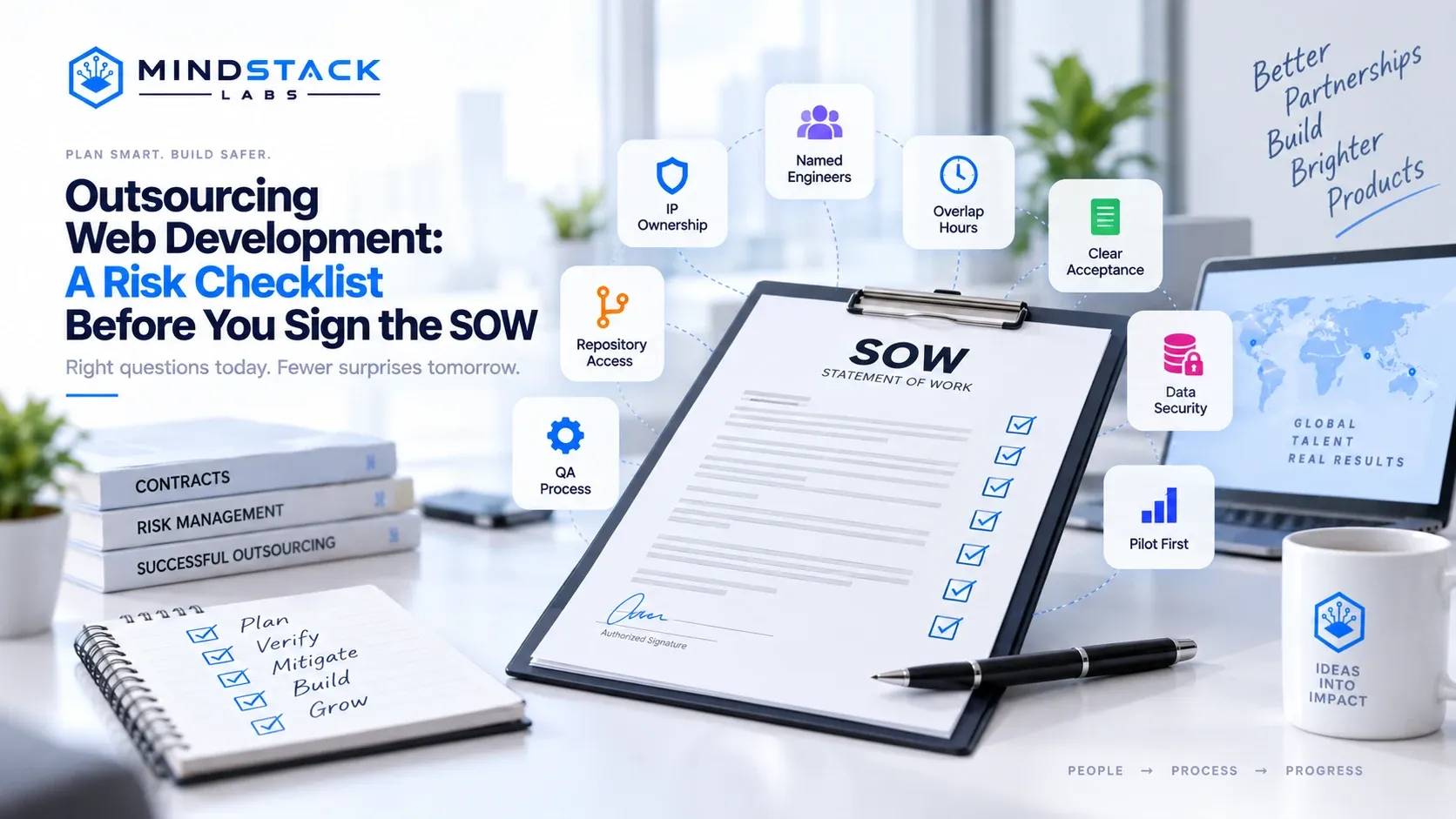
Before you sign, verify twelve things: IP assignment, repository access, acceptance criteria, warranty terms, change-control pricing, termination and handover, named engineers, working-hours overlap, QA process, callable references, data-handling terms, and a paid pilot before full commitment.
That is the whole answer. The rest shows you how to check each one.
TL;DR
Vague SOW = change orders later. Define acceptance criteria per deliverable, not per phase.
No IP assignment clause = you may not own your own code.
Cheapest bid = highest total cost, usually. Underscoped quotes convert into change orders.
No named engineers = key-person risk.
Paid pilot task first = cheapest possible way to test a vendor.
Should you outsource web development at all, or hire in-house?

Outsource when the work has a defined end. Hire in-house when the work never ends.
That single rule has resolved more of these debates than any cost spreadsheet I have built.
Outsource versus in-house: pros and cons at a glance
Pros | Cons | |
|---|---|---|
Outsource | Faster start, no hiring cycle | Needs an internal owner to review and approve |
Hire in-house | Full context on the product and roadmap | Slow to hire, weeks to months |
The three situations where outsourcing wins
Defined-scope builds. A marketing site, a customer portal, a migration.
Burst capacity. Your team is full and the deadline will not move.
Skills you need once. A payment integration, a real-time feature, a legacy rewrite.
The three situations where it backfires
Your roadmap changes weekly and nobody can define done
The system is your core advantage and needs daily iteration
Nobody internally has time to review, answer, or approve
That last one is the quiet killer. An outsourced team without an internal owner stalls in week two.
In-house, freelancer, agency, or dedicated team?
Model | Best for | Main risk |
|---|---|---|
In-house hire | Ongoing product work | Slow to hire, fixed cost |
Freelancer | Small isolated tasks | Single point of failure |
Agency, fixed scope | Defined builds, clear deliverables | Change orders when scope shifts |
Dedicated team | Multi-month, evolving work | Needs internal product direction |
Custom build versus WordPress, Webflow, or Shopify
Sometimes the right answer is not to outsource development at all.
Brochure site with a blog → a WordPress or WooCommerce build costs a fraction of custom
Custom logic, dashboards, or user roles → you need real engineering, typically a React, Next.js, or Node.js stack
A product, not a website → this is web application development, scoped differently
Outsourcing web development makes sense when you need custom logic. Not when you need pages.
What actually goes wrong when you outsource web development
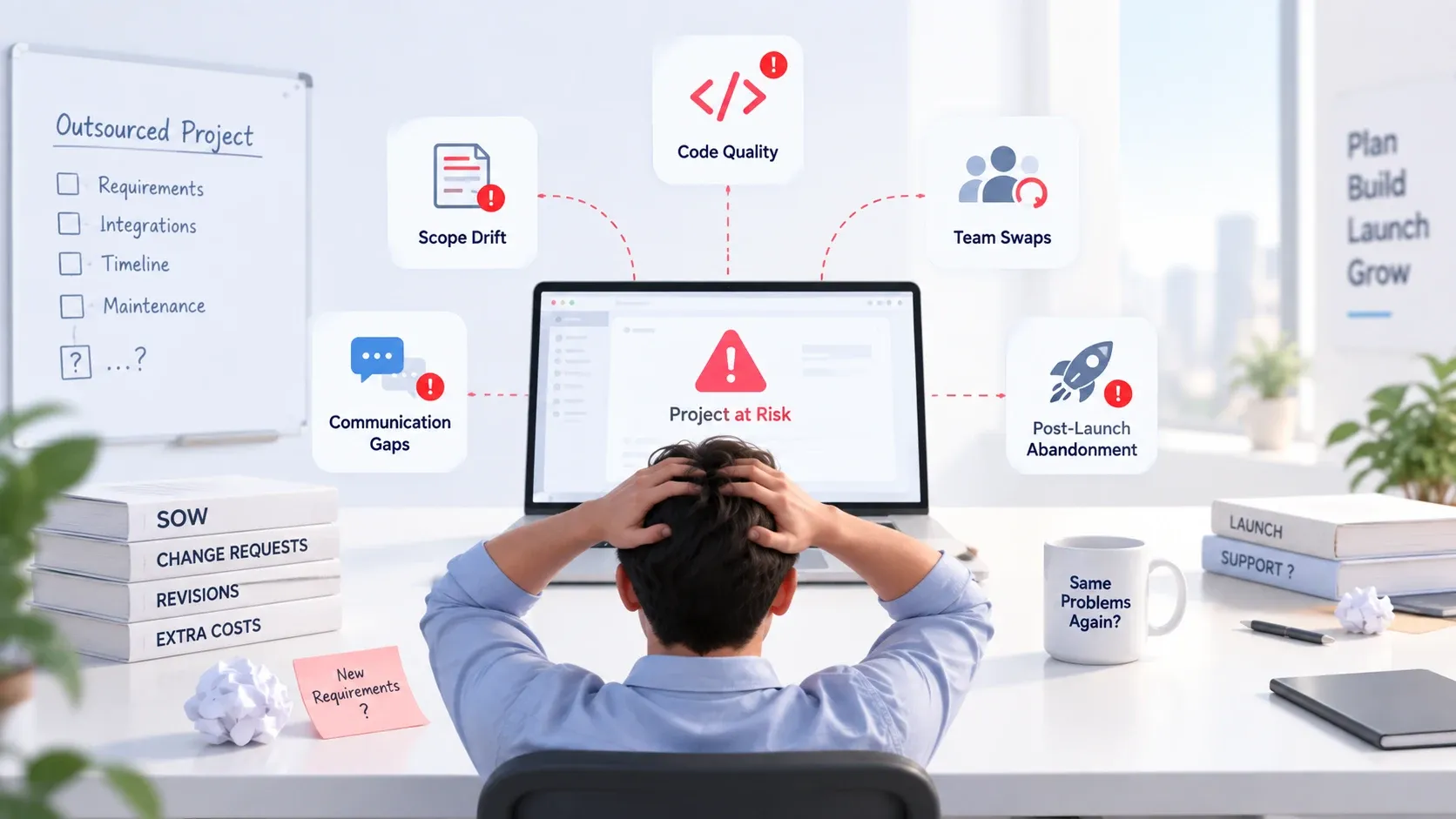
Projects fail on five predictable failure modes. Every one is visible in the SOW before work starts.
In the builds I have worked on, these five account for almost every escalation.
Scope and change-order drift
The SOW says "CRM integration." It does not say which CRM, how many objects sync, in which direction, or what happens when the sync fails.
Three months in, the client wants two-way sync. The vendor calls it new scope. Both are right.
Know why? The integration was never scoped.
Name the exact systems
Name the direction of data flow
Name the failure behaviour
Name who supplies the API credentials
That last point matters more than people expect. Most API integration work stalls on access, not on code.
Code quality and technical debt you inherit
You cannot see code quality in a demo. A build can look perfect and be unmaintainable underneath.
What to ask for instead:
Is there code review on every merge?
Are there automated tests?
Is setup documented so a new developer can run it?
If the answer is "our seniors check the work," that is not a process. That is a hope.
Key-person swaps and silent team substitution
You met a great senior engineer on the sales call. Six weeks later a different name is committing code.
This is common and not always malicious. Vendors reassign people.
But if your SOW does not name engineers, you have no grounds to object.
Communication and timezone failure modes
Timezone gaps are not the real issue. Response latency is.
A four-hour overlap with fast replies beats a full-day overlap with 48-hour replies
Ask for guaranteed overlap hours in writing
Ask for one named escalation contact, not a shared inbox
Post-launch abandonment
Launch day is when many engagements quietly end.
The site goes live
The final invoice clears
A bug appears in week two
You now have zero leverage
Fix this before signing by agreeing a warranty window and ongoing maintenance terms up front.
The pre-signature risk checklist: 12 checks
Run every candidate through these twelve checks before you sign anything.
I set out to evaluate vendors this way after watching a client lose two months untangling a handover. It has held up on every engagement since.
Vendor verification checks
Named engineers. Who specifically works on this, at what seniority?
Callable references. Two clients with similar project shape, on the phone.
Verifiable public presence. Their own site, real case studies, inspectable code.
Commercial and pricing checks
Line-item breakdown. Same categories from every vendor.
Change-order pricing. Rate and approval process agreed before you need it.
Milestone-linked payments. Tied to accepted deliverables, never dates alone.
Legal and IP checks
IP assignment. Full transfer on payment, stated explicitly.
Repository and credential access. Your accounts, your repo, from day one.
Data handling terms. NDA, DPA where relevant, rules for production data in test.
Delivery and process checks
Acceptance criteria per deliverable. Written definition of done.
Warranty window. Defined period, defined defect, no cost.
Termination and handover. What you receive, in what format, within how many days.
Pro tip: Send all twelve checks to every shortlisted vendor as one email and compare how fast and how specifically each replies. The response quality tells you more than the proposal does.
Free proposal review
Run this checklist against a real SOW
Send us the proposal or SOW you are reviewing. We will walk through all twelve checks with you on a 30-minute call and point out which clauses leave you exposed. No pitch, no obligation.
Reviewed by senior developers, not salespeople
What outsourcing web development actually costs, and what moves the number
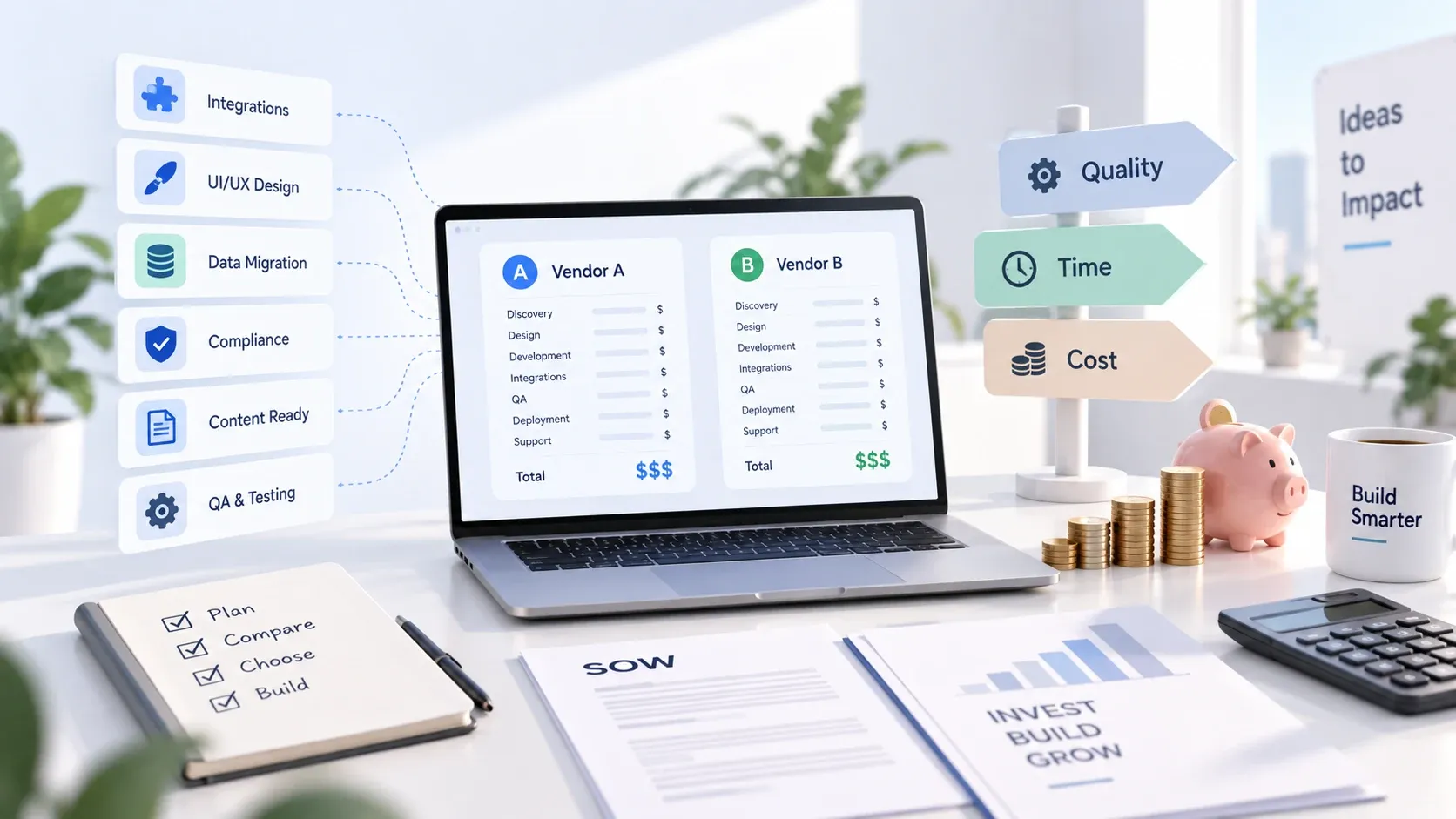
Your quote is a function of scope precision, not vendor location.
Two vendors in the same city quote differently on the same brief. They made different assumptions about what you meant.
Pricing models compared
Model | Who carries scope risk | Best when |
|---|---|---|
Fixed price | Vendor | Scope is genuinely locked |
Time and materials | Client | Scope will evolve |
Dedicated team | Shared | Multi-month, evolving roadmap |
Retainer | Shared | Ongoing maintenance and iteration |
Fixed price feels safer. It only is when scope is truly fixed. Otherwise you pay for it in change orders.
The variables that move your quote
Number and complexity of third-party integrations
Custom UI and UX design versus adapted templates
Data migration from an existing system
Compliance requirements in your industry
CMS flexibility you are asking for
Content readiness on your side
QA depth, browser and device matrix
What you trade for a lower rate
A lower rate is not free money. It buys you less of something:
Less senior engineers on the account
Fewer overlap hours with your working day
Thinner QA coverage
Less documentation
No dedicated project management
Decide which you can live without. That is a legitimate trade.
Discovering it after signing is not.
The hidden costs most SOWs leave out
Third-party licences and paid plugins
Hosting and infrastructure
Post-launch bug-fix window
Content population and data entry
Team training and documentation
Ongoing maintenance
Why the cheapest bid often becomes the most expensive engagement
The mechanism is simple:
Underscoped bid wins on price → recovers margin through change orders
Weak QA ships bugs → bugs become rework
Abandoned handover → next vendor charges you discovery on your own codebase
You do not pay less. You pay later, in worse conditions.
How to compare two quotes that look nothing alike
Ask every vendor for the same line items:
Discovery
Design
Frontend
Backend
Integrations
QA
Deployment
Project management
Post-launch support
Then compare line by line. A wild gap on one line usually means one vendor understood the requirement and the other did not.
SOW clauses that decide who carries the risk
Your protection lives in six clauses. Most SOWs I review are weak on at least three.
This section is general information for evaluating a contract, not legal advice. Have your own counsel review any SOW, MSA, or data processing agreement before you sign it.
Clause | Weak wording | Wording that protects you |
|---|---|---|
IP ownership | "Client owns deliverables" | Full IP assignment on payment: source code, assets, documentation |
Repo access | Not mentioned | Client-owned repo and credentials, vendor granted access, from day one |
Acceptance | "Client approves each phase" | Written criteria per deliverable, with a defined review window |
Warranty | "We fix bugs" | Defined period, defined defect, defined response time, no cost |
Change control | "Changes quoted separately" | Agreed rate, written approval, timeline impact stated |
Termination | 30 days notice | Notice period plus handover: code, credentials, docs, within X days |
Have counsel review the final wording before signature.
Wait, you might be thinking: is this level of contract detail overkill for a website?
Not if the website carries revenue.
These clauses cost nothing to add before signing
They are almost impossible to add afterwards
I have never seen a good vendor object to any of them
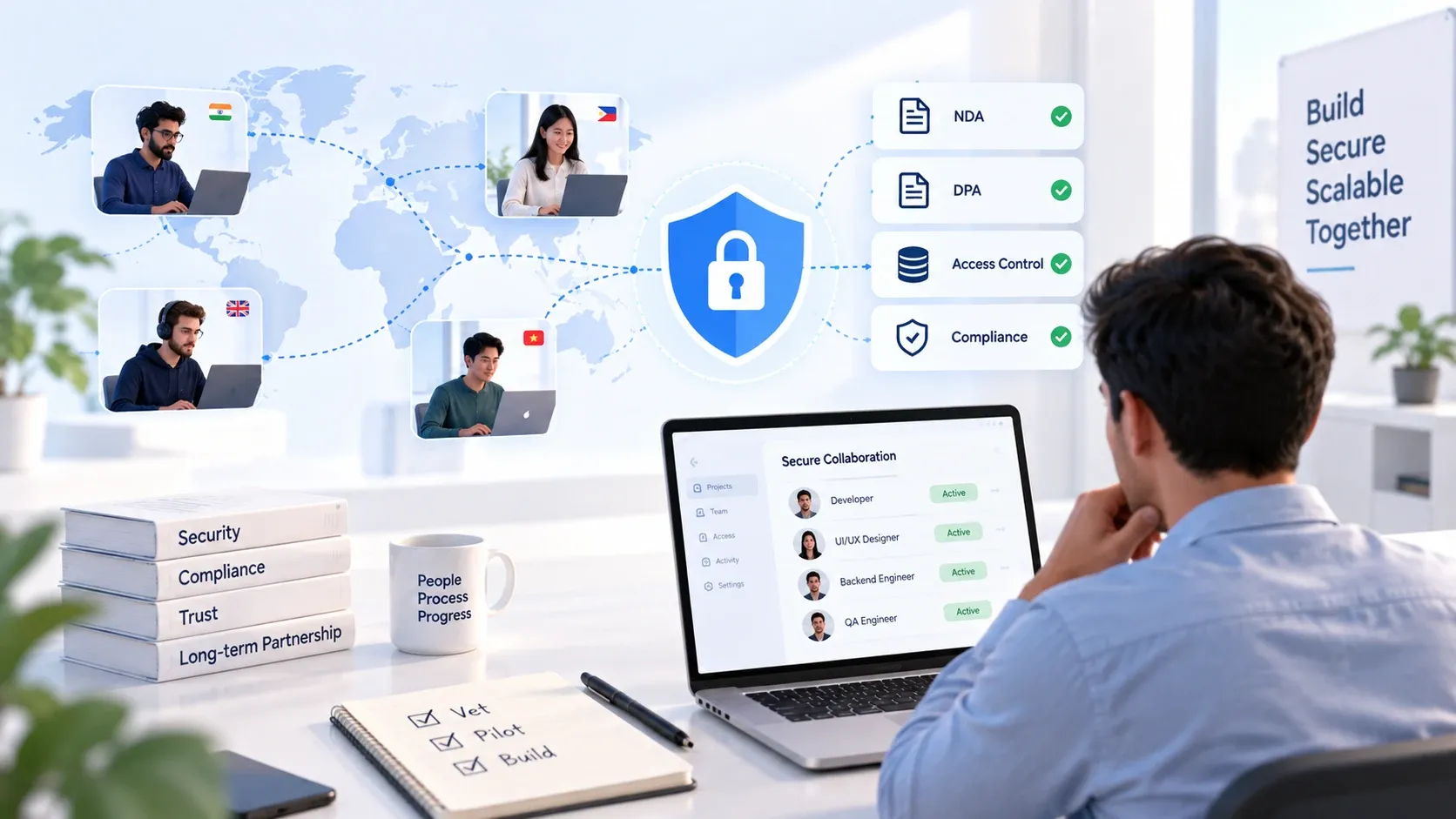
Data protection and compliance when your developers are in another country
Cross-border development is manageable, but access control matters more than paperwork.
An NDA does not stop a developer pulling production customer data into a local test database.
NDAs and DPAs should name the entity, jurisdiction, and subprocessors
Access control should be role-based, revocable, and logged
Environment separation should mean no production data in staging, ever
Regulated sectors like healthcare, finance, and education need this settled before kickoff
Again: have your counsel review any data processing agreement before you sign it.
How to vet an outsourcing partner without being technical
You do not need to read code to evaluate an engineering team. You need to test their process.
Every check below works without technical knowledge.
What to ask on the first call
Who writes the code, and at what seniority?
What happens if that person leaves mid-project?
How do you handle a requirement we got wrong?
What do you need from us weekly to stay on schedule?
Answers that should worry you: "we have a large team," "we will figure it out," and any answer that avoids naming a person.
How to read a proposal, and the red flags inside one
No assumptions section
No exclusions section
Estimates without breakdown
Timeline with no dependency on your inputs
Payment weighted heavily up front
Reference checks that actually reveal something
Skip "were you happy."
Ask: what went wrong, and how did they handle it?
Every real project has a problem. A reference who cannot name one probably was not a real client.
Running a paid pilot task before the full build
This is the highest-value check available to you.
Pay for one small, real task
Judge the code quality you receive
Judge the communication rhythm
Judge estimate accuracy against the actual delivery
Judge whether they raised the questions a good team should raise
A pilot costs a fraction of the project and tells you nearly everything.
Trust signals any partner should prove on request
Callable client references
Public review profile
Real code you can inspect
Named senior engineers on your account
Written QA and review process
Defined escalation path
IP assignment as standard
Maintenance terms in writing
Willingness to run a paid pilot
Public open-source work is one of the more honest signals, because anyone can read it. Our team maintains open-source libraries including FetchLane and a React datetime picker, which means our standards are inspectable rather than asserted.
Offshore, nearshore, or domestic: choose by risk profile, not by rate
Pick location based on overlap hours, legal recourse, and the seniority your budget buys. Not the headline rate.
Region | Genuine strength | Main consideration |
|---|---|---|
India | Deep talent pool across most stacks, wide range of engagement models | Contract overlap hours explicitly |
Philippines | Strong English communication, good support and maintenance work | Smaller senior pool for complex builds |
Eastern Europe | Strong engineering depth, EU legal framework | Higher rates than Asia |
LatAm | Near-full overlap with US hours | Rates closer to US than Asia |
USA | Same timezone, same jurisdiction | Highest cost per hour |
Best country to outsource web development for EU companies
GDPR is central to the build → an EU or UK partner simplifies data-transfer obligations
Cost matters more → offshore works with a solid DPA and documented access controls, but legal review takes longer
If you want the offshore cost profile with contractual clarity, that is what offshore JavaScript development and offshore Node.js teams are structured for.
Does the vendor's city matter?
For a remote build, no.
Whether you outsource web development in New York, Chicago, Dallas, or Los Angeles, the delivery model matters more than the address.
One exception: if you need regular on-site workshops, a local partner earns its premium.
Companies worth evaluating for outsourcing web app development
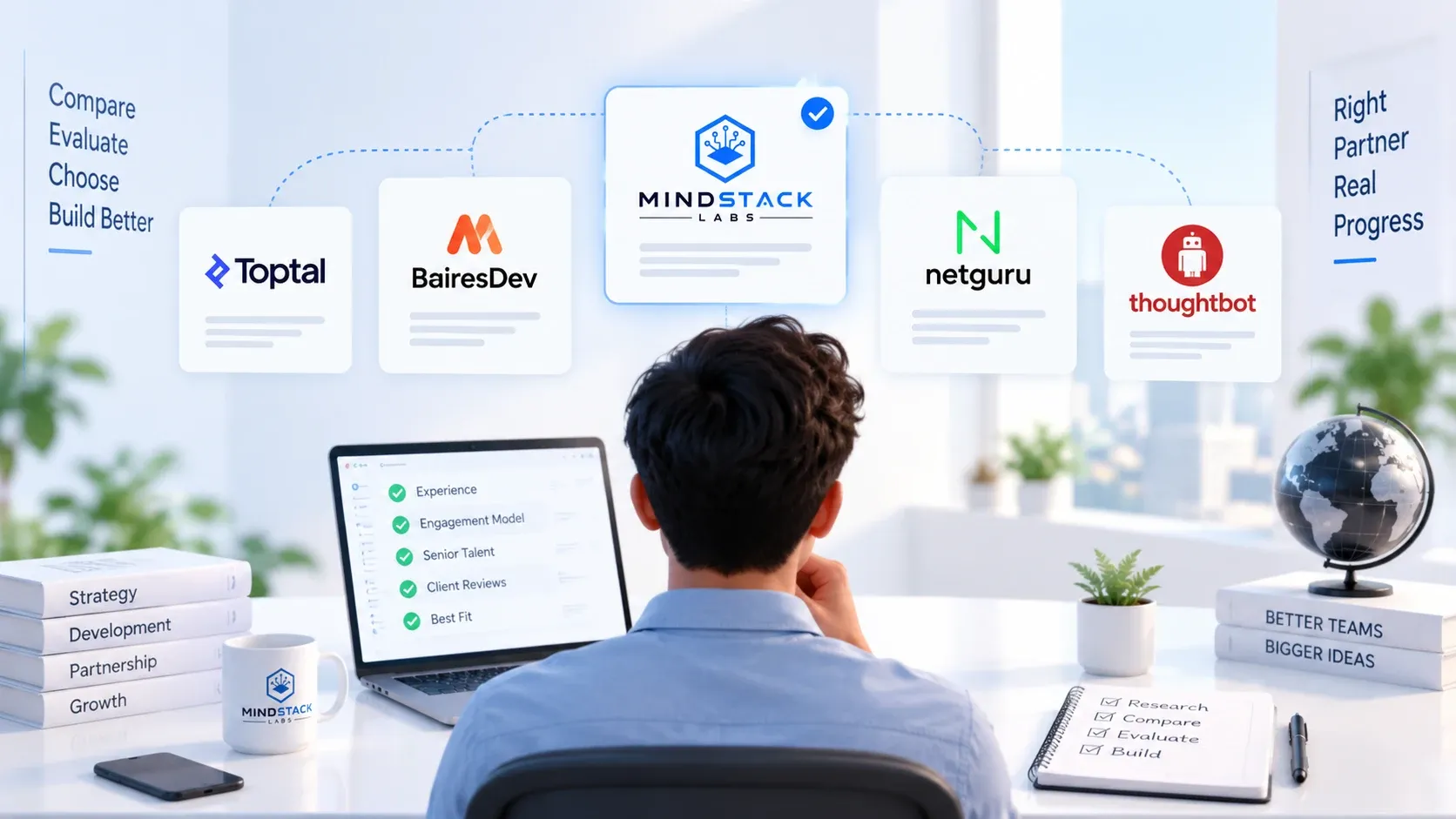
This is a fit-based shortlist, not a ranking.
I picked these five because they cover genuinely different delivery models. The right one depends on your project shape.
How to shortlist
Judge each candidate on:
Engagement models offered
Whether senior engineers are named on your account
IP and contract terms
Working-hours overlap
Verifiable public presence
Fit by project type
Five companies, compared by fit
Company | Best suited for | Engagement models | Verify independently |
|---|---|---|---|
Custom web and web app builds for US and UK companies, plus white-label delivery for agencies | Fixed scope, dedicated team, staff augmentation, white label, paid pilot | mindstacklabs.com, Clutch | |
Toptal | Sourcing individual senior contractors rather than a managed team | Staff augmentation | toptal.com, Clutch |
BairesDev | Nearshore LatAm delivery with US working-hours overlap | Dedicated team, staff augmentation | bairesdev.com, Clutch |
Netguru | Product-led web and mobile builds with design and process depth | Fixed scope, dedicated team | netguru.com, Clutch |
Thoughtbot | Product strategy paired with development, US and UK based | Retainer, fixed scope | thoughtbot.com, Clutch |
Check current details on each company's own site, since offerings change.
What each one is not for
Mind Stack Labs: a mid-sized specialist team, so not right if you need a large multi-workstream consultancy or on-site presence
Toptal: you manage the engineer, so not a fit for managed delivery
BairesDev: built for scale, so a small single-site build may not get the same attention
Netguru: process depth comes at a rate suited to funded product work
Thoughtbot: strategy-led, so it fits products more than brochure builds
Why an established company changes your risk profile
A company absorbs failures a single freelancer cannot:
Bench depth covers illness and departures
A documented process survives staff changes
A registered entity gives you contract capacity and recourse
Someone is still there in month nine when a bug appears
How we answer the twelve checks
Since we are on this list, here is our own scorecard against the same framework.
Check | Mind Stack Labs |
|---|---|
Named engineers | Named senior engineers per account |
IP ownership | Full IP assignment as standard |
Repository access | Your repo and credentials from day one |
Source code escrow | Available on request |
Acceptance criteria | Defined per deliverable in every SOW |
Warranty | Written warranty and bug-fix window |
Change control | Priced and approved in writing before work starts |
Termination and handover | Documented obligations for code, credentials, docs |
Overlap hours | US and UK working-hours overlap |
Agency delivery | White-label delivery available |
Entry point | Paid pilot task before full commitment |
Public code | Open-source libraries you can inspect |
Now run the other four through the same table. If a vendor will not fill it in, you have your answer.
You can see the delivery model in practice across our US web development work and UK web development work.
Timeline reality check
Outsourced builds slip on your inputs more often than on the vendor's velocity.
That is the uncomfortable part.
Typical sequence: discovery → design → build → integration → QA → UAT → launch → warranty.
What silently adds time
Content and copy that is not ready
Approval cycles with more than two stakeholders
Third-party API access and sandbox credentials
Your own team's review turnaround
Requirements discovered mid-build
Pro tip: Put your own obligations in the SOW with dates attached, because a timeline that only binds the vendor is not a timeline.
How to manage the engagement after you sign
Control comes from reporting structure, not daily check-ins. Set it up in week one.
Cadence: weekly written update plus one live call inside overlap hours
Every report shows: completed, in progress, blocked, and what the vendor needs from you
Documentation from day one: setup steps, architecture notes, deployment process
Maintenance: agree the post-launch arrangement before launch, not after
Exit plan: write down what handover looks like while everyone is still happy
Outsourcing web development for agencies and white-label delivery
Agencies carry double risk. Your delivery partner's failure becomes your client's experience of you.
That changes what your SOW needs:
Define who talks to the end client, and who never does
Confirm the partner works under your brand, in your tooling
Get IP flowing through to your client cleanly
Agree escalation timelines that fit your own client SLA
This is the same structure behind SaaS product delivery work, where the partner ships and the brand stays yours.
FAQs
1. Who owns the code if I outsource web development?
Only if your contract says so. Ask for full IP assignment on payment, covering source code, assets, and documentation. Without that clause, ownership can stay with the vendor.
2. Can you outsource web app development, or only websites?
Both, but web apps need tighter scoping. Application logic, user roles, and integrations create far more ambiguity than pages, so acceptance criteria matter much more.
3. What is a fair payment schedule for a website build?
Tie payments to accepted milestones, not calendar dates. A modest deposit, staged payments on acceptance, and a final portion held until handover keeps incentives aligned.
4. How do I compare quotes when outsourcing web development to India or the Philippines?
Ask every vendor for the same line-item breakdown, then compare each line. A large gap on one line usually means one vendor understood the requirement and the other assumed something cheaper.
5. Which companies should I consider for outsourcing web app development?
Mind Stack Labs, Toptal, BairesDev, Netguru, and Thoughtbot each cover a different delivery model. Treat it as a fit-based shortlist, then run all five through the twelve checks above.
Before you sign, verify these twelve things
Named engineers → callable references → verifiable public presence → line-item quote → change-order pricing → milestone payments → IP assignment → repo access → data terms → acceptance criteria → warranty window → termination and handover.
Print it. Take it into your next vendor call.
Ready to shortlist a partner?
Put us through your own checklist
We build and scale web applications for US and UK companies, and deliver white label for agencies. Start with a small paid pilot task so you can judge our code, communication, and estimate accuracy before committing to a full build.
Defined acceptance criteria in every SOW
Full IP assignment and repository access from day one
Fixed scope, dedicated team, or staff augmentation
Book a free 30-minute scoping call
Or send your SOW to us directly at https://www.mindstacklabs.com/contact>" rel="noopener">mindstacklabs.com/contact