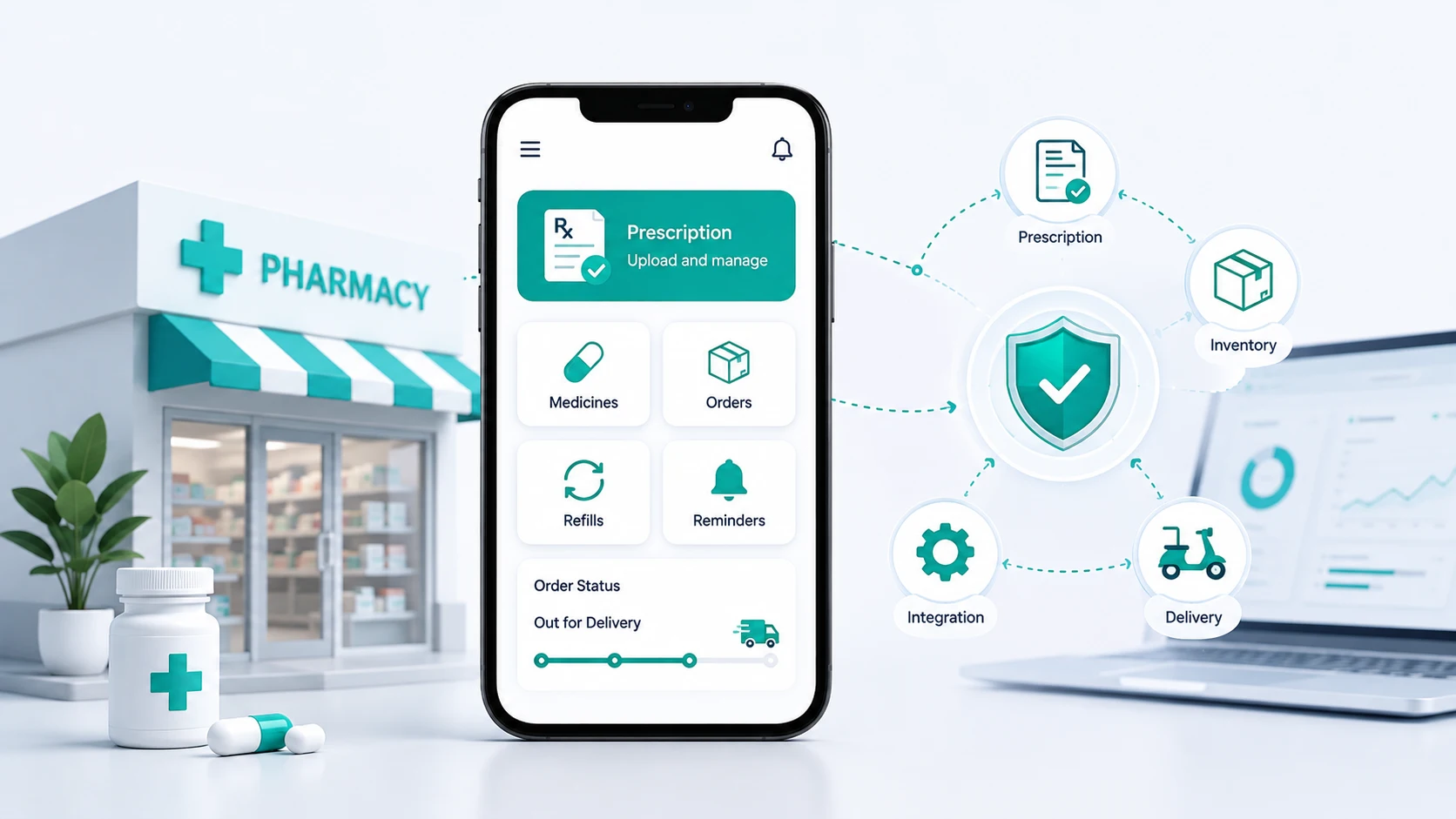
Pharmacy app development involves three connected systems, prescription intake, inventory truth and last-mile fulfilment, and the right build partner is the one who can explain how all three talk to your existing pharmacy management system before they quote you a price.

Everything else is interface.
TL;DR
- Pharmacy app development succeeds or fails on three systems: e-prescription intake, real-time inventory sync, and delivery with chain of custody.
- → Skip PMS integration discovery = timeline doubles. I have watched it happen more than once.
- e-Prescribing is not a feature you code. It is a standards conformance path, and your vendor must know that on day one.
- Phase one should be the smallest thing that can legally dispense and deliver. Nothing more.
- Judge vendors on domain questions, not portfolio screenshots. If they cannot describe a refill-authorization loop, they have not built one.
The 30-second version of why this is harder than it look
I have scoped or reviewed healthcare and pharma builds dozens of times over the past several years, and I still budget an extra two weeks purely for the pharmacy management system conversation.
Not for coding it. For finding out whether the vendor will even return the email.
Ever met a pharmacy owner who said their first app rollout went exactly to plan?
Me neither. Here is why.
The patient-facing app is maybe 30 percent of the work. The rest sits behind the counter, in the dispensing queue, in the stock ledger and in the courier handoff. Most quotes only price the 30 percent.
That is the gap this guide closes.
What a pharmacy app has to do before it can legally go live

A pharmacy app is not a storefront with a prescription upload button, it is an operational system that has to stay in sync with a regulated dispensing workflow.
In the builds I have worked on, the architecture always reduces to three systems.
The three systems every pharmacy app runs on
- Prescription intake → how a valid prescription enters your system and gets verified.
- Inventory truth → whether the app knows what is actually on the shelf, right now.
- Fulfilment → pickup or delivery, with proof that the right medication reached the right person.
Break any one of these and the other two stop mattering.
What the patient sees versus what your team runs
Patients see refills, order status, reminders and payments. Your team runs a dispensing queue, verification steps, exception handling and reconciliation.
Two products. One build. Price both.
The pharmacist workload nobody scopes
- Here is the failure mode I see most: an app that increases pharmacist clicks. Orders arrive digitally, then someone re-keys them into the pharmacy management system.
- That is not automation. That is a second job with a nicer logo.
- Scope the pharmacist screen with the same seriousness as the patient screen. Your pharmacist-in-charge holds veto power over adoption, and they will use it.
e-Prescription handling: how prescriptions actually reach your app

e-Prescriptions do not arrive through your app, they arrive through an e-prescribing network, and your job is to receive, parse and act on that message correctly.
This is the section that separates real pharmacy app development from generic health app work.
The routing path, simplified
- Prescriber writes in their EHR.
- The EHR transmits the prescription over an e-prescribing network.
- Your pharmacy management system receives it.
- Your app reads it, shows status to the patient and drives the workflow.
Most custom apps sit downstream of the pharmacy management system rather than replacing it.
From my experience, that is usually the correct architecture for an existing pharmacy. Rebuilding dispensing from scratch is a different, much larger project.
The standards layer you cannot route around
- Prescription messaging in the USA runs on the NCPDP SCRIPT standard. Refill requests, renewal responses, cancellations and change requests all have defined message types.
- Your developer does not need to have memorized them. Your developer does need to know they exist and design around them.
Controlled substances change the requirements
Electronic prescribing of controlled substances carries additional identity-proofing, two-factor authentication and audit requirements beyond standard e-prescribing.
If controlled substances are in scope, say so in your very first vendor conversation. It changes the architecture, not just the feature list.
Pro tip: ask your pharmacy management system vendor for their integration documentation before you brief a single developer, because that document determines your scope more than your wishlist does.
Inventory management: keeping the app and the shelf telling the same story
Inventory sync is where pharmacy apps quietly break trust, because a patient who orders something you do not have will not order twice.
An out-of-stock surprise costs you more than a missed sale. It costs the relationship.
What real-time sync actually requires
- A defined source of truth, almost always your pharmacy management system, never the app.
- A sync interval you can defend operationally, not just technically.
- Reservation logic so two orders cannot claim the last pack.
- A visible fallback state when sync fails, rather than silent stale data.
The details generic developers forget
- Batch and lot tracking → required for recalls and expiry control.
- Expiry-aware picking → oldest valid stock goes first.
- Multi-location visibility → useful for chains, essential for transfers.
- Substitution logic → generic equivalents need pharmacist approval, not an automatic swap.
- Partial fills → a real dispensing scenario your app must model, not error out on.
A three-location independent chain I reviewed had a working app and a broken transfer flow.
Store A promised stock that Store B had already dispensed. Know why? Inventory was read-only in the app and nobody built reservation locking.
Small gap. Large refund pile.
Delivery and fulfilment: the module most teams underestimate

Medication delivery is a chain-of-custody problem wearing a logistics costume, and pricing it like food delivery is the fastest way to blow your budget.
You are not moving a burrito. You are moving a regulated product to a verified individual.
The delivery decisions you make before you build
- In-house drivers → most control, highest fixed cost, best for dense local routes.
- Third-party courier → fastest to launch, less control over proof of delivery quality.
- Hybrid → in-house for controlled or cold-chain items, third party for routine refills.
What the build has to include either way
- Identity verification at handoff, including ID checks where required.
- Signature or photo proof of delivery, timestamped and stored.
- Temperature-sensitive handling for cold chain items, with exception logging.
- Live tracking and realistic delivery windows.
- Failed delivery, reattempt and return-to-pharmacy reconciliation.
That last one gets skipped in roughly every first-round scope I review. It should not be. Returned medication has to be accounted for against inventory and against the patient record.
Wait, you might be thinking: can I just use a white-label pharmacy platform?
Sometimes, yes. Genuinely.
If your workflow is standard, your pharmacy management system is widely supported and you need to launch this quarter, a white-label platform is the rational choice.
Custom becomes the right answer when your prescriber workflow, insurance layer or delivery model does not fit the box, or when the platform cannot integrate with the system you already run.
Custom is not automatically better. It is better when the box does not fit.
Pharmacy app development cost and timeline: how to think about the number
Cost tracks integration complexity far more than screen count, so any quote given before a PMS discovery call is a guess wearing a suit.
What actually drives the number
- Number and difficulty of integrations, especially your pharmacy management system.
- Whether controlled substances are in scope.
- Delivery model complexity, cold chain and proof of custody.
- Insurance, copay and prior authorization workflows.
- Compliance engineering, audit logging, access control and security testing.
- Post-launch maintenance, which is a running cost, not a one-time line.
At Mind Stack Labs, cost conversations start after pharmacy management system discovery, never before it.
In the pharmacy and healthcare builds we have scoped, the price tends to track integration and compliance work far more closely than the visible screens, which is exactly why we walk through your PMS and delivery model before we put a number in writing.
The timeline reality
In my experience, discovery and integration feasibility take longer than the first build sprint, and teams that compress discovery pay it back with interest during QA.
Sequence it properly:
- Discovery and PMS feasibility.
- Compliance scope review with counsel.
- Phase one build, often shipped as a cross-platform mobile build to move faster across iOS and Android.
- Security testing.
- Pilot with one location.
- Rollout.
Compliance and security: what HIPAA actually asks of your build
HIPAA does not certify apps, it sets safeguards your engineering has to satisfy, and responsibility is shared between you and your development partner.
Anyone selling you a "HIPAA certified app" is selling you a phrase.
What sits with the build team
- Encryption in transit and at rest, backed by a secure backend architecture.
- Role-based access control and least privilege.
- Comprehensive audit logging of PHI access.
- Secure authentication and session handling.
- Security testing before launch.
What stays with you
- Business associate agreements with every vendor touching PHI.
- Staff training and internal access policy.
- Breach response procedures.
- Data retention decisions.
- Final regulatory sign-off with your counsel.
Get this split written into the contract. Ambiguity here becomes expensive exactly once.
Adjacent topic: FHIR, and why prescribers keep bringing it up
HL7 FHIR is becoming the common language for clinical data exchange, and it increasingly shapes how your app talks to prescriber-side systems.
Pharmacy messaging still runs on NCPDP standards. Clinical context, medication lists and patient records increasingly move over FHIR APIs.
Why it matters to you:
- Medication history and allergy checks pull cleaner over FHIR.
- Prescriber-side integrations get easier as EHR vendors expand FHIR support.
- Building FHIR-aware now reduces rework later.
Ask your vendor whether they have worked with FHIR resources. The answer tells you a lot in about ten seconds.
How I evaluate a pharmacy app development company

Before any shortlist, I score on five plain criteria:
- Domain depth → can they describe a refill authorization loop unprompted?
- Integration track record → have they connected to a live clinical or operational system?
- Compliance engineering practice → safeguards described as engineering, not marketing.
- Delivery model transparency → who works on it, where, and who owns the code.
- Post-launch commitment → maintenance terms in writing.
The vendor questions that separate real from rehearsed
- How would you handle a refill request the prescriber denies?
- Where does inventory truth live in your proposed architecture?
- How do you model a partial fill?
- What happens in the app when PMS sync fails?
- Who signs the BAA, and what does it cover?
- What is the handover if we end the engagement?
Red flags
- A fixed quote before any integration discovery.
- "HIPAA certified" as a claim.
- No questions about your pharmacy management system.
- Portfolio full of screens, empty of workflows.
Working with Mind Stack Labs on pharmacy and healthcare builds

Mind Stack Labs builds custom software for regulated and operationally complex industries, and healthcare is one of the verticals we work in most consistently.
Two builds from our healthcare portfolio are directly relevant here.
CareBot AI

An AI medical appointment assistant handling patient-facing scheduling conversations.
- Conversational patient intake
- Appointment coordination logic
- Healthcare-context AI implementation
Best for understanding how we handle patient-facing automation in a clinical setting.
CareCheck

A healthcare application built around structured patient health workflows.
- Structured health data capture
- Workflow-driven clinical screens
- Secure handling of sensitive records
Best for understanding how we build the operational side, not just the interface.
How we approach a pharmacy build

- Discovery first. We start with your pharmacy management system and integration reality, not a feature list.
- Compliance scoped early. We build to HIPAA technical safeguards and write the responsibility split into the engagement. We do not claim certifications we do not hold.
- Phased delivery. Phase one is the smallest system that can legally dispense and deliver.
- You own the code. Full handover, documented.
Our healthcare app development practice sits alongside logistics and transportation work, which is exactly the combination a delivery-enabled pharmacy app needs.
You can review more of how we scope and deliver regulated builds in our case studies.
Not sure what your phase one should include?
Book a free 30-minute scoping call with Mind Stack Labs. We will walk through your pharmacy management system, your delivery model and what can realistically launch first. No pitch deck.
Book a Free Scoping Call →Which route should you take? Pick by priority
- If speed to market is the priority, go with a white-label platform and plan a custom rebuild later.
- If your PMS integration is the blocker, go with a custom build and start with integration discovery.
- If controlled substances are in scope, go with a partner who scopes EPCS requirements before quoting.
- If you run multiple locations, go with custom and prioritize multi-location inventory in phase one.
- If you already failed with an off-the-shelf app, go with a custom partner and start by auditing why it failed.
Your next 30 days
- Week one: align internally. Owner, pharmacist-in-charge and compliance lead in one room.
- Week two: request integration documentation from your pharmacy management system vendor.
- Week three: review compliance scope with counsel and decide on controlled substances.
- Week four: shortlist two or three vendors and run the question list above.
Pro tip: run the same six domain questions past every vendor and compare answers side by side, because the differences will be obvious and the marketing will not help them.
FAQs
1. How long does it take to build a pharmacy app?
Timeline depends mostly on integration complexity, not feature count. Discovery and PMS feasibility usually take longer than teams expect, so sequence those before committing to a launch date.
2. Can a pharmacy app legally accept e-prescriptions?
Prescriptions arrive through e-prescribing networks using established standards, not through an app upload form. Your app reads and acts on them, and controlled substances trigger additional requirements you should confirm with counsel.
3. Custom pharmacy app vs white label platform: which is better?
White label wins on speed and cost when your workflow is standard. Custom wins when your prescriber workflow, insurance layer or delivery model does not fit the platform, or when it cannot integrate with your existing system.
4. Do I have to integrate with my existing pharmacy management system?
In almost every case, yes. Your PMS should stay the source of truth for dispensing and inventory, with the app sitting downstream and syncing against it.
5. What does compliance actually cover in a pharmacy app build?
The development side covers encryption, access control, audit logging and security testing. Policy, staff training, business associate agreements and final regulatory sign-off stay with your organization.
My recommendation
Start with integration discovery before you commit to a build partner or a budget, and only choose custom development if your pharmacy management system, prescriber workflow or delivery model genuinely does not fit an off-the-shelf platform.
If it does not fit, build phase one small. Dispense, sync, deliver. Add everything else after real patients touch it.
Get a phased pharmacy app scope, not a guess
Send Mind Stack Labs your pharmacy management system and delivery setup. We will map integration feasibility, phase one scope and the compliance responsibility split before anyone talks numbers.
Request a Scoping CallSee our healthcare work