The right offshore mobile app development company depends on one thing: what you need most. Want your backend and app owned by one team, start with Mindstack Labs. Need enterprise scale, start with Appinventiv. Need full-day UK overlap, start with Miquido.
Expect $22 to $95 per hour across these ten companies depending on region and seniority. A cross-platform MVP lands between $35k and $60k in three to four months.
Now the disclosure, because you are going to ask anyway.
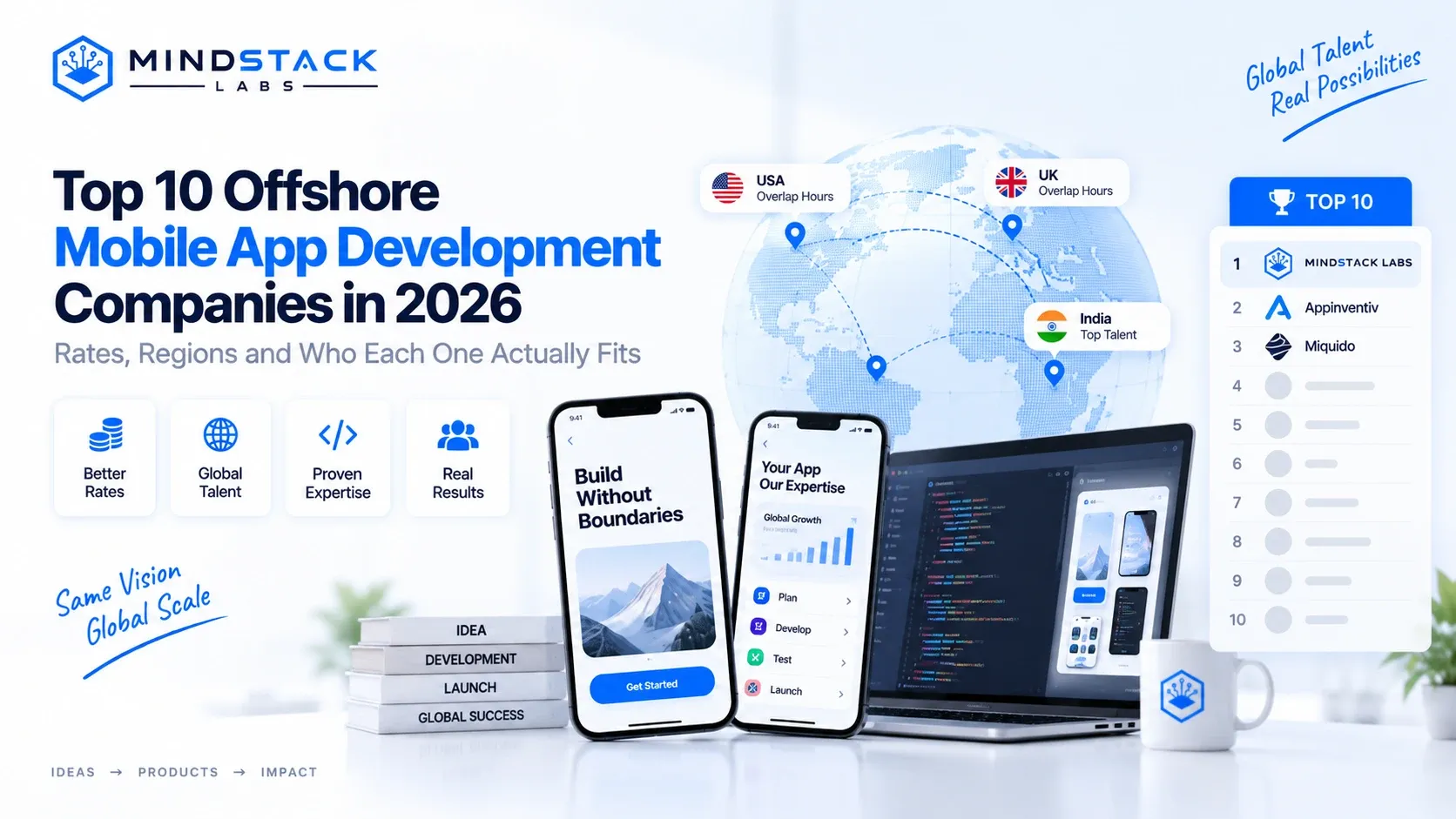
I run Mindstack Labs, the company I ranked first. So I published the seven criteria I scored every company on in the next section, before the ranking. Read those first and discount me accordingly. If you disagree with the weighting, the order changes.
I have sat on both sides of offshore mobile engagements since 2019, as a buyer and as a delivery partner. My first one ran four weeks over because I never asked who reviews pull requests. I ask now.
Every other list on this query tells you who exists. This one tells you who to call.
TL;DR
→ Ten companies scored on seven published criteria = a ranking you can audit, not a paid list
→ Offshore senior mobile rates run $35 to $60 per hour against $140 to $220 onshore = a four to five times spread on the same job title
→ Overlap hours, code review policy and IP assignment predict outcomes better than any portfolio deck
→ Mindstack Labs ranks first on stated overlap hours, named test frameworks and full-stack continuity, and last on native-only Swift or Kotlin work
→ Run a two week paid trial sprint before you sign anything longer
How I Ranked These 10 Companies (and Why I Put My Own Company First)
I scored every company on the same seven criteria, and I have disclosed that I own the one at the top so you can discount for it.
Every competing list on this query hides its methodology. That is the real gap, not the company selection.
The seven criteria every company was scored on
Stated overlap hours. A specific hour window you can put in a contract, not "we align to your time zone."
Code review and testing policy. Named frameworks and a written merge policy, not "we test thoroughly."
IP and repository terms. Assignment on creation, your repo from commit one.
Team continuity. Named engineers with a rotation notice period.
Verifiable proof. Case studies and reviews you can open and read, not a logo wall.
Full-stack continuity. Can one team own the backend and the app.
Rate transparency. Whether a real number appears anywhere before a sales call.
Why I included ourselves and how to discount for that
I included Mindstack Labs because excluding it would be dishonest by omission, and I ranked it first because it scores highest on criteria one, two and six. If you disagree with the weighting, the fix is simple. Drop criterion six and the order changes.
That is the point of publishing a rubric.
What I could not verify, and where the scores are directional
Every rate band on this page is a 2026 market estimate, not a quoted price. Rates for the other nine companies come from public directory ranges and vary widely by seniority mix.
I have not audited anyone else's internal code review process. I have read what they publish. Where a company does not publish a policy, I have said so rather than assumed the worst.
The 10 Best Offshore Mobile App Development Companies in 2026 at a Glance
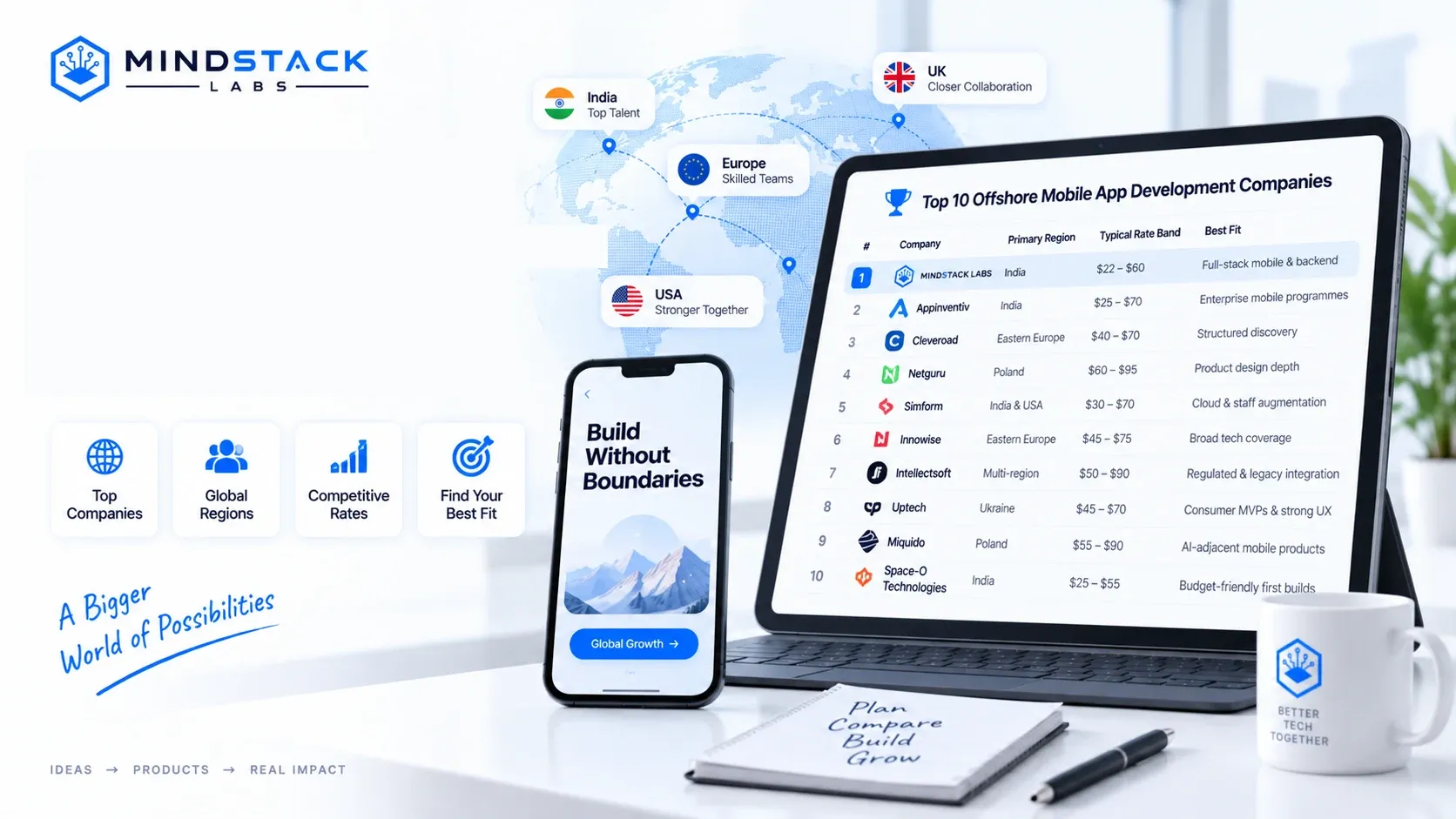
Screenshot this table, send it to your CFO, then read the two or three entries that match your scope.
# | Company | Primary region | Typical rate band | Best fit |
|---|---|---|---|---|
1 | Mindstack Labs | India | $22 to $60 | JavaScript-centric mobile plus backend under one team |
2 | Appinventiv | India | $25 to $70 | Large enterprise mobile programmes |
3 | Cleveroad | Eastern Europe | $40 to $70 | Mid-market builds needing structured discovery |
4 | Netguru | Poland | $60 to $95 | Funded startups wanting product design depth |
5 | Simform | India and USA | $30 to $70 | Cloud-heavy and staff augmentation needs |
6 | Innowise | Eastern Europe | $45 to $75 | Enterprise teams needing broad tech coverage |
7 | Intellectsoft | Multi-region | $50 to $90 | Regulated and legacy-integration projects |
8 | Uptech | Ukraine | $45 to $70 | Consumer product MVPs with strong UX |
9 | Miquido | Poland | $55 to $90 | AI-adjacent mobile products |
10 | Space-O Technologies | India | $25 to $55 | Budget-constrained first builds |
The fastest way to turn this table into a three-vendor shortlist
→ Filter by overlap requirement first = removes half the list instantly
→ Then filter by rate ceiling = leaves four or five
→ Then pick the two whose "best fit" line matches your actual scope
Pro tip: shortlist one company from a higher rate band than you can afford, because the way they scope the work will expose gaps in the cheaper proposals.
1. Mindstack Labs: Best for JavaScript-Centric Mobile Builds With Stated Overlap Hours
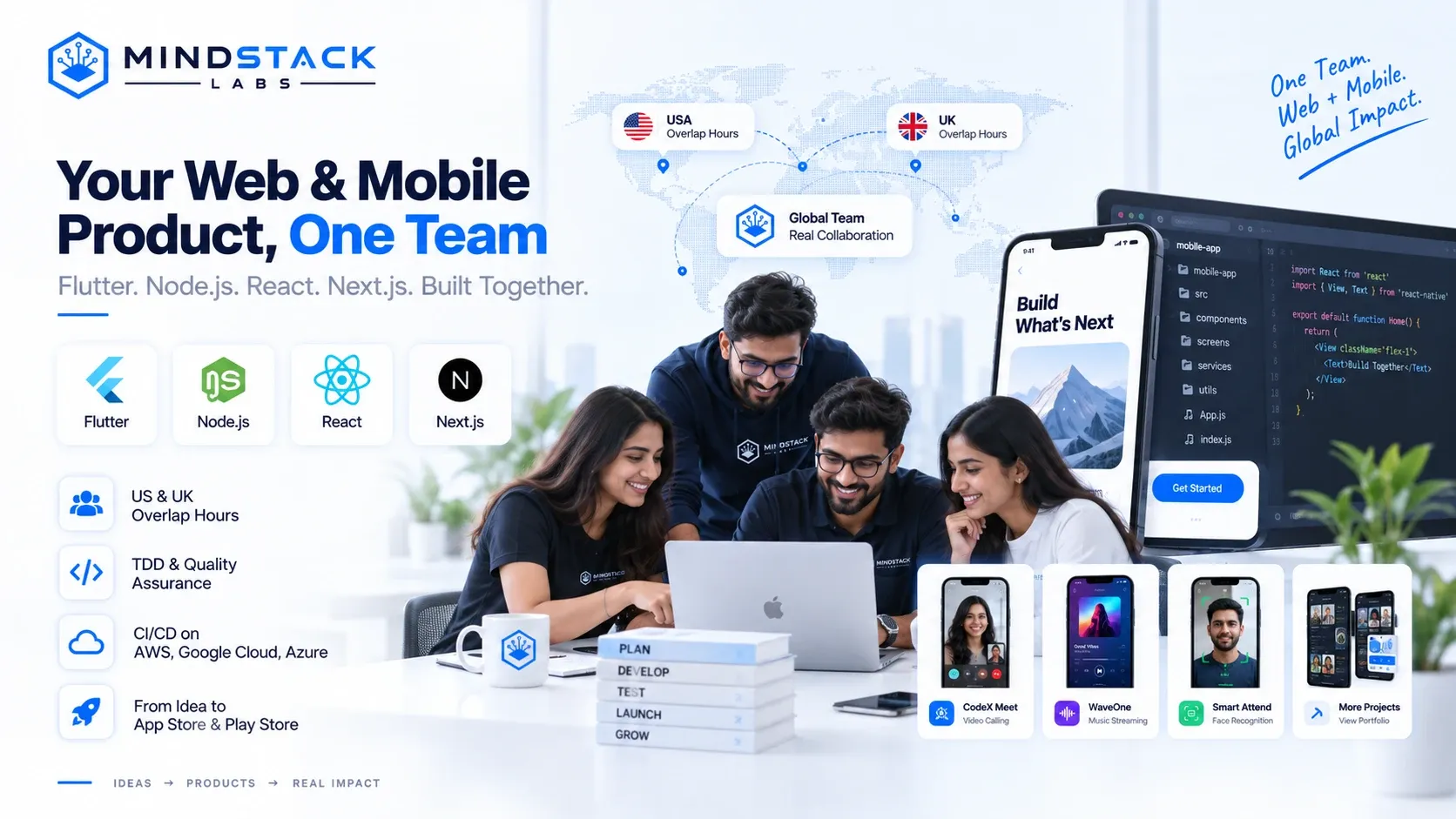
Choose us when your backend is Node or your web app is React or Next.js and you want one team owning the API and the mobile app.
We have been building since 2019, work in Flutter and JavaScript across mobile and web, and publish our working-hours commitment rather than promising alignment on a call.
Key capabilities
Flutter and cross-platform mobile, plus Node, React and Next.js backends
US and UK compatible working hours with overlapping office time and daily standups, stated on our offshore JavaScript development and offshore Node.js developers pages
TDD with unit, integration and end to end coverage using Jest, Mocha, Cypress and Playwright
CI/CD and deployment across AWS, Google Cloud and Azure
A six stage delivery process ending in store submission and post-launch support
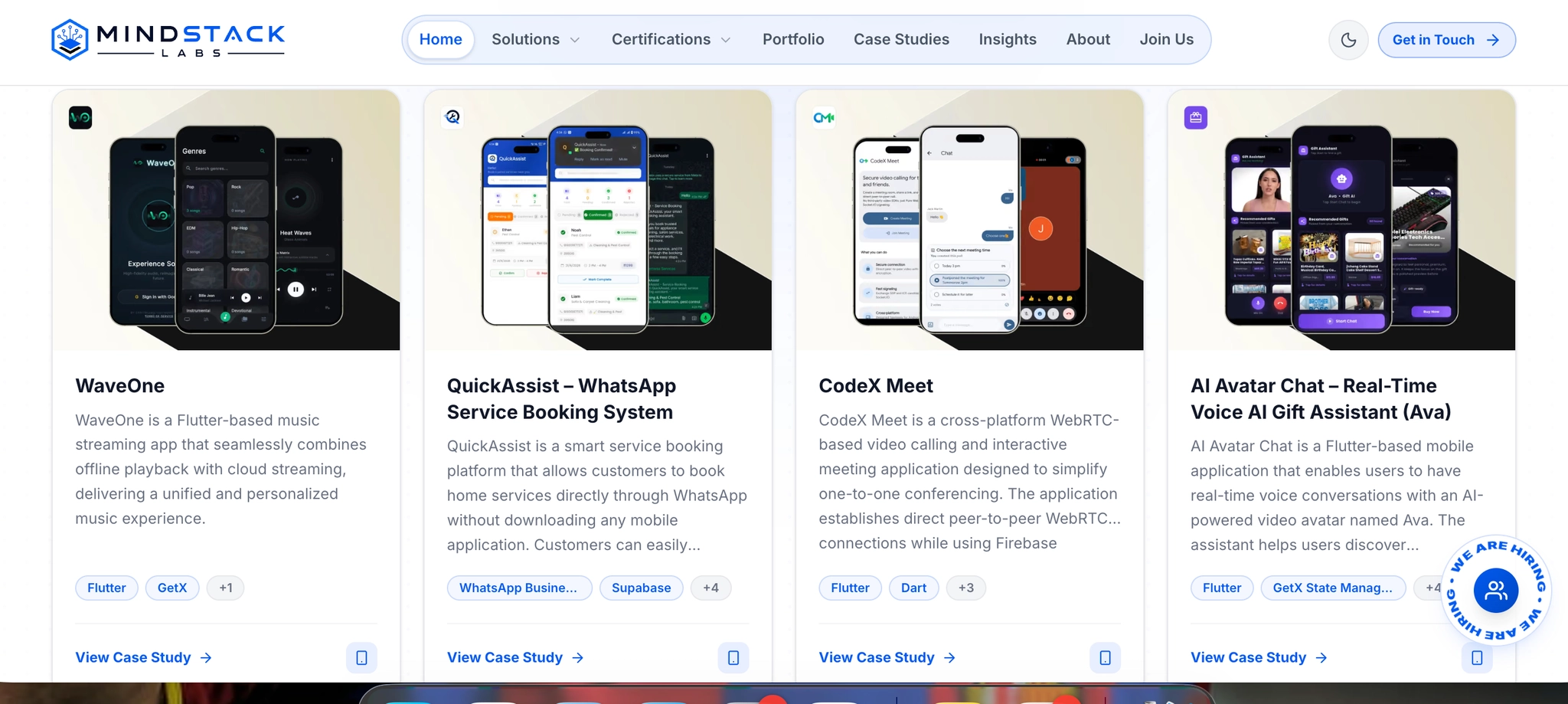
Live builds you can open: CodeX Meet for WebRTC video, WaveOne for offline-first media, Smart Attend for on-device face recognition, and the full portfolio
Rates and engagement: $22 to $60 per hour by seniority. Dedicated developers, hourly consulting or project pricing.
Best for: teams wanting mobile and backend continuity with a contracted overlap window.
Look elsewhere if: you need pure native Swift or Kotlin specialists, or a vendor holding formal compliance certifications.
2. Appinventiv
Choose Appinventiv when your build is a multi-year enterprise mobile programme rather than a single app.
One of the larger India-headquartered mobile firms, with broad industry coverage and enterprise delivery structure.
Key capabilities
Native iOS and Android alongside cross-platform
Enterprise mobility, IoT and emerging tech practices
Large delivery teams for parallel workstreams
Rates: roughly $25 to $70 per hour by role.
Best for: enterprise buyers who need scale and a formal programme structure.
Look elsewhere if: you are a small team who will get a junior account tier at this size of firm.
3. Cleveroad
Choose Cleveroad when you want a structured discovery phase before anyone writes code.
An Eastern European firm with a documented delivery process and useful public engineering content.
Key capabilities
Cross-platform and native mobile
Formal discovery and specification stage
Better default overlap for UK buyers than most Asian vendors
Rates: roughly $40 to $70 per hour.
Best for: mid-market projects where the spec is not finished yet.
Look elsewhere if: your budget assumes India-tier rates.
4. Netguru
Choose Netguru when product design quality matters as much as engineering throughput.
A Poland-based firm known for design-led product work with funded startups and scale-ups.
Key capabilities
Strong product design and research practice
React Native and native mobile
Mature agile delivery and reporting
Rates: roughly $60 to $95 per hour.
Best for: funded consumer products where UX is the differentiator.
Look elsewhere if: you are cost-sensitive. This is near-nearshore pricing, not offshore pricing.
5. Simform

Choose Innowise when you need broad technology coverage across several parallel projects.
A large Eastern European group covering mobile, data, enterprise systems and QA.
Key capabilities
Wide stack coverage including legacy and enterprise platforms
Dedicated team and outstaffing models
Multiple delivery locations across Europe
Rates: roughly $45 to $75 per hour.
Best for: enterprises consolidating several vendors into one.
Look elsewhere if: you want a small senior team that stays constant for a year.
7. Intellectsoft
Choose Intellectsoft when your app has to integrate with old, ugly, business-critical systems.
A multi-region firm with enterprise and regulated-sector experience.
Key capabilities
Enterprise integration and legacy modernisation
Construction, healthcare and finance sector experience
Multi-location delivery for time zone flexibility
Rates: roughly $50 to $90 per hour.
Best for: integration-heavy builds inside larger organisations.
Look elsewhere if: you are building a greenfield consumer MVP on a startup budget.
8. Uptech
Choose Uptech when you are building a consumer product and want a small senior team on it.
A Ukraine-based product studio focused on consumer mobile apps.
Key capabilities
Product discovery plus mobile delivery
Small dedicated teams rather than large pods
Strong published case study detail
Rates: roughly $45 to $70 per hour.
Best for: consumer MVPs where product thinking matters.
Look elsewhere if: you need enterprise procurement processes and large-scale capacity.
9. Miquido
Choose Miquido when your mobile product has a genuine AI or machine learning component.
A Krakow-based firm with mobile and AI practice areas.
Key capabilities
Mobile plus AI and ML product work
Flutter and native delivery
Full-day overlap for UK and EU buyers
Rates: roughly $55 to $90 per hour.
Best for: AI-adjacent consumer or B2B mobile products.
Look elsewhere if: your app is a straightforward CRUD build. You will overpay for capability you do not use.
10. Space-O Technologies
Choose Space-O when budget is the binding constraint and your scope is genuinely simple.
An India-based firm with high project volume across small and mid-size apps.
Key capabilities
High-volume mobile delivery
Cross-platform and native
Lower entry price point than most of this list
Rates: roughly $25 to $55 per hour.
Best for: first builds and prototypes with tight budgets.
Look elsewhere if: your build is complex or regulated. Verify the QA arrangement specifically.
Wait, You Might Be Thinking: "You Ranked Yourself First, So Why Trust Any of This?"
Fair. So check the ranking against the criteria instead of trusting me.
Every claim in the Mindstack entry links to a page you can open. Every other entry names a real limitation. If the nine other blocks were filler, the list would be worthless to you and useless to me.
A biased list with a published rubric beats an "objective" list with none.
How Much Do Offshore Mobile App Development Companies Charge in 2026?
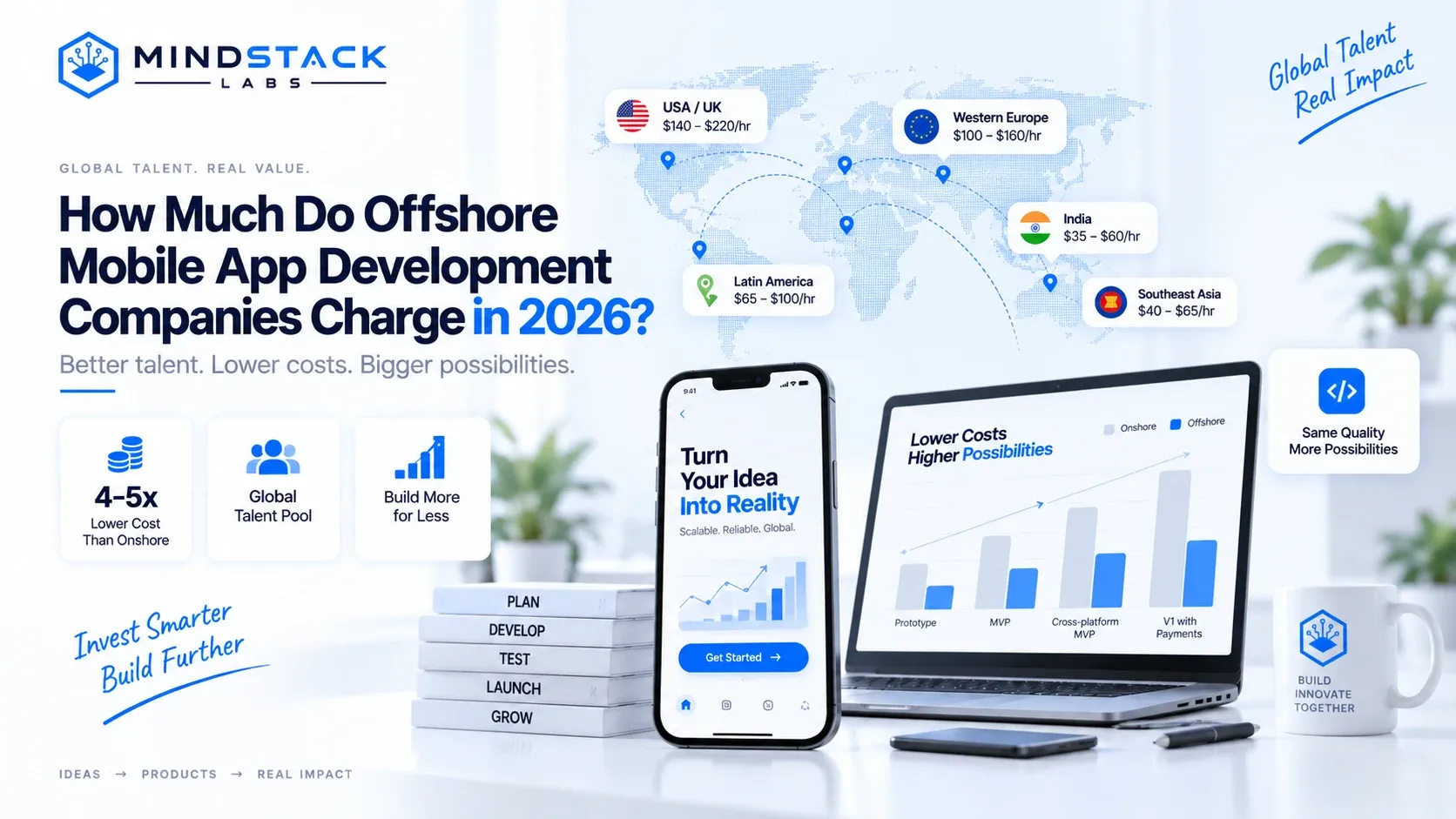
Senior offshore mobile engineers run $35 to $60 per hour against $140 to $220 onshore, which puts a cross-platform MVP near $35k to $60k instead of $120k to $200k.
In the builds I have worked on, seniority mix moves the final number more than country does.
Hourly rates by region and seniority
Region | Mid-level | Senior | Tech lead |
|---|---|---|---|
USA / UK | $95 to $150 | $140 to $220 | $180 to $260 |
Western Europe | $70 to $110 | $100 to $160 | $140 to $200 |
Eastern Europe | $40 to $65 | $60 to $95 | $85 to $120 |
Latin America | $45 to $70 | $65 to $100 | $90 to $130 |
India | $22 to $38 | $35 to $60 | $55 to $85 |
Southeast Asia | $25 to $42 | $40 to $65 | $60 to $90 |
What a full build costs offshore versus onshore
Build type | Offshore | Onshore | Typical hours |
|---|---|---|---|
Prototype | $8k to $18k | $30k to $60k | 250 to 400 |
MVP, one platform | $25k to $45k | $80k to $150k | 900 to 1,400 |
MVP, cross-platform | $35k to $60k | $120k to $200k | 1,300 to 1,900 |
V1 with payments and admin | $60k to $110k | $200k to $350k | 2,200 to 3,200 |
Annual maintenance | $9k to $30k | $30k to $70k | 15 to 20% of build |
The costs that never appear in the headline quote
Discovery and architecture
Project management, which I have seen run 10 to 15% of engineering hours
Independent QA, which tends to add 15 to 25% of engineering cost
DevOps, CI/CD and environment costs
Store submission and rejection fixes
Maintenance, commonly 15 to 20% of build cost per year
Most budgets stop at launch day. Then month four arrives.
Which pricing model protects you
Model | You carry the risk of | Best for |
|---|---|---|
Fixed price | Change orders and padded estimates | Tight, unchanging scope |
Time and materials | Overrun if scope drifts | Evolving products with an engaged owner |
Dedicated team | Paying for idle capacity | Multi-quarter roadmaps |
Fixed price feels safest. It is usually the most expensive way to buy change.
Get a number you can take to your CFO
Want your actual scope priced instead of a rate band?
Send us your feature list, target platforms and launch date. You will get an itemised estimate with the seniority mix, QA coverage and project management hours broken out separately, so you can compare it line by line against any other quote on your shortlist.
Itemised estimate within 24 hours. No obligation, and yours to use in other vendor conversations.
Which Region Should You Hire From?
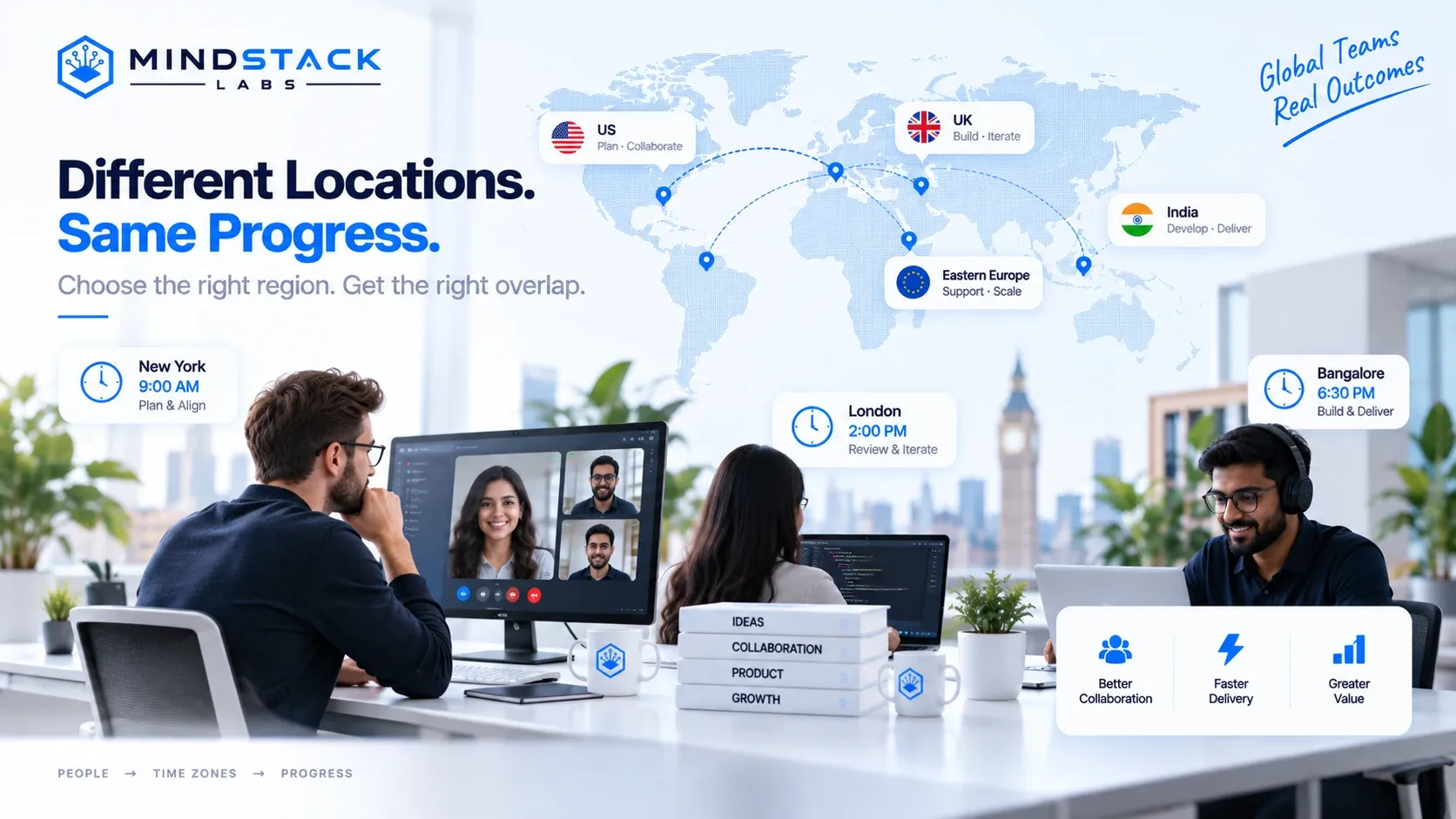
Pick the region by how many overlap hours your decision-making needs, then filter by rate.
Four hours of genuine overlap covers almost any mobile build. Two works with strong async discipline.
Buyer | Region | Realistic overlap | With shifted hours |
|---|---|---|---|
US East | India | 1 to 2 hours | 4 to 5 hours |
US West | India | Under 1 hour | 3 to 4 hours |
US East | Eastern Europe | 2 to 3 hours | 5 to 6 hours |
UK | India | 3 to 4 hours | 5 to 6 hours |
UK | Poland / Ukraine | 6 to 8 hours | Full day |
When nearshore beats offshore outright: when your product is still being discovered and decisions change daily. A 10 hour gap plus daily pivots equals expensive churn.
That is not a quality judgement. It is a latency one.
What Actually Goes Wrong, and the Clause That Prevents Each One
Every offshore failure I have seen traces back to a missing clause, not a missing skill.
What goes wrong | The clause that prevents it |
|---|---|
The team you interviewed quietly changes | Named resources with a rotation notice period and replacement overlap |
You do not own the code | IP assignment on creation, your repository from commit one |
Scope drifts silently | Written definition of done plus a scope change log |
Quality collapses by month three | Mandatory pull request review, no self-merges, independent QA |
Communication breaks down | A contracted overlap window and one named decision maker |
Data gets exposed | DPA, least-privilege access, separated environments |
One client of mine lost six weeks because approvals sat with a founder who travelled constantly.
Know why it stalled? There was no named decision maker in the sprint ceremony.
Compliance and Contracts: What Your Legal Review Will Ask
Get IP, data handling and exit terms signed before kickoff, because none of them negotiate fairly once you are dependent. This is a checklist, not legal advice.
GDPR: confirm where data is processed and stored, and get a DPA if real user data touches dev environments
US health data: ask what the vendor has actually built to HIPAA technical safeguards, and never accept "HIPAA certified" as a phrase, because no such certification exists
SOC 2: if your enterprise customers require it of you, those requirements push down to your vendor
Contractor versus employer of record: long-term individual engagements can create misclassification exposure. An agency contract or an EOR removes it
Exit clause: notice period, handover deliverables, documented knowledge transfer
That last one gets skipped most often, and it is the one you need on your worst day.
How Long Does an Offshore Mobile App Build Take?
Plan three to four months for a real MVP and six to nine for a complex app.
Build type | Realistic range |
|---|---|
Prototype | 3 to 6 weeks |
MVP | 3 to 4 months |
V1 with integrations | 5 to 7 months |
Complex or regulated | 6 to 9 months and up |
Add time for platform requirements. Google Play raised its target API level requirement for new apps and updates in August 2025, and Apple moved submissions onto a newer SDK baseline in April 2025. Both cost real engineering hours on existing codebases.
The first two weeks are not build weeks. Onboarding, access provisioning and domain learning are real. Budget them honestly.
The 2026 Shift: AI-Assisted Delivery and What to Ask About It
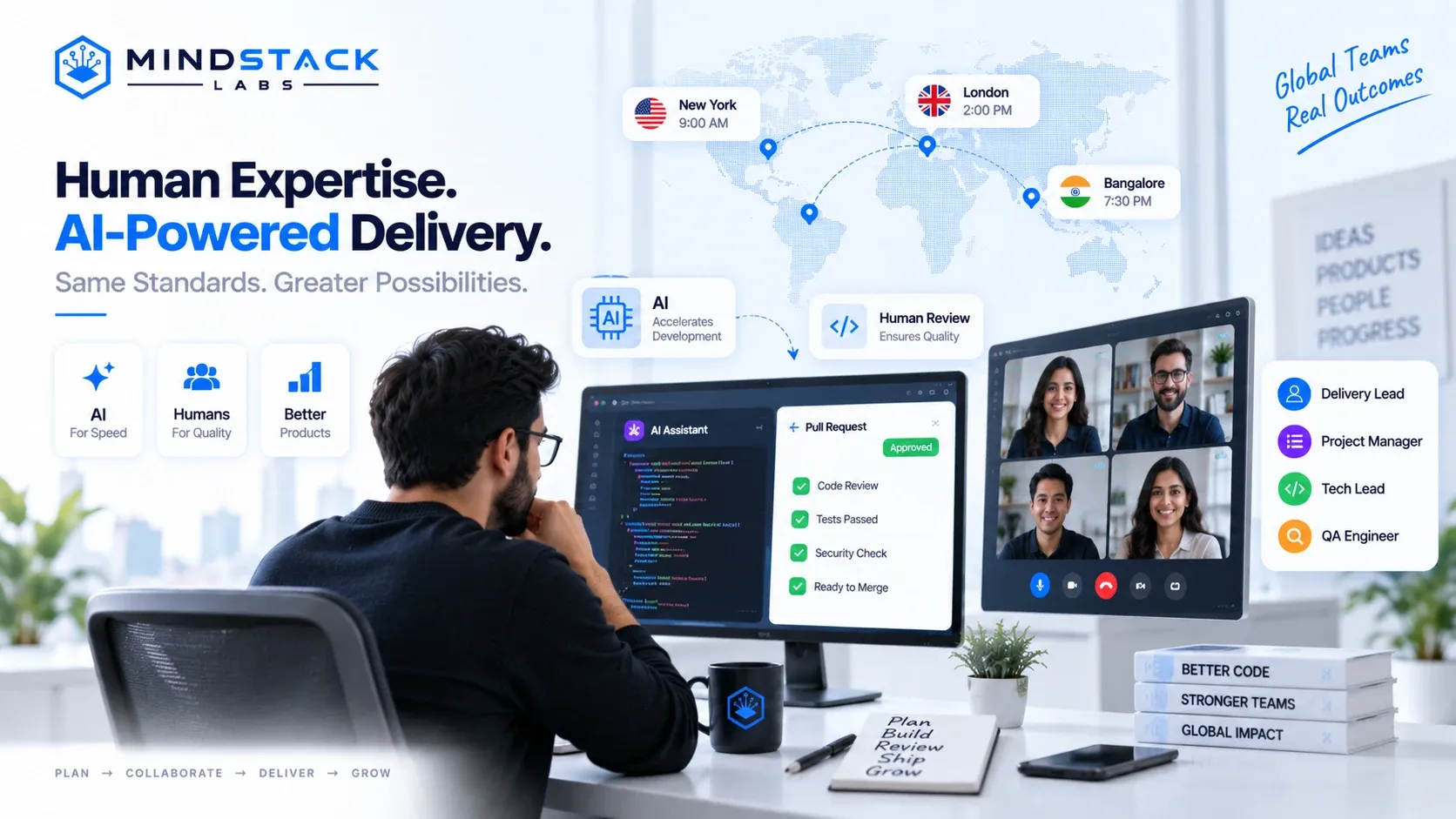
Ask every vendor how they use AI coding tools and who reviews the output, because in 2026 nearly all of them do and very few have a policy.
From my experience, AI assistance changes velocity on boilerplate and changes nothing on architecture. The risk is not the tool. It is unreviewed generated code entering your repo.
Three questions worth asking:
→ Which AI tools do your developers use = you need the actual answer, not a denial
→ Does generated code go through the same review gate = it must
→ Is any of our code or data sent to third-party models = a contractual question, not a technical one
One vendor I spoke with had no policy at all. Another had a written one.
Guess which proposal I trusted.
How to Manage an Offshore Team You Will Never Meet
One named point of contact, one written cadence, one set of tracked outputs.
Delivery lead for commercial and escalation, weekly or monthly
Project manager for day to day, daily
Tech lead for architecture and estimates, weekly and on demand
QA engineer for sprint sign-off
Track outputs, not hours: tickets closed against committed scope, an installable build every sprint, pull request review turnaround, bug reopen rate.
Managing across a 10 hour gap sounds exhausting. It is mostly just writing things down.
Pro tip: agree a four-level escalation ladder before kickoff so nobody improvises during a production incident.
If You Only Have Time for One Decision: Match Your Priority to a Company
Find your priority, take the recommendation, book the call.
If backend and mobile continuity matters most, go with Mindstack Labs
If enterprise scale and parallel workstreams matter most, go with Appinventiv or Innowise
If product design quality matters most, go with Netguru or Uptech
If full-day UK overlap matters most, go with Miquido or Cleveroad
If lowest defensible cost matters most, go with Space-O, and pay separately for independent QA
Why I Ranked Mindstack Labs Number One
We score highest on the three criteria that predict delivery: stated overlap hours, specified testing and full-stack continuity.
Overlap is published, not promised. Our US and UK pages commit to compatible working hours with overlapping office time and daily standups.
Testing is named. TDD with Jest, Mocha, Cypress and Playwright, rather than "comprehensive QA."
One team owns the API and the app. Node, React, Next.js and Flutter under one delivery lead.
The work is openable. CodeX Meet, WaveOne, Smart Attend, Secure Auth Vault and the rest of the portfolio.
Where we are genuinely not the right choice: pure native Swift or Kotlin products with deep platform-specific requirements, and builds that require a vendor holding formal certifications. We describe compliance as engineering practice, not as certification, because that is the truthful version.
I would rather lose that deal than win it wrongly.
Verify us before you commit
Test us on a two week paid sprint, then decide
Everything we recommend asking of a vendor, applied to us from day one. You get a named team, a written definition of done, code review on every pull request and repository access from commit one. At the end you own the code and the decision.
Named developers with a stated rotation notice period
Full IP assignment and your repository from day one
Your overlap hour window agreed in writing before kickoff
Detailed proposal within 24 hours
Building on JavaScript or Node? See offshore JavaScript development for US companies and offshore Node.js developers for UK businesses.
Frequently Asked Questions
1. Which offshore mobile app development company is best for a startup MVP?
For a cross-platform MVP on a startup budget, I would shortlist Mindstack Labs, Uptech and Space-O. Expect $35k to $60k and three to four months. Insist on independent QA in the quote.
2. Offshore vs nearshore mobile app development company: which is better?
Nearshore wins when your product is still changing daily and you need five or more overlap hours. Offshore wins on rate and on defined scope. From my experience, the deciding factor is decision latency, not code quality.
3. How much do offshore mobile app development companies charge per hour in 2026?
Expect $22 to $60 in India and Southeast Asia, $40 to $95 in Eastern Europe and $95 to $220 onshore. Seniority mix moves the total more than the country does.
4. Do offshore app development companies give you the source code?
Only if the contract assigns IP on creation rather than on final payment. Require your repository from the first commit, and add documented knowledge transfer to the exit terms.
5. Which offshore development companies actually work in US time zones?
Ask for a specific hour window in the statement of work. Most Indian vendors can shift to four or five overlap hours with US East. "We align to your time zone" is not an answer.
Your Next Step: Shortlist Three Companies This Week
Start with the three companies whose "best for" line matches your scope, then run all three through the same two-week paid trial sprint offer. Use a dedicated team model if your roadmap runs past one quarter, and time and materials if it does not.
If you want your scope priced before you call anyone, book a free 30 minute scoping call with Mindstack Labs. Itemised proposal within 24 hours, no commitment attached.