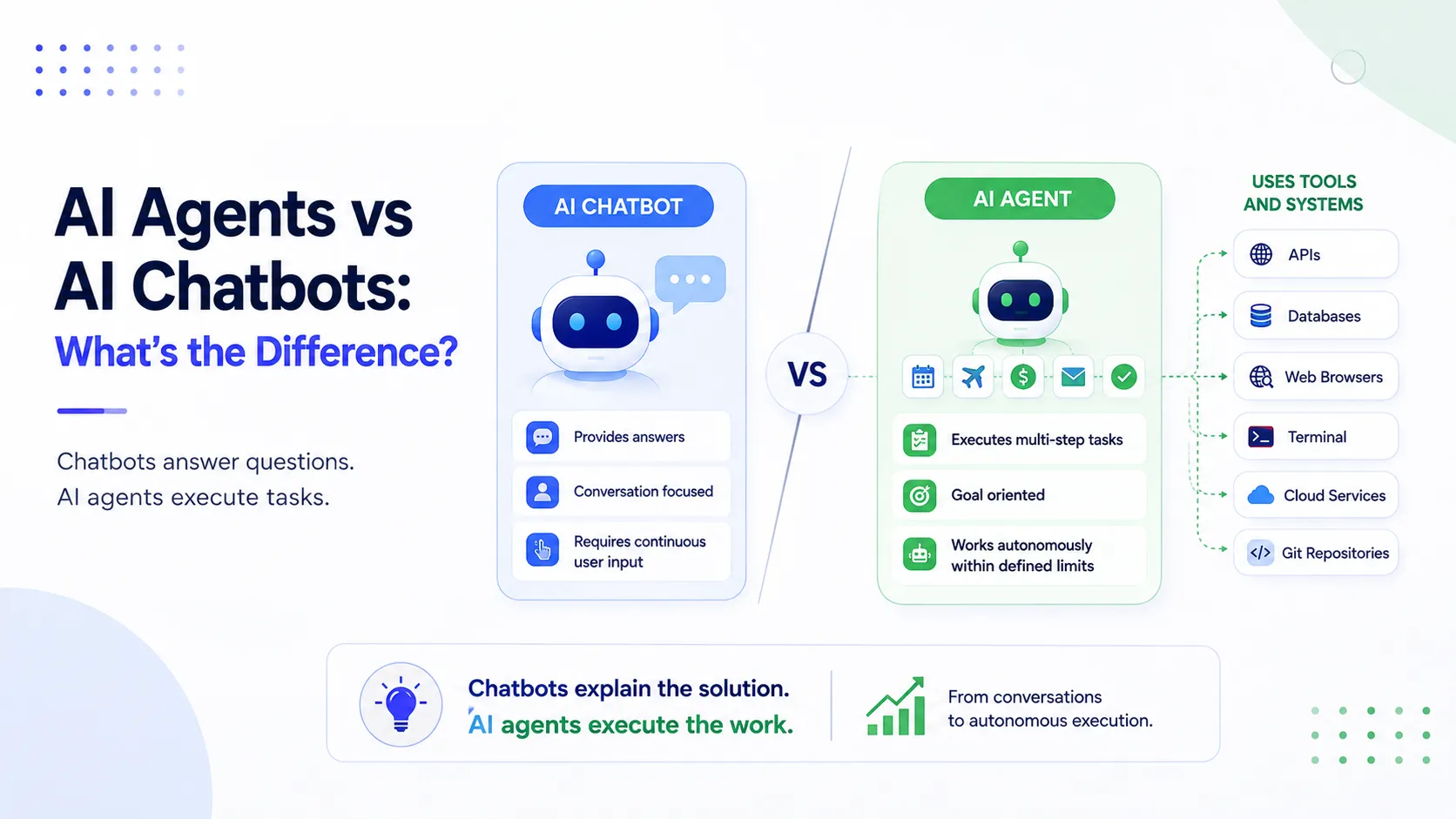
If you've been following AI news lately, you've probably noticed a major vocabulary shift happening across the tech world. A couple of years ago, everyone was talking about chatbots. Today, nearly every AI product announcement mentions AI agents.
At first glance, it might seem like a simple marketing trend. However, beneath the surface, AI agents represent a significant evolution from traditional AI chatbots.
While both are powered by Large Language Models (LLMs), they differ dramatically in autonomy, tool usage, memory, and their ability to execute complex tasks.
Let's explore what separates AI chatbots from AI agents and why this distinction matters for developers and businesses.
The Conversationalist vs. The Autonomous Worker
An AI chatbot is primarily designed for conversation. It accepts a prompt, generates a response, and waits for the next instruction.
For example, if you ask:
Book a flight to San Francisco for next Tuesday.
A chatbot will usually explain how to book the flight or recommend travel websites.
An AI agent approaches the same request differently. Instead of simply answering, it treats the request as a goal to accomplish.
An AI agent can:
- Check your calendar for availability.
- Search airline APIs for available flights.
- Compare prices based on your preferences.
- Book the ticket.
- Send the confirmation email.
| AI Chatbot | AI Agent |
|---|---|
| Provides answers | Executes multi-step tasks |
| Conversation focused | Goal oriented |
| Requires continuous user input | Works autonomously within defined limits |
Key Differences Between AI Agents and AI Chatbots
1. Autonomy and Planning
Chatbots follow a request-response pattern. Every action requires user input.
AI agents use LLMs as reasoning engines to plan tasks, decide execution order, and adapt when circumstances change.
2. Tool Usage and Function Calling
Chatbots mainly generate text.
AI agents integrate with external systems and tools, including:
- REST APIs
- Databases
- Web browsers
- Terminal environments
- Cloud services
- Git repositories
This allows agents to interact with real-world systems instead of only producing text responses.
3. Memory and State Management
Traditional chatbots rely on the conversation context and often lose information when sessions end.
AI agents maintain persistent memory, enabling them to remember previous actions, track long-running workflows, and continue unfinished tasks.
4. Self-Correction and Error Recovery
If a chatbot generates an incorrect answer, it depends on the user to point out the mistake.
AI agents can detect failures, inspect logs, retry failed operations, and modify their execution strategy automatically.
This makes them significantly more reliable for automation and production workflows.
AI Chatbots vs AI Agents for Software Development
Chatbot Workflow
You paste a broken Python function into ChatGPT and ask why it throws a KeyError. The chatbot explains the issue and provides corrected code for you to implement manually.
AI Agent Workflow
You assign the issue to an AI agent. It can:
- Clone the Git repository.
- Search the codebase.
- Identify the root cause.
- Create unit tests.
- Implement the fix.
- Run automated tests.
- Open a pull request for review.
The chatbot explains the solution. The AI agent executes the work.
When Should You Use Each?
| Use Case | AI Chatbot | AI Agent |
|---|---|---|
| Answering questions | Excellent | Good |
| Brainstorming ideas | Excellent | Good |
| Writing content | Excellent | Good |
| Code explanation | Excellent | Excellent |
| Automating workflows | Limited | Excellent |
| API integrations | Limited | Excellent |
| Multi-step task execution | Limited | Excellent |
The Future of AI: From Conversations to Autonomous Execution
AI chatbots remain valuable tools for learning, brainstorming, summarization, content creation, and answering questions.
However, AI agents represent the next generation of AI-powered productivity. Instead of assisting with individual prompts, they can independently execute complex workflows while collaborating with humans.
As businesses continue adopting agentic AI systems, software teams will spend less time performing repetitive tasks and more time defining objectives, validating outcomes, and building reliable systems.
Conclusion
The difference between AI chatbots and AI agents isn't just better conversation—it's autonomous execution.
Chatbots are designed to answer questions and generate content. AI agents are designed to plan, reason, use tools, and complete real-world tasks with minimal supervision.
Understanding this distinction is becoming increasingly important as organizations move toward AI-powered automation, autonomous software development, and intelligent business workflows.