Code review is one of the most valuable practices in software development. It catches bugs before production, improves code quality, encourages knowledge sharing, and helps engineers grow.
Today, AI-powered tools such as GitHub Copilot, ChatGPT, Claude Code, Gemini, and Cursor can review code in seconds. They identify bugs, suggest refactoring opportunities, explain complex logic, and recommend best practices.
While these capabilities are impressive, AI is not a replacement for experienced engineering judgment.
The strongest engineering teams combine AI-assisted code reviews with human expertise to build higher-quality software faster.
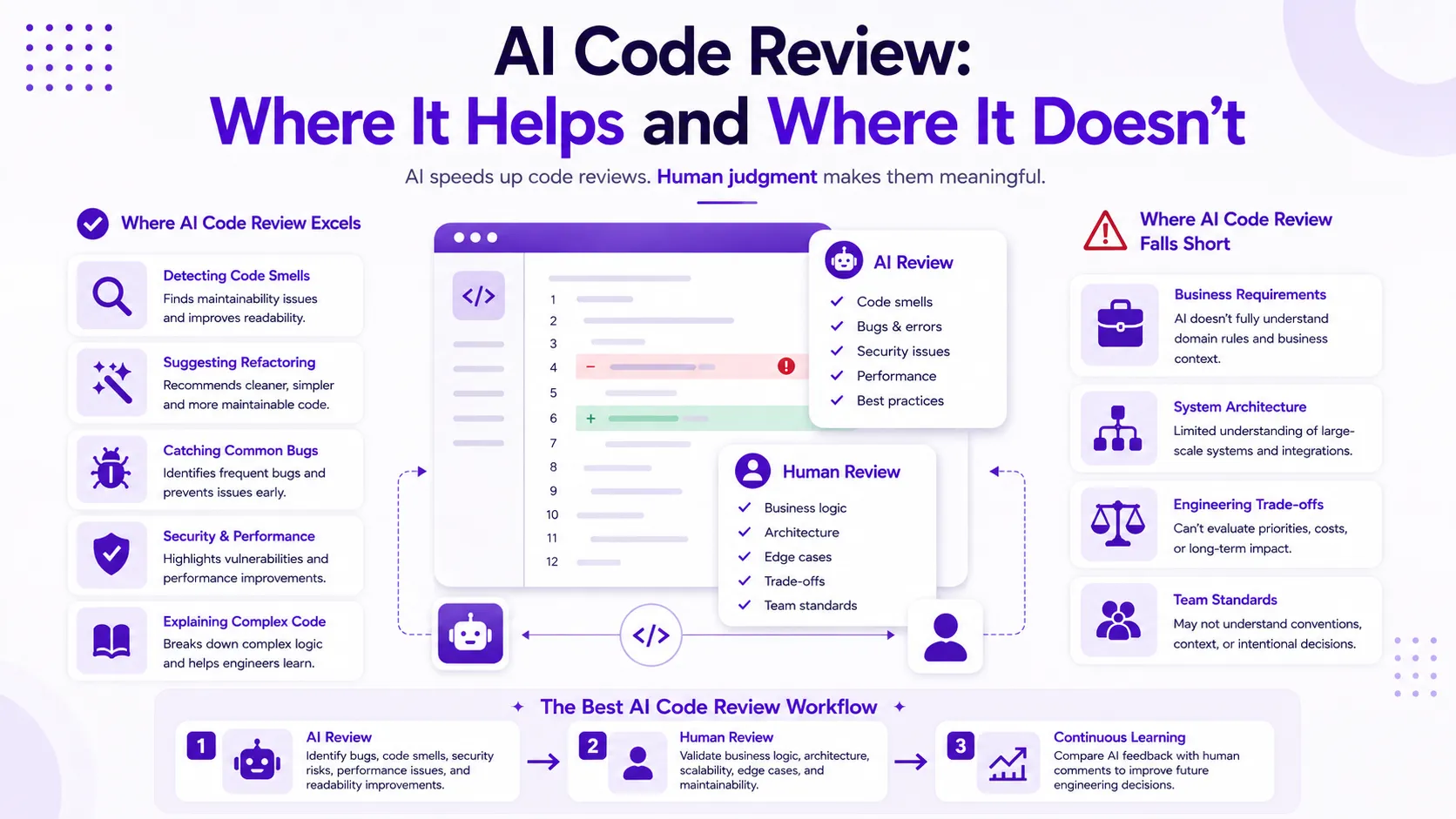
Where AI Code Review Excels
AI performs exceptionally well at identifying issues based on established programming patterns and best practices.
Detecting Code Smells
AI quickly identifies maintainability problems such as:
- Duplicate code
- Long methods
- Poor variable naming
- Dead or unused code
- Deeply nested conditions
- Large classes with multiple responsibilities
These suggestions help improve readability and long-term maintainability.
Suggesting Refactoring
AI can recommend cleaner implementations by:
- Extracting reusable functions
- Reducing duplicated logic
- Simplifying conditional statements
- Improving object responsibilities
- Applying common design patterns
These improvements often make code easier to understand without changing its behavior.
Catching Common Bugs
AI frequently detects issues before they reach production, including:
- Null reference exceptions
- Off-by-one errors
- Missing error handling
- Unhandled exceptions
- Incorrect loop conditions
- Forgotten return statements
Security and Performance Reviews
Modern AI models recognize many common security vulnerabilities and performance issues.
Typical recommendations include:
- Prevent SQL injection
- Remove hard-coded secrets
- Add input validation
- Improve authentication checks
- Reduce unnecessary database queries
- Select more efficient data structures
Explaining Complex Code
AI is also an excellent learning companion. It can explain legacy code, concurrency concepts, design patterns, algorithms, frameworks, and unfamiliar libraries in a clear and accessible way.
Where AI Code Review Falls Short
Despite its strengths, AI struggles whenever deep context and engineering experience are required.
Business Requirements
AI reviews code without fully understanding the business rules behind it. A seemingly cleaner implementation may accidentally break compliance requirements, customer workflows, or years of accumulated domain knowledge.
System Architecture
AI performs well at reviewing individual files but has limited understanding of:
- Distributed systems
- Cross-service communication
- Legacy integrations
- Infrastructure constraints
- Large-scale software architecture
Engineering Trade-Offs
Real-world software engineering involves balancing scalability, maintainability, performance, delivery speed, infrastructure cost, and technical debt.
AI can recommend improvements but cannot fully understand organizational priorities or long-term engineering strategy.
Team Standards and Engineering Judgment
Every engineering team has unique coding conventions, architectural principles, documentation requirements, and review expectations.
Experienced reviewers can recognize when unusual code is intentional, while AI may incorrectly flag it as a problem.
The Best AI Code Review Workflow
| Step | Responsibility |
|---|---|
| 1. AI Review | Identify bugs, code smells, security risks, performance issues, and readability improvements. |
| 2. Human Review | Validate business logic, architecture, scalability, edge cases, and maintainability. |
| 3. Continuous Learning | Compare AI feedback with human comments to improve future engineering decisions. |
Using AI before human review allows engineers to spend more time discussing architecture and product decisions instead of formatting or minor syntax issues.
Common Mistakes to Avoid
- Accepting every AI suggestion without verification.
- Assuming AI understands business requirements.
- Ignoring architectural implications.
- Treating AI feedback as absolute truth.
- Skipping human code reviews because AI already reviewed the code.
Conclusion
AI has transformed code review by making it faster, more consistent, and more accessible. It excels at detecting common bugs, identifying code smells, suggesting refactoring opportunities, and reinforcing software engineering best practices.
However, software engineering extends far beyond writing syntactically correct code. Business context, architecture, technical trade-offs, collaboration, and engineering judgment remain human responsibilities.
The future of code review isn't AI replacing developers—it's AI handling repetitive feedback while experienced engineers focus on the strategic decisions that ultimately determine software quality.