For years, cybersecurity was largely a race between attackers finding vulnerabilities and defenders trying to close them.
AI is changing that race.
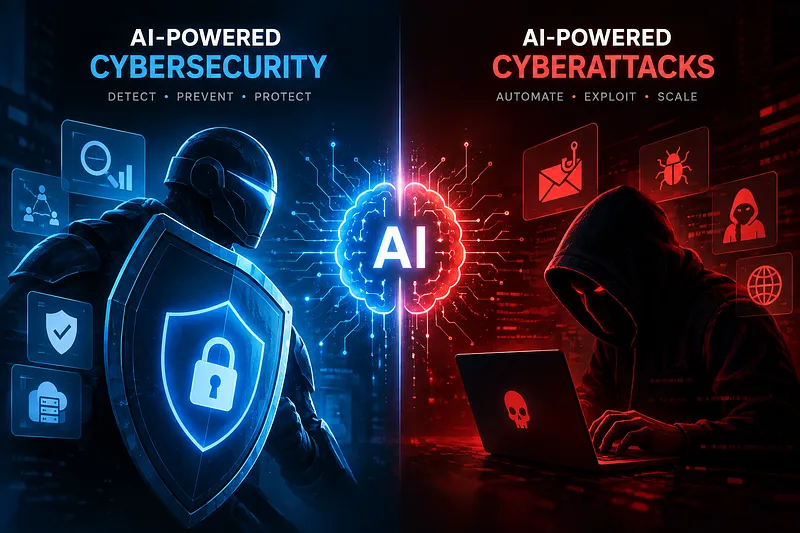
The same technology that can help a security team analyze thousands of alerts can also help an attacker automate reconnaissance, generate convincing phishing content, or adapt malicious activity at a much larger scale. NIST now explicitly recognizes both sides of this equation: AI can strengthen defensive capabilities while also creating new risks and attack surfaces. (NIST)
That creates an uncomfortable reality:
AI is not inherently defensive or offensive. It depends on who controls it, what access it has, and what it is allowed to do.
So the question isn’t whether AI will transform cybersecurity.
It already is.
The bigger question is:
Who will use AI more effectively — the defenders or the attackers?
1. AI-Powered Cybersecurity: Defenders Get a New Advantage
Modern security teams deal with an enormous amount of information.
Every day, organizations generate:
Authentication events
Network activity
Endpoint alerts
Application logs
Cloud events
Vulnerability reports
Email security alerts
User behavior signals
Humans cannot manually investigate everything.
AI can help security teams process this information much faster.
For example, an AI-powered security system can identify unusual behavior, correlate events across multiple systems, prioritize suspicious activity, and help analysts investigate incidents.
Instead of giving a security analyst thousands of unrelated alerts, AI can help answer:
Which events actually require attention right now?
This is one of the biggest opportunities for AI in cybersecurity.
2. Where AI Can Strengthen Cybersecurity
AI can support multiple stages of the security lifecycle.
Threat Detection
Machine learning can identify patterns that don’t look normal compared with historical behavior.
For example, an account suddenly behaving very differently from its usual pattern could trigger additional investigation.
Anomaly Detection
AI can analyze large volumes of activity and identify unusual combinations that traditional rule-based systems might miss.
Vulnerability Management
Security teams can use AI to help prioritize vulnerabilities based on factors such as exposure, affected assets, and potential business impact.
Incident Response
AI can help summarize incidents, correlate evidence, and recommend response actions so analysts can move faster.
Security Operations
AI assistants can help security teams investigate alerts, search logs, explain suspicious activity, and generate structured incident summaries.
NIST’s current work around AI and the Cybersecurity Framework reflects this direction, including practical ways AI can support cybersecurity analysis, planning, implementation, and monitoring. (NIST)
3. But Attackers Have Access to the Same Technology
This is where the story becomes more complicated.
The capabilities that help defenders can also reduce the effort required for attackers.
AI can make certain malicious activities:
Faster
More scalable
More personalized
More automated
Easier to coordinate
Research and industry reporting increasingly show AI being incorporated into real-world cyber operations. Anthropic’s analysis of hundreds of accounts associated with malicious activity found AI-enabled operations mapped across multiple stages of the attack lifecycle. (Anthropic)
The important point isn’t that AI suddenly makes every attacker highly sophisticated.
It’s that AI can lower the cost of certain activities and allow existing attackers to operate at greater scale.
4. AI-Powered Phishing Is Becoming More Convincing
Phishing has existed for decades.
What changes with AI is the ability to produce highly personalized content quickly.
Instead of sending the same generic message to thousands of people, attackers can use AI to generate messages that appear more relevant to specific targets.
AI can also help attackers adapt language, impersonate communication styles, and produce convincing fraudulent content.
NIST has specifically identified the ability of generative AI to create persuasive fraudulent and impersonation content as a cybersecurity risk. (NIST Publications)
This means traditional warning signs such as:
The email has obvious spelling mistakes.
may become less reliable.
Organizations increasingly need stronger identity verification, authentication, email security, and user-awareness controls rather than relying solely on spotting bad grammar.
5. Automation Is the Bigger Story
The most important change isn’t simply that AI can write malicious content.
It’s automation.
Traditional attacks often required humans to manually perform many steps.
AI agents can increasingly help coordinate multiple tasks, analyze results, and adapt based on what they encounter.
Recent reporting has highlighted experiments and incidents involving AI systems interacting with real software ecosystems and performing actions with limited human intervention. (Reuters)
This creates a new security challenge.
Organizations aren’t only protecting:
People → Applications → Networks
They increasingly need to protect:
People → AI Agents → Tools → Data → Applications → Infrastructure
That changes the attack surface.
6. The AI System Itself Can Become the Target
There is another layer that organizations sometimes overlook.
AI isn’t just a cybersecurity tool.
AI systems themselves need to be secured.
An AI application may have access to:
Internal documents
Customer information
Databases
APIs
Source code
Cloud resources
Business workflows
If that system is compromised or manipulated, the consequences can go far beyond a traditional software vulnerability.
AI systems can face risks such as:
Prompt injection
Data poisoning
Sensitive information exposure
Model manipulation
Insecure agent permissions
Excessive tool access
NIST’s recent work on AI-agent security notes that traditional cybersecurity principles still matter, but they need to be adapted to address the new risks introduced by AI agents. (NIST)
7. The Defender’s Biggest Advantage: Context
Attackers may have powerful AI.
But defenders have something extremely valuable:
Knowledge of their own environment.
A company knows:
Which systems it operates
Which users are legitimate
Which applications are business-critical
Where sensitive data lives
Which network activity is normal
Which assets should never communicate with each other
AI can help security teams turn that context into faster decisions.
Imagine a security system that doesn’t simply say:
Suspicious login detected.
Instead, it can correlate:
Unusual login → New device → Unusual location → Sensitive application access → Abnormal data activity
That context can dramatically improve detection and response.
8. The Biggest Problem: Speed
Cybersecurity has always been a race against time.
The longer an attacker remains undetected, the more opportunity they have to cause damage.
AI can compress the timeline on both sides.
Attackers can potentially:
Discover → Adapt → Automate
Defenders can potentially:
Detect → Investigate → Respond
This creates an important shift.
Security teams can’t rely only on periodic security reviews anymore.
Continuous monitoring and continuous improvement become increasingly important.
AI can help make that practical at a scale humans alone cannot manage.
9. AI Doesn’t Replace Security Teams
There is a temptation to think:
We’ll just deploy an AI security system and let it handle everything.
That’s risky.
Security decisions often require business context and judgment.
AI can produce false positives.
It can misunderstand context.
It can recommend inappropriate actions.
And an AI system with excessive permissions can itself become a security problem.
The better approach is AI-assisted security, where AI handles large-scale analysis and repetitive work while humans remain responsible for important decisions and oversight.
Think of AI as a force multiplier — not an automatic replacement for security expertise.
10. What Organizations Should Do Now
The answer isn’t to avoid AI.
It’s to adopt AI with security controls around it.
Organizations should focus on several areas.
Protect AI Access
AI systems should have only the permissions they actually need.
Secure Data
Sensitive business information shouldn’t automatically be available to every AI system or agent.
Monitor AI Activity
Organizations should know which AI systems are being used, what data they access, and what actions they perform.
Strengthen Identity
Strong authentication and authorization become even more important when AI agents can interact with business systems.
Test AI Systems
Organizations should actively test their AI applications for security weaknesses such as prompt injection, data leakage, and unsafe tool usage.
Keep Humans in the Loop
High-impact actions should have appropriate approval and monitoring mechanisms.
11. The Future Is AI vs AI — but Not Only AI vs AI
It is tempting to describe the future of cybersecurity as:
AI vs AI
But that is too simplistic.
The real picture is closer to:
AI + Humans + Security Architecture
versus
AI + Humans + Attack Infrastructure
Technology alone won’t determine the winner.
Organizations also need:
Strong identity controls
Secure architecture
Good access management
Continuous monitoring
Security awareness
Incident response
Governance
Skilled security teams
AI can amplify a weak security strategy just as easily as it can amplify a strong one.
The Hidden Reality: The Attack Surface Is Expanding
The biggest change brought by AI may not be better phishing or faster threat detection.
It may be the fact that AI is becoming part of the infrastructure itself.
Organizations are adding AI to customer support, development, analytics, operations, security, and internal workflows.
Every new AI integration creates another component that must be secured.
That means security teams now have two responsibilities:
Use AI to protect the organization.
And:
Protect the AI systems being introduced into the organization.
Those two responsibilities will increasingly overlap.
Final Thoughts: The Advantage Goes to the Better-Prepared Team
AI is making cybersecurity faster on both sides.
Attackers can use it to automate and scale malicious activity.
Defenders can use it to analyze more data, identify threats faster, and respond more efficiently.
Neither side automatically wins.
The organizations that succeed will be the ones that combine AI with strong security fundamentals, good identity controls, careful permissions, continuous monitoring, and human oversight.
The goal isn’t to build a system where AI fights AI without humans.
It’s to build a security operation where AI makes defenders faster, more informed, and harder to overwhelm.
Because in the AI era, the biggest cybersecurity advantage may not be having the most advanced AI.
It may be knowing how to use AI safely before your adversaries figure out how to use it against you.