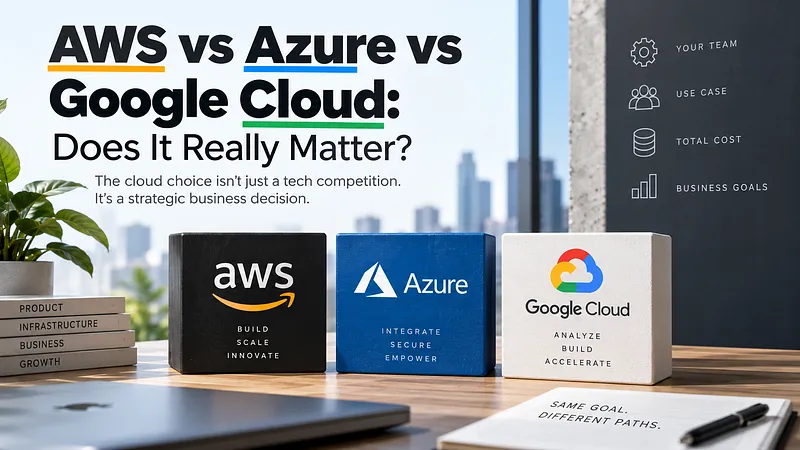
The cloud choice isn’t just a tech competition. It’s a strategic business decision that can make or break your product velocity.
The Illusion of Choice
Ask a group of developers which cloud they would choose for a new project, and you will get three distinct answers. Someone always insists on AWS because “everything is there.”
Someone else will argue for Azure, pointing out that the enterprise already runs on Microsoft. Meanwhile, another engineer claims Google Cloud is the obvious choice for AI, data, or Kubernetes.
Then the debate turns into a familiar feature showdown. Pricing, regions, certifications, performance benchmarks, and AI tools dominate the chat.
We have had these discussions countless times. But the deeper you get into cloud architecture, the more you realize the debate is missing the mark.
It isn’t really AWS vs Azure vs Google Cloud. That comparison misses the actual goal of building software.
Which cloud makes the most sense for the company, the team building the product, and the problems they need to solve?
That distinction becomes much more important once you move beyond tutorials and start dealing with real applications.
The Three Clouds Are More Similar Than You Think
At a foundational level, AWS, Azure, and Google Cloud can all handle what most applications require. You can run APIs, store files, host databases, and deploy containers without friction.
You can easily build data pipelines and train AI models on all three platforms. All of them scale to handle millions of requests.
Context Over Technicality
When someone asks which cloud is the best, there is no universal answer. For a lean team building a simple SaaS product, all three will get the job done.
However, for an enterprise tied to Microsoft software or a startup relying on massive data processing, the answer changes rapidly.
The technology matters, but your operational context matters far more.
Market Share vs Architectural Fit
AWS still holds the largest piece of global infrastructure market share, sitting at 28% in Q2 2026. Microsoft follows at 20%, with Google Cloud at 15% in a $143 billion quarterly market.
AWS leads because of its massive ecosystem, expansive service catalog, and early adoption advantage. That ecosystem holds tremendous practical value for developers.
Yet market share shouldn’t be a shortcut for architecture choices. Choosing AWS simply because “everyone uses it” is just as flawed as picking Google Cloud purely because “Google knows AI.”
A Practical Perspective: Startup vs Enterprise
The Startup Reality
Imagine a startup with twelve engineers building a modern web product. They don’t have a dedicated infrastructure team, and their main priority is shipping fast.
For them, cloud nuance matters very little. What actually counts is existing team expertise, low operational burden, and predictable monthly billing.
A cloud provider that saves a team 20 hours of operational hassle every month is far more valuable than one with superior theoretical benchmarks.
The Enterprise Paradigm
Now change the scenario to a 2,000-person enterprise running on Microsoft 365, Active Directory, and Power BI. Here, Azure becomes a completely different conversation.
It’s not that Azure is technically superior — it’s that the surrounding ecosystem shifts the economic equation entirely.
“You are not really choosing a cloud. You are choosing an ecosystem.”
Where Google Cloud Fits In
Google Cloud shines in data engineering, analytics, Kubernetes, and AI workloads. When a product aligns with those core strengths, GCP becomes compelling fast.
The core question isn’t which cloud has the longest feature list, but which provider’s strengths match your primary workload.
The Hidden Costs: Lock-In and Migration
It is easy to claim you’ll switch clouds later, but cloud migration is notoriously painful. The level of lock-in depends heavily on how you architect your system.
Using open tools like containers, PostgreSQL, and Terraform keeps options flexible. Conversely, relying deeply on proprietary databases and queue systems creates sticky lock-in.
Managed services offer speed at the cost of portability. The key is making that tradeoff deliberately rather than by accident.
Rethinking the Cloud Bill
Cloud pricing goes far beyond virtual machine rates. The cheapest instance doesn’t translate to the cheapest overall system architecture.
A slightly costlier database service that eliminates maintenance overhead often saves money when factoring in engineering salaries.
Stop asking “Which provider is cheapest?” Start asking “What is the total cost of running this system, including human overhead?”
Pick for the Team, Not the Features
A theoretically perfect cloud architecture fails if your team cannot debug it at 2 AM. Familiarity beats feature density every time.
For startups especially, every hour spent wrestling with unfamiliar infrastructure is an hour stolen from product development and customer feedback.
The Final Verdict
All three major clouds are capable of supporting multi-million dollar businesses. Your success won’t hinge on raw provider capabilities, but on alignment with your team and business model.
“The best cloud isn’t the one with the biggest market share or feature list. It’s the one that makes sense for your business.”
What Do You Think?
Which cloud provider is your team currently using, and what was the single biggest factor in that decision? Let me know in the comments below!