Introduction
When generative AI first became mainstream, “prompt engineering†quickly became one of the most talked-about skills in technology. Developers experimented with different prompt styles to get better responses from AI models.
While prompts are still important, they’re no longer enough for building reliable AI applications.
Today’s AI systems need more than a single instruction. They need access to relevant information, project documentation, previous conversations, tools, and business rules.
This shift has given rise to a new concept: context engineering.
Prompt Engineering vs. Context Engineering
Prompt engineering focuses on how you ask AI to perform a task.
For example:
Write a Flutter login screen with email validation.
This works well for simple requests.
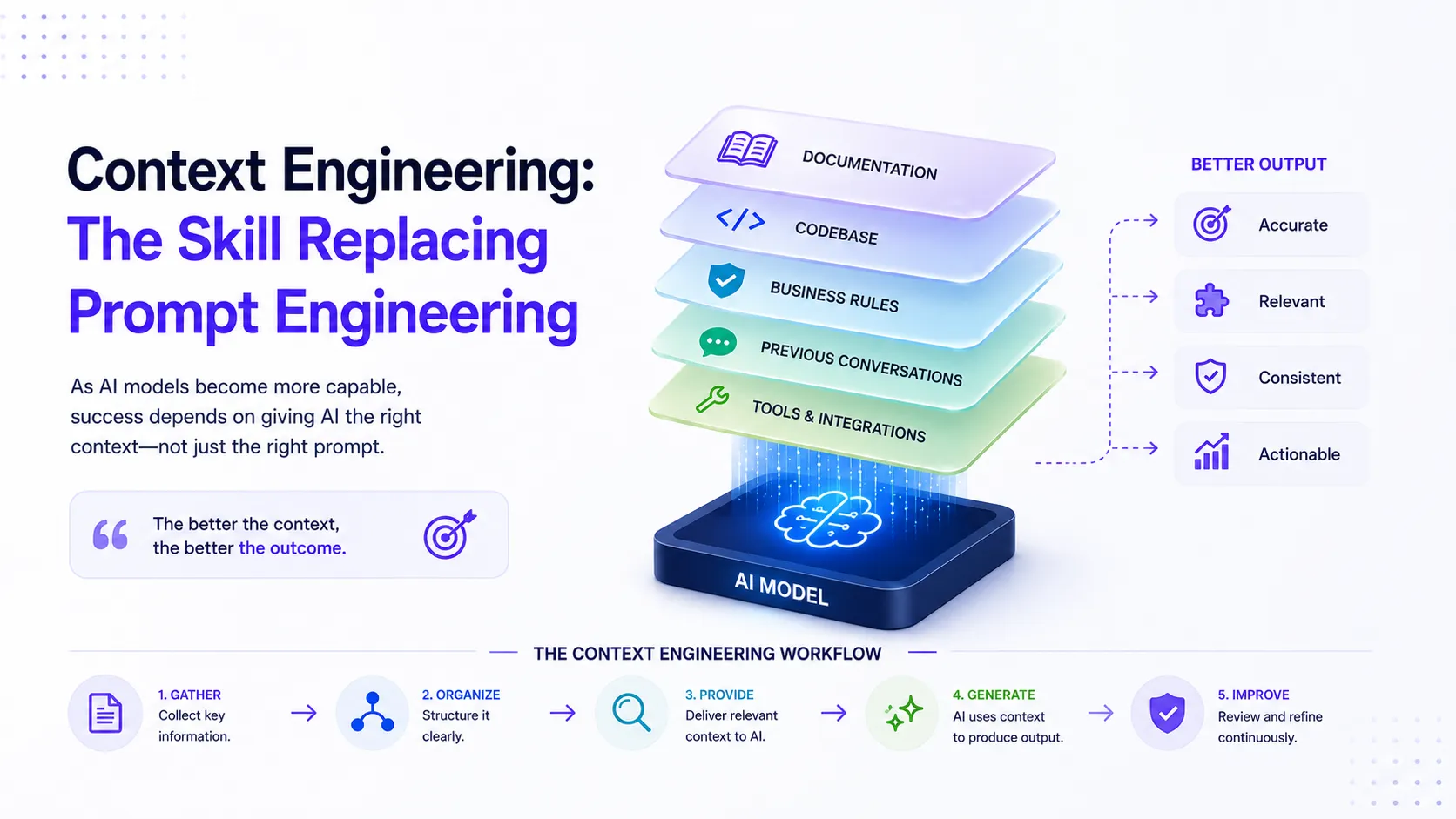
Context engineering, on the other hand, focuses on everything the AI needs to know before generating an answer.
Instead of relying on one prompt, the AI receives additional information such as:
- Project documentation
- Existing codebase
- Coding standards
- Business requirements
- Previous conversations
- Available tools
The result is more accurate, relevant, and consistent output.
Why Context Matters
Imagine asking an AI assistant to add a new feature to your application.
Without context, it might generate code that works but doesn’t follow your project’s architecture or coding conventions.
With the right context, it can understand how your application is structured and produce code that fits naturally into the existing system.
The better the context, the better the outcome.
Long-Term Memory Makes AI More Useful
One limitation of early AI assistants was that they treated every conversation as a fresh start.
Modern AI applications increasingly use long-term memory to remember important information across interactions.
For example, an AI assistant can remember:
- Your preferred coding style
- Frequently used frameworks
- Project structure
- Team conventions
- Previously discussed requirements
This reduces repetitive instructions and creates a more personalized development experience.
Documentation Is Part of the Context
Good documentation isn’t just for developers anymore — it’s also valuable for AI.
When documentation is clear and up to date, AI can better understand:
- System architecture
- API behavior
- Business rules
- Deployment processes
- Feature requirements
Well-maintained documentation improves both human collaboration and AI-generated results.
Retrieval Gives AI the Right Information
AI models don’t automatically know the details of your private projects.
This is where retrieval becomes important.
Instead of relying only on what the model already knows, modern AI systems can retrieve relevant documents, database records, or internal knowledge before generating a response.
This helps AI produce answers based on current, project-specific information rather than generic assumptions.
Tool Access Expands AI’s Capabilities
Modern AI assistants can do much more than generate text.
With access to tools, they can:
- Read files
- Search documentation
- Query databases
- Call APIs
- Create tickets
- Execute workflows
Instead of simply answering questions, AI becomes an active participant in the development process.
The Role of Model Context Protocol (MCP)
One of the biggest developments in AI is the Model Context Protocol (MCP).
MCP provides a standardized way for AI models to connect with external tools and data sources.
Rather than building custom integrations for every application, developers can use MCP to give AI structured access to documentation, databases, repositories, and other services.
As more AI platforms adopt MCP, integrating AI into development workflows becomes simpler and more consistent.
The Future Belongs to Context, Not Clever Prompts
Prompt engineering isn’t disappearing, but it’s becoming just one part of a much larger workflow.
The most effective AI applications are built by providing rich context, accurate documentation, relevant knowledge, and the right tools.
The focus is shifting from writing the perfect prompt to designing systems that continuously supply AI with everything it needs to make informed decisions.
Conclusion
Prompt engineering introduced developers to working effectively with AI, but context engineering is taking that collaboration to the next level.
By combining long-term memory, documentation, retrieval, tool access, and standards like Model Context Protocol (MCP), AI systems become more accurate, reliable, and useful in real-world software development.
As AI continues to evolve, the engineers who understand how to build and manage context will create better AI-powered applications than those who rely on prompts alone.
The future of AI isn’t just about asking better questions — it’s about giving AI the right context to produce better answers.