There was a time when shipping software meant throwing code over the wall to an operations team and hoping it survived production.
Then DevOps changed the conversation.
Developers and operations teams started working together, infrastructure became automated, deployments became repeatable, and practices like CI/CD, infrastructure as code, monitoring, and observability became standard parts of modern software delivery.
But as engineering organizations grew, a new problem appeared.
DevOps practices were working — but developers were still spending too much time dealing with infrastructure.
Creating deployment pipelines, configuring Kubernetes, managing cloud resources, setting up observability, handling security policies, and troubleshooting environments could consume hours that developers would rather spend building the product.
This is where Platform Engineering enters the picture.
So, are DevOps and Platform Engineering competing approaches?
Not really.
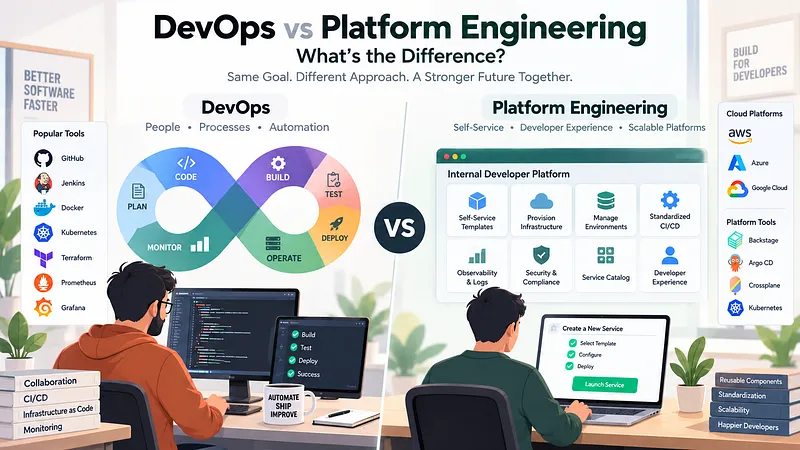
DevOps is largely about how teams collaborate and deliver software. Platform Engineering is about building an internal platform that makes that delivery easier, safer, and more repeatable.
Understanding that distinction is becoming increasingly important for modern engineering teams.
1. What Exactly Is DevOps?
DevOps is not a specific tool, programming language, or job title.
It is a combination of culture, practices, automation, and collaboration designed to reduce the gap between software development and operations.
Traditionally, developers focused on writing code while operations teams were responsible for deploying and maintaining it.
That separation created friction.
A developer might say:
“The code works on my machine.”
The operations team would then have to figure out how to run it reliably in production.
DevOps tries to eliminate that disconnect.
Instead of treating development and operations as completely separate responsibilities, teams collaborate throughout the software lifecycle.
A typical DevOps workflow might look like:
Plan → Code → Build → Test → Deploy → Operate → Monitor
Automation plays a major role.
Teams may use:
GitHub Actions, GitLab CI, or Jenkins for CI/CD
Docker for containerization
Kubernetes for container orchestration
Terraform for infrastructure as code
Prometheus and Grafana for monitoring
Cloud platforms such as AWS, Azure, or Google Cloud
Automated security and testing tools
The goal is straightforward:
Make software delivery faster, safer, and more reliable.
But there is a catch.
As systems become more complex, developers can end up responsible for understanding a huge amount of infrastructure themselves.
And that creates the problem Platform Engineering attempts to solve.
2. What Is Platform Engineering?
Platform Engineering takes many of the lessons learned from DevOps and turns them into an internal product for developers.
Instead of asking every development team to independently figure out how to deploy an application, configure infrastructure, implement observability, and satisfy security requirements, a platform team builds reusable capabilities that developers can consume through self-service workflows.
Think of it like this:
DevOps establishes the practices.
Platform Engineering builds the systems that make those practices easy to follow.
For example, imagine a company with 50 development teams.
Without a platform, every team might need to understand:
Kubernetes
Docker
Terraform
Cloud networking
Secrets management
CI/CD configuration
Logging
Monitoring
Security policies
That is a lot of infrastructure knowledge for application developers to maintain.
A platform team can instead create a standardized internal developer platform.
A developer might simply select:
Create New Service → Choose Runtime → Deploy
Behind the scenes, the platform could automatically create:
Infrastructure
CI/CD pipelines
Container configuration
Logging
Monitoring
Security policies
Domain configuration
Environment variables
Deployment environments
The complexity still exists.
It is simply moved behind a better developer experience.
3. The Biggest Difference: Where the Complexity Lives
This is probably the easiest way to understand the difference.
With a traditional DevOps approach, developers may interact directly with many infrastructure tools.
With Platform Engineering, the platform team tries to hide unnecessary infrastructure complexity behind reusable abstractions.
Consider a simple example.
A developer needs to deploy a backend service.
DevOps-heavy workflow
The developer may need to:
Create a Dockerfile
Configure a CI pipeline
Create infrastructure definitions
Configure Kubernetes manifests
Set up secrets
Configure monitoring
Configure alerts
Set resource limits
Configure networking
Deploy the service
Platform Engineering workflow
The developer might simply:
Create service → Configure application → Deploy
The platform handles the infrastructure details.
This doesn’t mean Platform Engineering eliminates DevOps.
It productizes DevOps capabilities.
4. Why Platform Engineering Became Necessary
Small teams can often manage infrastructure manually or with a relatively simple DevOps setup.
But organizations become more complicated as they grow.
Imagine a company going from:
5 developers → 50 developers → 500 developers
At five developers, everyone might understand the infrastructure.
At 500 developers, asking every team to independently understand Kubernetes, cloud networking, deployment strategies, observability, and security becomes extremely inefficient.
You start seeing problems such as:
Different deployment processes
Inconsistent infrastructure
Repeated configuration
Security mistakes
Duplicate tooling
Poor developer experience
Increased onboarding time
Infrastructure knowledge scattered across teams
This is where an internal platform becomes valuable.
Instead of solving the same infrastructure problem 50 times, the platform team solves it once and provides it as a reusable capability.
Platform Engineering is essentially an attempt to create leverage for engineering organizations.
5. DevOps vs Platform Engineering: A Practical Comparison
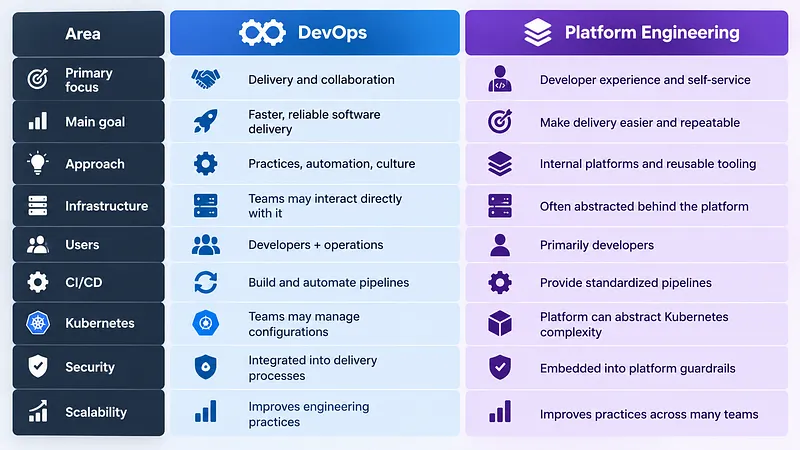
The distinction isn’t absolute.
A company can have both.
In fact, many mature organizations should.
6. Platform Engineering Is Not “DevOps 2.0”
It’s tempting to describe Platform Engineering as the next version of DevOps.
That isn’t quite accurate.
DevOps and Platform Engineering operate at different levels.
DevOps focuses heavily on how software is built, delivered, and operated.
Platform Engineering focuses on building a product that enables developers to do those things efficiently.
The platform itself becomes a product.
That means platform teams need to think about:
Developer usability
Documentation
Self-service
Reliability
Adoption
Feedback
Product roadmaps
Backward compatibility
Internal customers
This is an important mindset shift.
A platform that technically works but developers hate using is not a successful platform.
The platform has to be easier than doing the infrastructure work manually.
7. Internal Developer Platforms: The Real Product
A modern platform might provide a centralized interface where developers can access common engineering capabilities.
For example:
Application Catalog
→ Create service
→ Deploy service
→ View logs
→ Check health
→ Manage environments
→ View deployments
Behind that interface, the platform might integrate with Kubernetes, cloud providers, Terraform, CI/CD systems, observability tools, identity systems, and security tooling.
Tools such as Backstage, Argo CD, Crossplane, Terraform, Kubernetes, and cloud-native services can become components of such platforms.
But tools alone don’t create a platform.
The architecture, workflows, documentation, and developer experience are what make the platform valuable.
8. The Hidden Risk: Building a Platform Nobody Uses
Platform Engineering sounds attractive, but it introduces its own risk.
A company can easily spend months building an enormous internal platform that developers don’t actually want.
This usually happens when the platform team optimizes for infrastructure complexity instead of developer problems.
For example:
“We’ve built an advanced Kubernetes abstraction layer.”
Sounds impressive.
But developers might simply need:
“Give me a reliable way to deploy my API without understanding Kubernetes.”
Those are very different goals.
The best platforms don’t expose every infrastructure capability.
They expose the right capabilities through simple interfaces.
Start with painful, repetitive workflows.
Automate those first.
Then expand based on actual developer feedback.
9. When Should a Startup Use DevOps?
For a small startup, you probably don’t need a huge internal developer platform on day one.
If you have:
A small engineering team
One or two applications
Simple deployment requirements
Limited infrastructure complexity
A relatively small number of environments
A straightforward DevOps setup may be enough.
For example:
Git → CI/CD → Cloud → Monitoring
You can automate deployments, infrastructure, testing, and monitoring without creating a dedicated platform team.
At this stage, building a sophisticated internal platform could actually slow you down.
Don’t build an abstraction layer before you have a problem worth abstracting.
10. When Does Platform Engineering Start Making Sense?
Platform Engineering becomes increasingly valuable when engineering complexity grows.
Consider it when you have:
Many development teams
Multiple services
Complex cloud infrastructure
Kubernetes at significant scale
Repeated deployment workflows
Strict security requirements
Compliance requirements
Long developer onboarding times
Significant infrastructure duplication
At this point, asking every developer to become an infrastructure expert doesn’t scale.
A platform team can create standardized paths that allow developers to remain focused on their primary responsibility:
building the product.
11. The Goal Isn’t to Remove Developers From Operations
Another common misunderstanding is that Platform Engineering means developers no longer need to care about infrastructure.
That’s not the goal.
Modern engineering teams still need ownership.
Developers should understand:
How their applications behave in production
What their service depends on
How to investigate failures
What performance characteristics matter
What security responsibilities they have
The platform simply provides guardrails and automation.
Think of it as:
You own the application.
The platform helps you operate it correctly.
This creates a healthier balance between developer autonomy and organizational standards.
12. So, Which One Should You Choose?
The answer isn’t DevOps vs Platform Engineering.
For most organizations, the evolution looks more like:
DevOps practices → Automation → Standardization → Internal Platform
A small team might stop at the first two stages.
A growing organization may eventually need all four.
Choose a DevOps-focused approach if:
Your engineering team is small
Infrastructure is relatively simple
Teams can manage deployments themselves
You need to move quickly
There isn’t enough repeated infrastructure work to justify a platform
Consider Platform Engineering if:
Multiple teams repeatedly solve the same infrastructure problems
Developers are spending too much time on infrastructure
Deployments are inconsistent
Security and compliance need standardized guardrails
Kubernetes/cloud infrastructure has become difficult to manage
Developer onboarding is becoming painful
Use both if:
You have a mature engineering organization
You need strong DevOps practices
You also need scalable developer self-service
This is where many larger engineering organizations eventually land.
The Bigger Picture: Engineering Is Becoming a Product
The most interesting thing about Platform Engineering isn’t Kubernetes, Terraform, or CI/CD.
It’s the mindset behind it.
Infrastructure is becoming something engineering teams design as a product.
Developers are internal customers.
The platform is the product.
Infrastructure is the underlying implementation.
And developer productivity becomes one of the key metrics.
That changes how engineering organizations think about internal tooling.
Instead of asking:
“What infrastructure tools should we give developers?”
The better question becomes:
“What should developers be able to accomplish without needing to understand all the infrastructure underneath?”
That’s the real promise of Platform Engineering.
Final Thoughts: Don’t Replace DevOps — Build on It
DevOps and Platform Engineering aren’t competing technologies.
They solve different layers of the same organizational problem.
DevOps helps teams build, deliver, and operate software effectively.
Platform Engineering helps organizations make those practices scalable through self-service platforms, automation, and standardized workflows.
For a five-person startup, a simple DevOps setup might be all you need.
For a company with hundreds of developers and dozens of services, a well-designed internal platform can dramatically reduce duplicated effort and infrastructure complexity.
The important lesson is not to adopt Platform Engineering because it is the latest industry trend.
Adopt it when the complexity of your engineering organization becomes a problem that a platform can genuinely solve.
The best platform is not the one with the most features.
It’s the one that makes developers forget how complicated the infrastructure underneath actually is.