Introduction
Artificial Intelligence has evolved far beyond answering questions and generating code. Modern AI systems can search databases, interact with APIs, read files, execute commands, access cloud services, and even coordinate multiple tools to complete complex tasks.
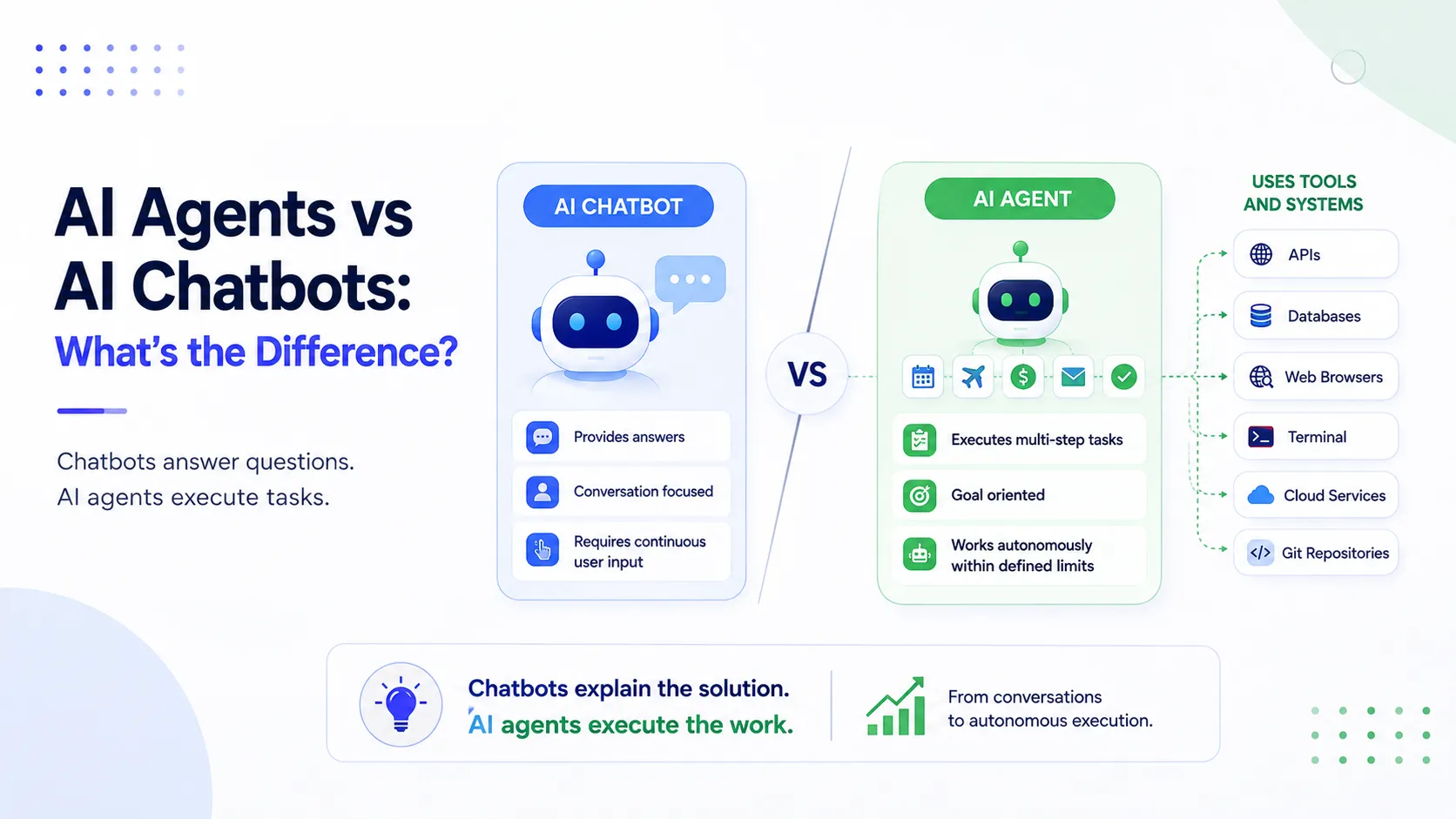
This shift has given rise to AI agents—systems that don't just generate responses but can actively perform work on behalf of users.
However, enabling an AI model to interact with external tools introduces a challenge. Every application, service, and API exposes its capabilities differently. Without a common standard, every AI platform would need custom integrations for every tool it wanted to support.
This is where the Model Context Protocol (MCP) comes in.
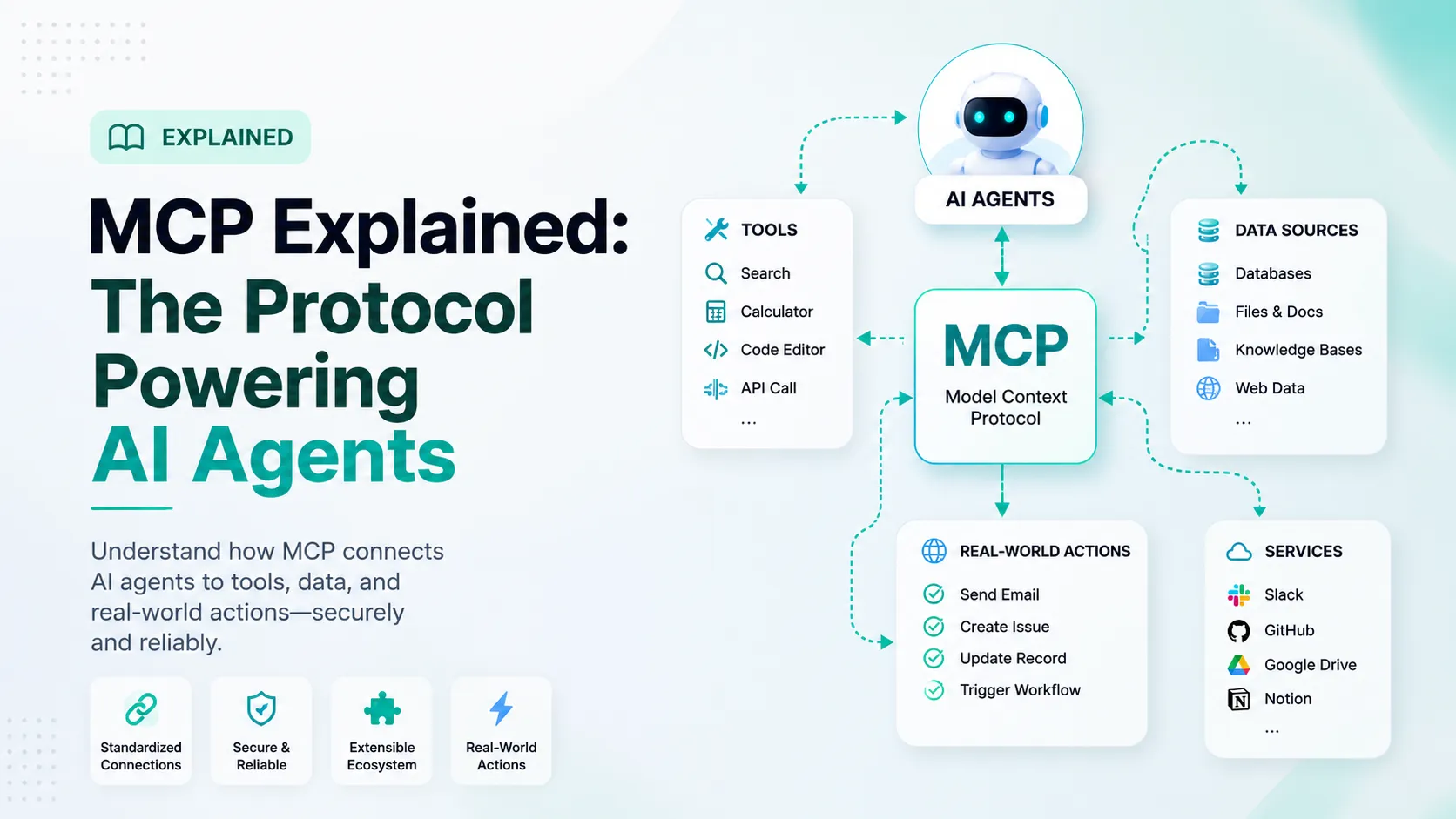
MCP provides a standard way for AI models to discover, understand, and use external tools, data sources, and services. Instead of building separate integrations for each AI model and every application, developers can expose capabilities through a common protocol that different AI clients can understand.
In this article, we'll explore what MCP is, why it matters, how it works, and how it's changing the way developers build AI-powered applications.
The Problem Before MCP
Imagine you're building an AI assistant that needs to interact with GitHub, Slack, Google Drive, PostgreSQL, Jira, Notion, local files, and internal company APIs.
Without a shared protocol, every integration becomes a custom implementation.
For each tool, you need to define authentication, API endpoints, request formats, response parsing, error handling, and documentation.
Now imagine supporting multiple AI models. Every model may require different integration logic, increasing development effort and maintenance costs.
This creates unnecessary complexity.
What Is MCP?
At its core, the Model Context Protocol (MCP) is a communication standard between AI models and external systems.
Instead of hardcoding every integration, MCP defines a consistent way for an AI client to discover available tools, understand what those tools do, receive structured input schemas, execute tools, and receive structured results.
Think of it as a common language that allows AI models and software systems to communicate reliably.
Understanding MCP with a Real-World Analogy
Imagine travelling internationally.
Different countries speak different languages.
Instead of learning every language, people often rely on a common language like English to communicate.
MCP plays a similar role.
Instead of every AI model learning every application's unique API, both sides agree to communicate using the same protocol.
This dramatically simplifies integration.
Why AI Agents Need MCP
Traditional chatbots only generate text.
Modern AI agents need to perform actions such as reading project files, running SQL queries, searching documentation, calling REST APIs, creating GitHub issues, sending Slack messages, updating Jira tickets, and deploying applications.
Without a protocol like MCP, every one of these actions requires custom engineering.
With MCP, tools become discoverable and reusable across multiple AI clients.
Core Components of MCP
1. MCP Client
The client is the AI application.
Examples include AI coding assistants, desktop AI applications, IDE extensions, and enterprise AI platforms.
The client communicates with one or more MCP servers to discover and invoke tools.
2. MCP Server
The server exposes capabilities to AI models.
It may provide access to databases, APIs, file systems, cloud services, and internal business systems.
The server describes each available capability in a structured format that the AI client can understand.
3. Tools and Resources
The server publishes functionality such as searching documentation, reading files, creating tasks, executing SQL queries, fetching customer data, and sending emails.
Rather than exposing raw APIs, the server provides well-defined operations with clear input and output structures.
How MCP Works
- An AI client connects to an MCP server.
- The server advertises its available tools.
- The AI model analyses the user's request.
- The model decides whether a tool is required.
- The client invokes the selected tool.
- The server executes the action.
- The result is returned in a structured format.
- The AI incorporates the result into its response.
This separation keeps the AI focused on reasoning while the external system performs the requested action.
A Practical Example
Suppose a user asks: "Create a Jira ticket for the login bug."
Without MCP: The AI needs a custom Jira integration. Another AI platform would need its own implementation, and a third platform would repeat the work again.
With MCP: Jira exposes its capabilities through an MCP server. Any compatible AI client can discover the Create Issue tool, supply the required fields, create the ticket, and confirm the result.
The integration becomes reusable rather than platform-specific.
Why Developers Should Care
MCP offers several advantages for software engineers.
- Standardised integrations across multiple AI platforms.
- Better maintainability by updating functionality within the MCP server.
- Improved discoverability through dynamic tool inspection.
- Cleaner architecture by separating reasoning from business logic.
MCP vs Traditional APIs
Many developers ask whether MCP is just another API.
Traditional REST APIs expose endpoints designed for developers, requiring knowledge of authentication, endpoints, request bodies, response formats, and error handling.
MCP operates at a higher level by describing capabilities that AI systems can understand and invoke through a standard protocol.
In other words, APIs expose services, while MCP makes those services discoverable and usable by AI systems.
MCP vs Function Calling
Function calling allows an AI model to invoke predefined functions inside a single application.
MCP is broader. It provides a standard way for external tools, resources, and prompts to be shared across different AI clients.
Think of function calling as one feature, while MCP provides the wider ecosystem.
Security Considerations
Giving AI access to external systems requires strong security controls.
- Authentication
- Authorization
- Permission checks
- Audit logging
- Rate limiting
- Input validation
The protocol standardises communication—it does not replace application security.
Common Use Cases
- AI coding assistants accessing repositories
- Enterprise knowledge search
- Customer support automation
- Database querying
- DevOps workflows
- Documentation search
- Cloud infrastructure management
- Internal business systems
Common Misconceptions
MCP replaces REST APIs.
No. MCP complements existing APIs by making them easier for AI systems to discover and use.
Only large companies need MCP.
Even small teams benefit from standardised integrations when building AI-powered workflows.
MCP makes AI autonomous.
MCP provides access to tools, but developers still decide what those tools expose, what permissions they require, and how actions are authorised.
MCP is only for coding assistants.
While coding tools are a popular use case, MCP also supports business automation, customer support, operations, and data analysis.
Best Practices for Building MCP Servers
- Keep each tool focused on a single responsibility.
- Provide clear descriptions for AI models.
- Validate all inputs before performing actions.
- Return structured and predictable outputs.
- Implement strong authentication and authorization.
- Log tool usage for auditing and debugging.
- Design tools to be idempotent whenever possible.
The Future of MCP
As AI agents become more capable, interoperability will become increasingly important. Rather than every AI platform maintaining separate integrations, shared protocols allow tools and services to be reused across a growing ecosystem.
Future developments are likely to include richer tool discovery, more sophisticated permission models, improved support for long-running workflows, and tighter integration with enterprise systems.
Conclusion
The Model Context Protocol represents an important step in the evolution of AI applications. Instead of forcing developers to create bespoke integrations for every AI model and external service, MCP provides a common way for AI clients to discover and interact with tools, resources, and data.
For software engineers, this means simpler integrations, better maintainability, and the ability to build AI-enabled systems that work across multiple platforms without unnecessary duplication. Rather than replacing existing APIs, MCP builds on them by giving AI models a consistent and structured way to understand what capabilities are available.
As AI agents continue to move from answering questions to completing real-world tasks, protocols like MCP will become increasingly important. Understanding how MCP works today will help developers design applications that are better prepared for the next generation of AI-powered software.