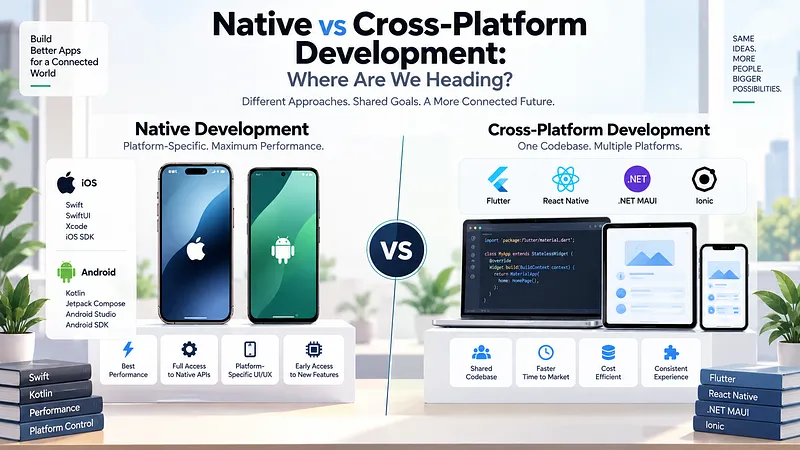
For years, mobile development followed a straightforward path: build separately for iOS and Android. Native development gave teams maximum control and performance, but it also meant maintaining two codebases, two release processes, and often two specialized teams.
Then cross-platform development changed the equation.
Frameworks such as Flutter and React Native made it possible to share a large portion of application code across platforms. For startups and growing teams, that can mean faster releases and lower development overhead.
But does that mean native development is becoming irrelevant?
Not at all. The future is less about choosing one side and more about knowing where each approach makes sense.
1. Native Development: Maximum Platform Control
Native development means building specifically for each operating system using its official technologies.
For iOS, that generally means:
Swift
SwiftUI
Xcode
iOS SDK
For Android:
Kotlin
Jetpack Compose
Android Studio
Android SDK
The biggest advantage is direct access to platform capabilities.
When Apple or Google introduces a new API or hardware feature, native applications can typically take advantage of it without waiting for a cross-platform framework to add support.
Native development is especially useful for applications involving:
Advanced camera processing
Bluetooth and IoT
AR/VR
High-performance graphics
Complex audio/video
Background processing
Deep hardware integration
The trade-off is simple: you are maintaining separate applications.
A feature may need to be implemented, tested, debugged, and maintained independently on iOS and Android.
2. Cross-Platform Development: One Codebase, Multiple Platforms
Cross-platform development takes a different approach.
Instead of creating two completely independent applications, teams share a significant portion of the codebase between platforms.
Popular technologies include:
Flutter
React Native
.NET MAUI
Ionic
For applications such as marketplaces, booking platforms, social networks, food delivery apps, and business tools, this approach can be extremely effective.
A small team can build a feature once and deliver it across multiple platforms.
That creates a simple advantage:
Shared code → Faster development → Lower duplication → Easier maintenance
However, cross-platform doesn’t mean that everything is automatically platform-independent.
Certain features may still require native Swift or Kotlin code.
3. The Real Difference Isn’t Just Performance
Performance is usually the first argument in the native vs cross-platform debate.
And yes, native development can provide an advantage when an application requires extremely optimized, platform-specific processing.
But for many everyday applications, the difference is much less important than developers assume.
Consider an application built around:
API calls
Forms
Lists
Authentication
Payments
Image feeds
Navigation
Notifications
A well-designed cross-platform application can handle these use cases very effectively.
The more important question is:
How much platform-specific control does your product actually require?
Choosing native simply because it can be faster isn’t always the right engineering decision.
4. The Hidden Cost of Native
The biggest cost of native development isn’t necessarily writing native code.
It’s duplication.
Imagine you want to introduce a new onboarding experience.
With cross-platform development, much of the UI and business logic can be shared.
With native development, you may have:
iOS implementation → Android implementation → iOS testing → Android testing
The same applies to many features, including:
Authentication
Analytics
API integrations
Notifications
Payment flows
UI changes
Bug fixes
For a large company with dedicated platform teams, this may be completely reasonable.
For a small startup, however, the additional workload can slow down product development significantly.
5. Cross-Platform Has Its Own Trade-Offs
Cross-platform development isn’t a perfect solution either.
As applications become more complex, teams may encounter:
Platform-specific bugs
Native integration requirements
Dependency conflicts
Framework upgrade challenges
iOS and Android behavior differences
Additional debugging complexity
There is also an abstraction layer between your application and the operating system.
For standard application functionality, that abstraction is often helpful.
For highly specialized functionality, it can become a limitation.
The more unique your requirements are, the more valuable direct platform control becomes.
6. The Future May Be Hybrid
The most interesting direction isn’t necessarily Native vs Cross-Platform.
It’s Native + Cross-Platform.
Instead of asking whether the entire application should be native or cross-platform, teams can decide which parts should be shared and which parts should remain platform-specific.
For example, a company could use Flutter or React Native for:
UI
Navigation
Business logic
Networking
Authentication
And native Swift/Kotlin for:
Advanced camera processing
Bluetooth
Background services
Specialized hardware
Complex media processing
This approach provides the productivity benefits of cross-platform development while preserving native capabilities where they actually matter.
7. Native Is Still the Right Choice When the Platform Is the Product
Some applications simply cannot treat iOS and Android as interchangeable platforms.
Think about:
Professional camera applications
AR applications
Advanced video editors
Wearable applications
IoT control systems
Real-time audio applications
High-performance gaming
In these products, platform capabilities aren’t just technical details.
They are part of the product itself.
When hardware, operating-system behavior, or performance is central to the experience, native development can provide the control required to build the right product.
8. Cross-Platform Is Powerful for Startups
For startups, the equation is often different.
The initial goal isn’t necessarily to build the most technically sophisticated architecture possible.
It’s to:
Build → Launch → Learn → Iterate
If a small team can launch both iOS and Android using a shared codebase, that can provide a major competitive advantage.
Instead of spending months maintaining separate applications, the team can focus on validating the product and responding to user feedback.
Once the product grows, native optimization can be introduced where it creates meaningful value.
Don’t optimize for hypothetical problems before your product has real users.
9. So, Which One Should You Choose?
Choose Native if:
Your product depends heavily on platform-specific capabilities.
Maximum performance is critical.
You need immediate access to new OS APIs.
Advanced hardware integration is central to the product.
You have dedicated iOS and Android teams.
Choose Cross-Platform if:
You have a small development team.
You need to launch quickly.
Most functionality is shared between platforms.
Development cost is an important consideration.
Your application is primarily UI and API driven.
Choose Hybrid if:
Most of your application can be shared.
Only specific features require deep native integration.
You want faster development without giving up platform capabilities.
For many modern applications, hybrid development can provide a practical middle ground.
The Bigger Picture: Shared by Default, Native Where It Matters
The future of mobile development probably isn’t going to eliminate native development.
Instead, we’re likely to see a more flexible approach:
Shared code where it makes sense.
Native code where it matters.
Cross-platform frameworks will continue improving their access to native capabilities, while native development will remain important for applications that push the limits of hardware and operating systems.
The valuable skill won’t simply be knowing Flutter, React Native, Swift, or Kotlin.
It will be understanding where abstraction helps - and where abstraction gets in the way.
Final Thoughts: Choose Based on the Product, Not the Trend
Native and cross-platform development aren’t competing technologies that require one universal winner.
They are tools designed for different requirements.
If you’re a startup with a small team and need to move quickly, cross-platform development can be a major advantage.
If your application depends on deep hardware integration or extreme performance, native may be the better investment.
And if you need both speed and specialized platform capabilities, a hybrid approach can give you the best of both worlds.
The most important question isn’t:
Which technology is better?
It’s:
Which approach lets our team build the best product with the resources and requirements we have today?
Because the best technology isn’t necessarily the most powerful one.
It’s the one that gets your product where it needs to go.