Ever had an offshore build land on time, on budget, with clean code and zero surprises on the first attempt? Me neither. Here is why.
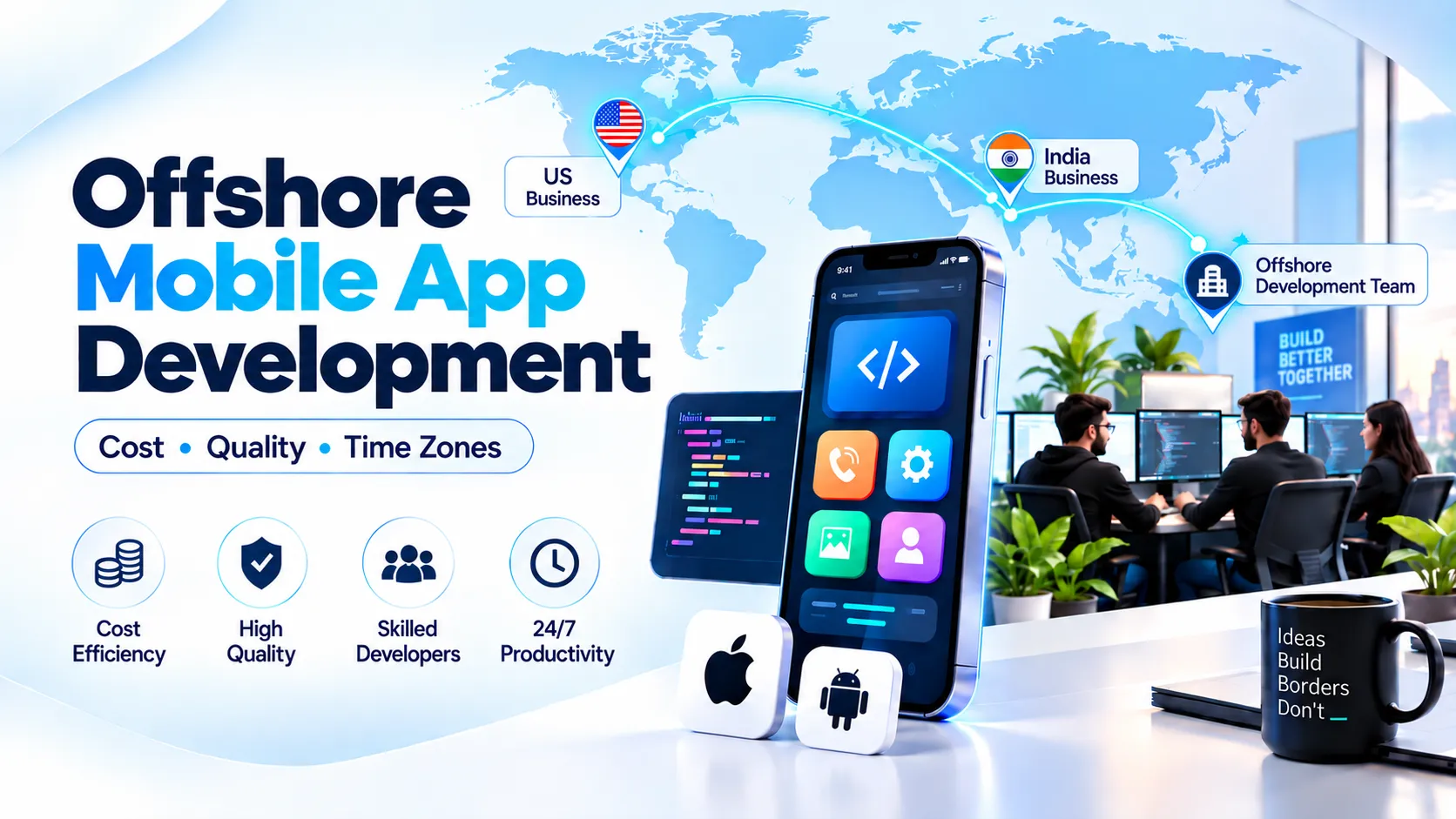
Offshore mobile app development works when you control three things in writing: the rate structure, the number of real overlap hours, and the quality process.
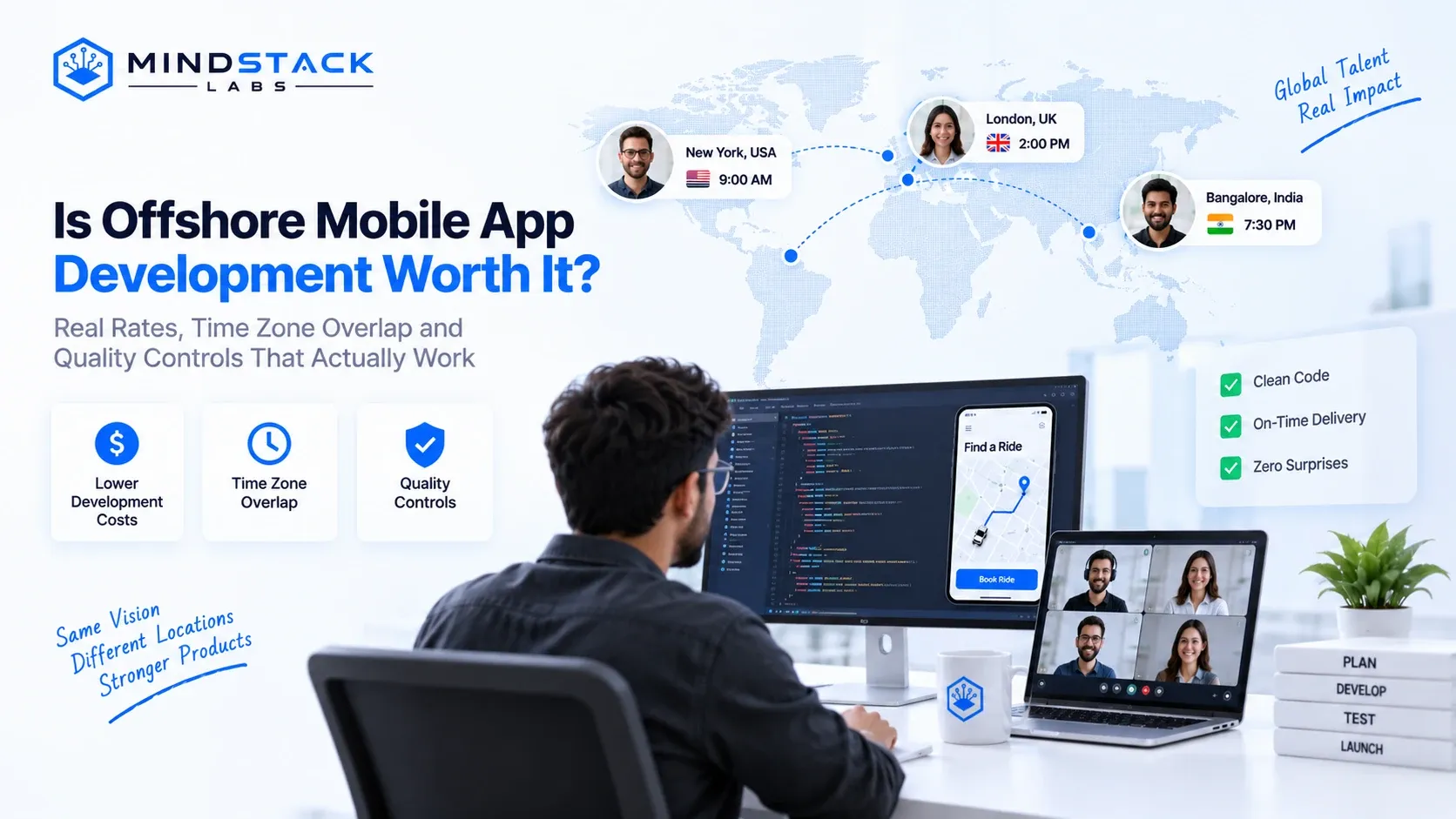
The short answer on money: senior offshore mobile developers run roughly $22 to $60 per hour against $95 to $220 onshore, which puts a two platform MVP near $35k to $60k instead of $120k to $200k.
It fails when any one of those three stays vague at contract stage, and in my experience the vague one is almost always quality.
This is written for founders, product leads and engineering managers in the US and UK who have already decided to look offshore and now need to de-risk it.
TL;DR
→ Senior offshore mobile devs run $35 to $60 per hour and a cross-platform MVP lands at $35k to $60k = compare total cost of ownership, not hourly rate
→ Overlap hours must be a number in the contract, not a promise on a sales call
→ Eight quality controls (code review, CI/CD, independent QA, definition of done and four more) decide the outcome more than the developer's location
→ IP assignment, NDA and exit terms get signed before kickoff or they never get signed properly
→ A two week paid trial sprint tells you more than a three month reference check
When Offshore Mobile App Development Actually Makes Sense (and When It Does Not)
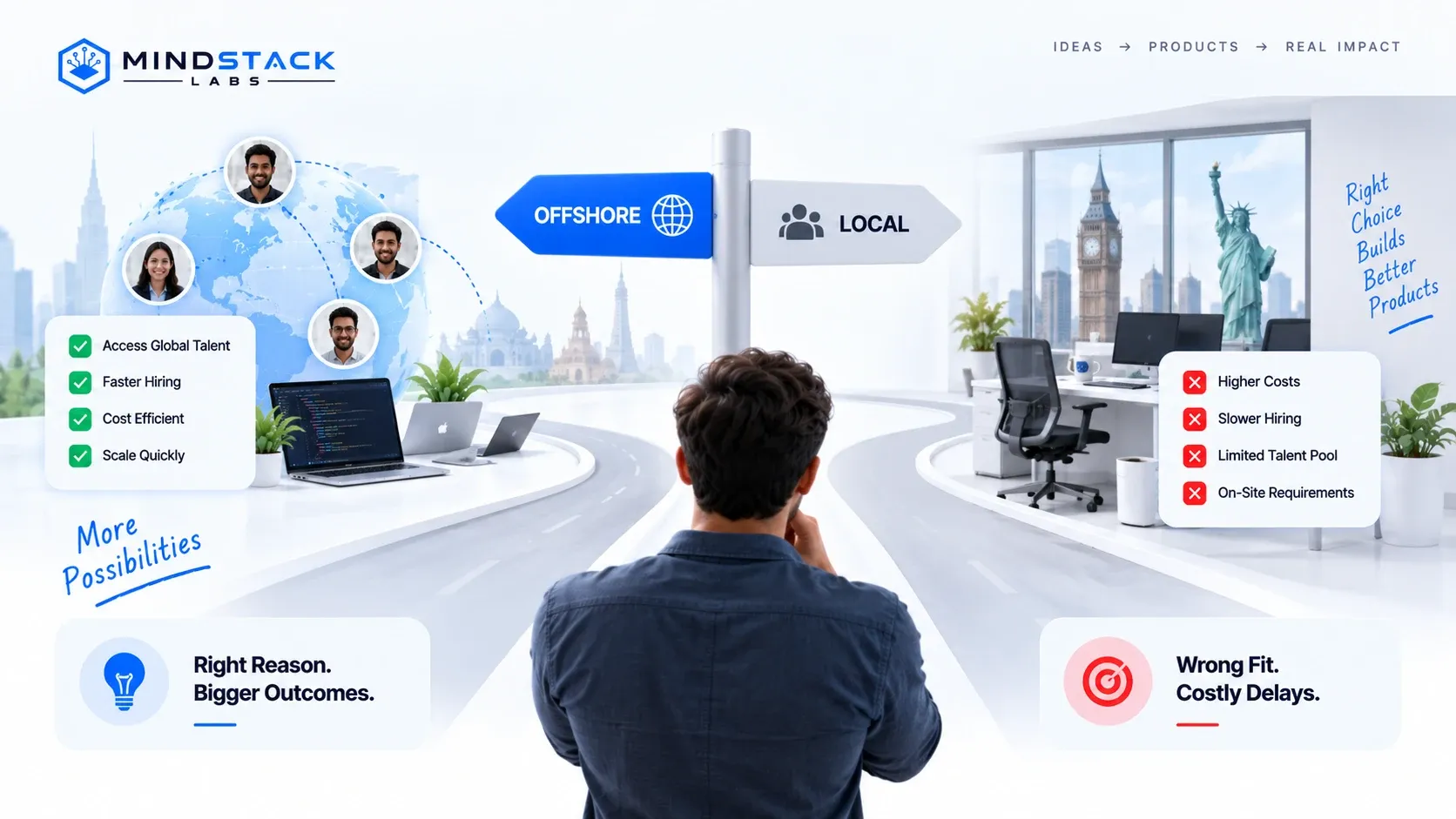
Offshore is the right call when your bottleneck is engineering capacity, not product clarity. It is the wrong call when nobody internally can make a decision within 24 hours.
That distinction has predicted more outcomes than any vendor's portfolio.
Four scenarios where offshore is the right call
You need mobile capacity you cannot hire fast enough. Recruiting a senior iOS engineer in the US or UK routinely runs a full quarter. Offshore capacity starts in two to three weeks.
Mobile is a channel, not your core product. Retail, logistics, healthcare and services companies rarely need a permanent in-house mobile team.
You have a defined scope and a real product owner. Offshore rewards clear specs brutally.
You are extending an existing web stack to mobile. If your backend is already JavaScript or Node, an offshore team fluent in that stack ships faster than a fresh native team.
Three situations where you should hire locally instead
Your product is still being discovered. Daily pivots plus a 10 hour time gap equals expensive churn.
Nobody internally owns product decisions. An offshore team without an empowered decision maker builds the wrong thing very efficiently.
You need on-site regulated work. Some healthcare and public sector contracts restrict where data and personnel can sit.
I once watched a team burn six weeks of offshore capacity because approvals sat with one founder who travelled constantly.
Know why it stalled? There was no named decision maker in the sprint ceremony.
Offshore vs nearshore vs onshore: the honest trade-off
Model | Typical overlap with US/UK | Relative rate | Best fit |
|---|---|---|---|
Onshore (US/UK) | Full day | Highest | Regulated, on-site, or discovery-heavy work |
Nearshore (LATAM for US, Eastern Europe for UK) | 4 to 7 hours | Middle | Teams needing frequent live collaboration |
Offshore (India, Southeast Asia) | 2 to 5 hours, extendable by shift | Lowest | Defined scope, async-mature teams, long engagements |
Offshore is not automatically the cheapest option. It is the cheapest option per hour. Those are different claims.
What Offshore Mobile Application Development Really Costs
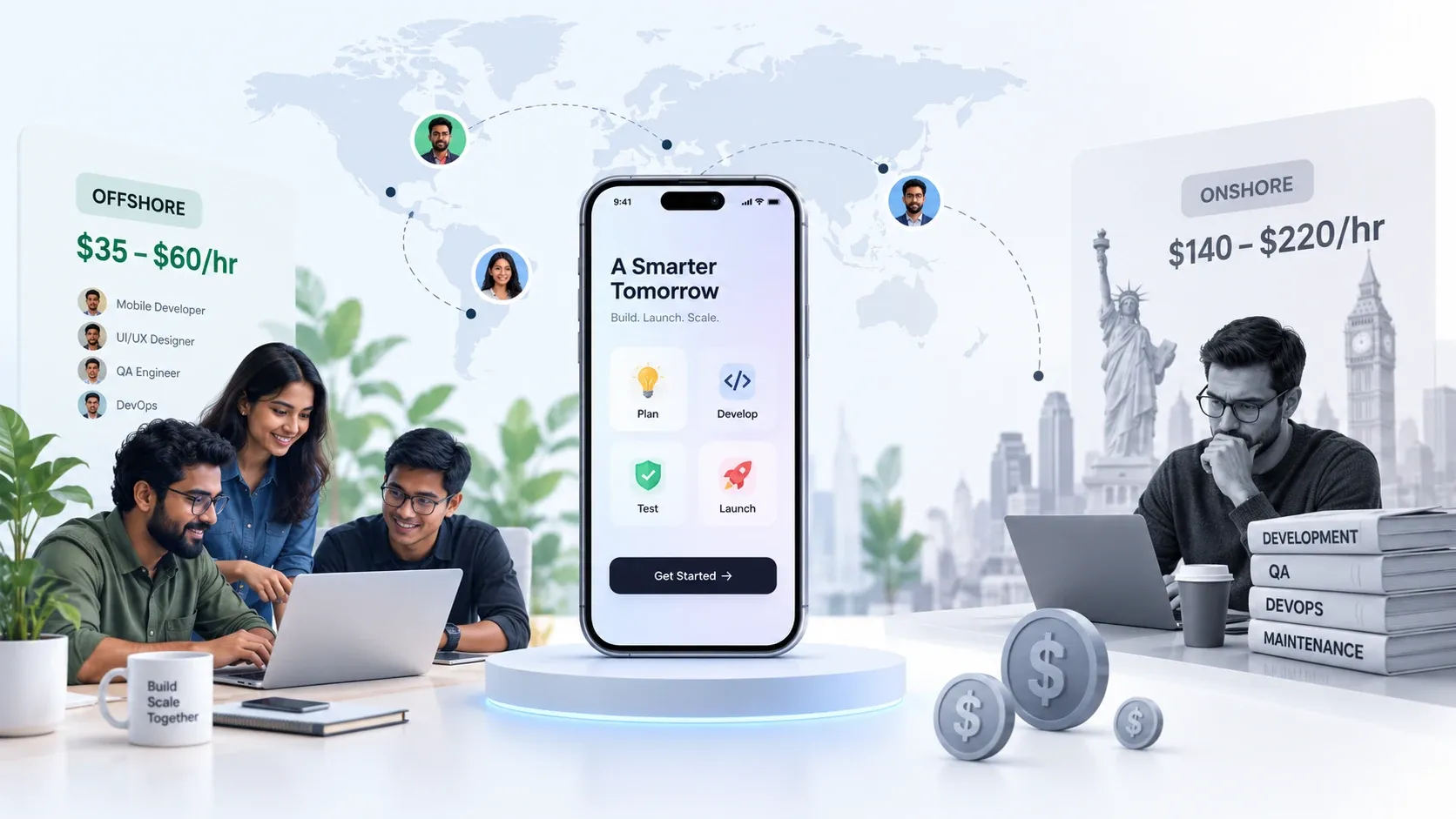
Your final cost is driven by seniority mix and QA coverage far more than by country. In the builds I have worked on, two vendors in the same city quoted a 40% difference on identical scope because one included a dedicated QA engineer and DevOps time and the other did not.
Real hourly rates by region
Senior mobile engineers cost $35 to $60 per hour in India and Southeast Asia against $140 to $220 in the US or UK. That is a four to five times spread on the same job title.
These are market bands for 2026, not quotes. Get your own number in writing.
Region | Mid-level hourly | Senior hourly | Tech lead hourly | Notes |
|---|---|---|---|---|
USA / UK | $95 to $150 | $140 to $220 | $180 to $260 | Full overlap, highest management convenience |
Western Europe | $70 to $110 | $100 to $160 | $140 to $200 | Strong compliance familiarity |
Eastern Europe | $40 to $65 | $60 to $95 | $85 to $120 | Good UK overlap, tightening talent supply |
Latin America | $45 to $70 | $65 to $100 | $90 to $130 | Best US overlap outside onshore |
India | $22 to $38 | $35 to $60 | $55 to $85 | Deepest talent pool, widest quality spread |
Southeast Asia | $25 to $42 | $40 to $65 | $60 to $90 | Competitive, smaller senior mobile pool |
The widest quality spread sits in the cheapest bands. That is not a regional judgement, it is a supply observation.
What a full offshore mobile app build actually costs
A cross-platform MVP lands at $35k to $60k offshore against $120k to $200k onshore. Hours barely change between the two. The rate does.
Build type | Offshore (India / SE Asia) | Onshore (US / UK) | Typical hours |
|---|---|---|---|
Prototype or clickable demo | $8k to $18k | $30k to $60k | 250 to 400 |
MVP, one platform | $25k to $45k | $80k to $150k | 900 to 1,400 |
MVP, cross-platform, both stores | $35k to $60k | $120k to $200k | 1,300 to 1,900 |
Version 1 with payments and admin panel | $60k to $110k | $200k to $350k | 2,200 to 3,200 |
Complex or regulated app | $120k to $200k and up | $350k and up | 4,000 and up |
Annual maintenance after launch | $9k to $30k | $30k to $70k | 15 to 20% of build |
Notice the maintenance row. Most budgets stop at launch day and then get a surprise in month four.
Monthly cost of a dedicated offshore team
If you are buying capacity rather than a project, price it per month per team shape.
Team shape | Composition | Offshore per month | Onshore equivalent |
|---|---|---|---|
Solo developer | 1 senior mobile dev | $5k to $9k | $18k to $30k |
Small squad | 2 devs, half a QA, half a PM | $12k to $20k | $45k to $70k |
Full pod | 3 devs, 1 QA, 1 PM, part-time DevOps | $22k to $35k | $80k to $120k |
Pod plus design | Full pod plus 1 product designer | $28k to $44k | $100k to $150k |
A worked example: same scope, two quotes
A retail client scoped a two platform loyalty app. Eight screens, login, payments, admin panel.
Onshore quote → 1,600 hours at $155 = $248,000
Offshore quote → 1,750 hours at $45 = $78,750
The offshore team priced 150 extra hours for overlap, handover and documentation
→ Same scope, $169,250 apart = the arbitrage is real, but only if the quality process holds
They went offshore and shipped in five months. The deciding factor was not the price.
It was the written definition of done.
What actually moves your rate up or down
→ Seniority mix = the single biggest lever, more than location
→ Compliance scope (GDPR, HIPAA, SOC 2 support) = adds documentation and process cost
→ QA coverage = a dedicated QA engineer typically adds 15 to 25% of engineering cost
→ Stack scarcity = native Swift and Kotlin specialists cost more than cross-platform generalists
→ Engagement length = longer commitments buy better rates and better people
Pro tip: ask every vendor to quote the same scope with and without a dedicated QA engineer, then compare the two numbers side by side.
Which pricing model actually protects you
Model | You carry the risk of | Best for |
|---|---|---|
Fixed price | Change orders and padded estimates | Tightly specced, short, unchanging scope |
Time and materials | Cost overrun if scope drifts | Evolving products with an engaged owner |
Dedicated team | Paying for idle capacity | Multi-quarter roadmaps and ongoing product work |
Staff augmentation | Managing the people yourself | Teams with existing engineering leadership |
Build, operate, transfer | Long ramp before you own the team | Companies planning a permanent offshore office |
Fixed price feels safest. It is usually the most expensive way to buy change.
The costs that never appear in the headline quote
Discovery and architecture phase
Project management time (often 10 to 15% of engineering hours)
QA and device testing
DevOps, CI/CD setup and environment costs
Design and design revisions
App Store and Play Store submission plus rejection fixes
Post-launch maintenance, commonly budgeted at 15 to 20% of build cost per year
Native versus cross-platform, in cost terms
Cross-platform (React Native or Flutter) typically lands cheaper than two native builds, not cheaper than one. If you only need iOS, native is often the better economic call. Cross-platform wins when you need both platforms with shared logic.
Offshore versus in-house: compare total cost, not hourly rate
Cost component | In-house hire | Offshore team |
|---|---|---|
Recruiting time and fees | Weeks to a quarter, plus agency fees | Days to weeks |
Salary, taxes, benefits, equity | Full load | Included in rate |
Equipment, tooling, office | Yours | Vendor's |
Bench risk between projects | Yours | Vendor's |
Management overhead | Lower per person | Higher, needs async discipline |
Knowledge retention | Stays in-house | Requires contractual knowledge transfer |
Time Zones: How Many Overlap Hours Do You Actually Need?

Four hours of genuine overlap is enough for almost any mobile build. Two is workable with strong async practice. Zero is where projects quietly die.
Every vendor says they align to your time zone. Ask for the number.
Overlap hours by region
Buyer | Offshore region | Realistic overlap | With shifted hours |
|---|---|---|---|
US East Coast | India | 1 to 2 hours | 4 to 5 hours |
US East Coast | Eastern Europe | 2 to 3 hours | 5 to 6 hours |
US West Coast | India | Under 1 hour | 3 to 4 hours |
UK | India | 3 to 4 hours | 5 to 6 hours |
UK | Eastern Europe | 6 to 8 hours | Full day |
Mind Stack Labs states on both its offshore JavaScript development and offshore Node.js developers pages that its developers work in US and UK compatible hours with overlapping office time and daily standups. That is the kind of commitment worth getting written into a statement of work with a specific hour window attached.
The three collaboration models
Full overlap. Vendor shifts to your hours. Highest convenience, usually a rate premium, and harder on retention.
Partial overlap (4 to 6 hours). The practical default. Live standup and decisions in the shared window, deep work outside it.
Follow the sun. You hand off at your end of day, they hand back at theirs. Excellent for QA and bug fix cycles, poor for ambiguous feature work.
What a real day looks like across a 10 hour gap
Their morning → they build against yesterday's decisions
Overlap window → standup, demo, decisions, blockers cleared
Your afternoon → you review, comment on pull requests, record Looms
Their next morning → they act on your written feedback
One overlap window per day is enough if decisions get made inside it.
Async practices that make the gap a feature
Written standups in a shared channel, not verbal only
Every decision recorded in the ticket, never only in a call
Loom or screen recordings instead of scheduling another meeting
A single named decision maker with a 24 hour response commitment
Pull request descriptions that explain intent, not just changed files
Escalation outside overlap hours
Agree three things before kickoff: what counts as a production incident, who is reachable, and the response time commitment. Without this, a Friday evening crash becomes a Monday morning problem.
How to Manage an Offshore Mobile Team You Will Never Meet in Person

You manage an offshore team with one named point of contact, one written cadence and one set of tracked outputs, not with more meetings.
Managing across a 10 hour gap sounds exhausting. It is mostly just writing things down.
Who you actually talk to: the contact model
Insist on one accountable owner and at least two people who can answer technical questions. A single salesperson as your only contact is not a team structure, it is a filter.
Role | What they own | You use them for | Cadence |
|---|---|---|---|
Delivery lead or account owner | Commercial terms, scope, escalation | Budget, team changes, disputes | Weekly or monthly |
Project manager | Day to day delivery | Tickets, blockers, sprint status | Daily |
Tech lead | Architecture and estimates | Tradeoffs, feasibility, risk | Weekly and on demand |
Developers | Implementation | Detail questions in the shared channel | As needed |
QA engineer | Acceptance and bug triage | Sign-off on each sprint | Per sprint |
In the builds I have worked on, the projects that went sideways all had one thing in common: the tech lead was never in the channel.
The operating rhythm that survives a time zone gap
Six ceremonies cover everything, and only three of them are live.
Cadence | Ceremony | Format | Output you keep |
|---|---|---|---|
Daily | Written standup | Async, in channel | Yesterday, today, blockers |
Daily | Overlap call, 15 minutes | Live | Decisions and unblocks |
Weekly | Demo of working software | Live, 30 minutes | An installable build |
Weekly | Delivery report | Async | Burn, scope changes, risks |
Fortnightly | Sprint planning and retro | Live, 60 minutes | Committed scope |
Monthly | Commercial review | Live, 30 minutes | Budget against plan |
Everything else is a message. Protect the live hours for decisions only.
What to track instead of hours logged
Hours tell you what was spent. These five tell you what was built.
→ Tickets closed against committed sprint scope = real velocity
→ An installable build every sprint = progress you can hold in your hand
→ Pull request review turnaround time = team health
→ Bug reopen rate = quality trend, and the first thing to slip
→ Scope change log = where your budget actually went
A timesheet with no build attached is an invoice, not a status report.
The escalation ladder, agreed before kickoff
Write four levels into the statement of work so nobody improvises during a crisis.
Level | Trigger | Who handles it | Response commitment |
|---|---|---|---|
1 | Blocker raised in channel | Project manager | Same overlap window |
2 | Missed sprint commitment | Delivery lead | 24 hours, with a written cause |
3 | Repeat quality failure | Delivery lead and tech lead | 48 hours, with a remediation plan |
4 | Continuity risk or contract breach | Escalation clause and notice period | As stated in the SOW |
Your side of the deal
Most offshore failures I have seen were client-side, not vendor-side.
Name one decision maker with a 24 hour response commitment
Answer questions in the shared channel, never in private messages
Review each demo within 24 hours or you lose the next sprint
Keep one ranked backlog, in one tool, with one owner
Grant repository and environment access on day one, not in week three
That last point costs more projects than any skill gap.
Give them access. Then give them decisions.
Work out your overlap requirement
Not sure how many overlap hours your build actually needs?
Tell us your team's working hours, release cadence and how often you need live decisions. We will map the overlap model that fits, including the async practices that cover the rest of the day. No obligation to hire.
Free 30 minute discovery call with a delivery lead. Response within 24 hours.
Wait, You Might Be Thinking: "I Cannot Judge Code Quality, So How Would I Even Know?"
You do not need to read the code. You need to inspect the process that produces it, and every control below is visible to a non-technical buyer.
If a vendor cannot show you their code review policy in writing, that is your answer.
The Eight Quality Controls That Separate a Good Offshore Build From a Bad One
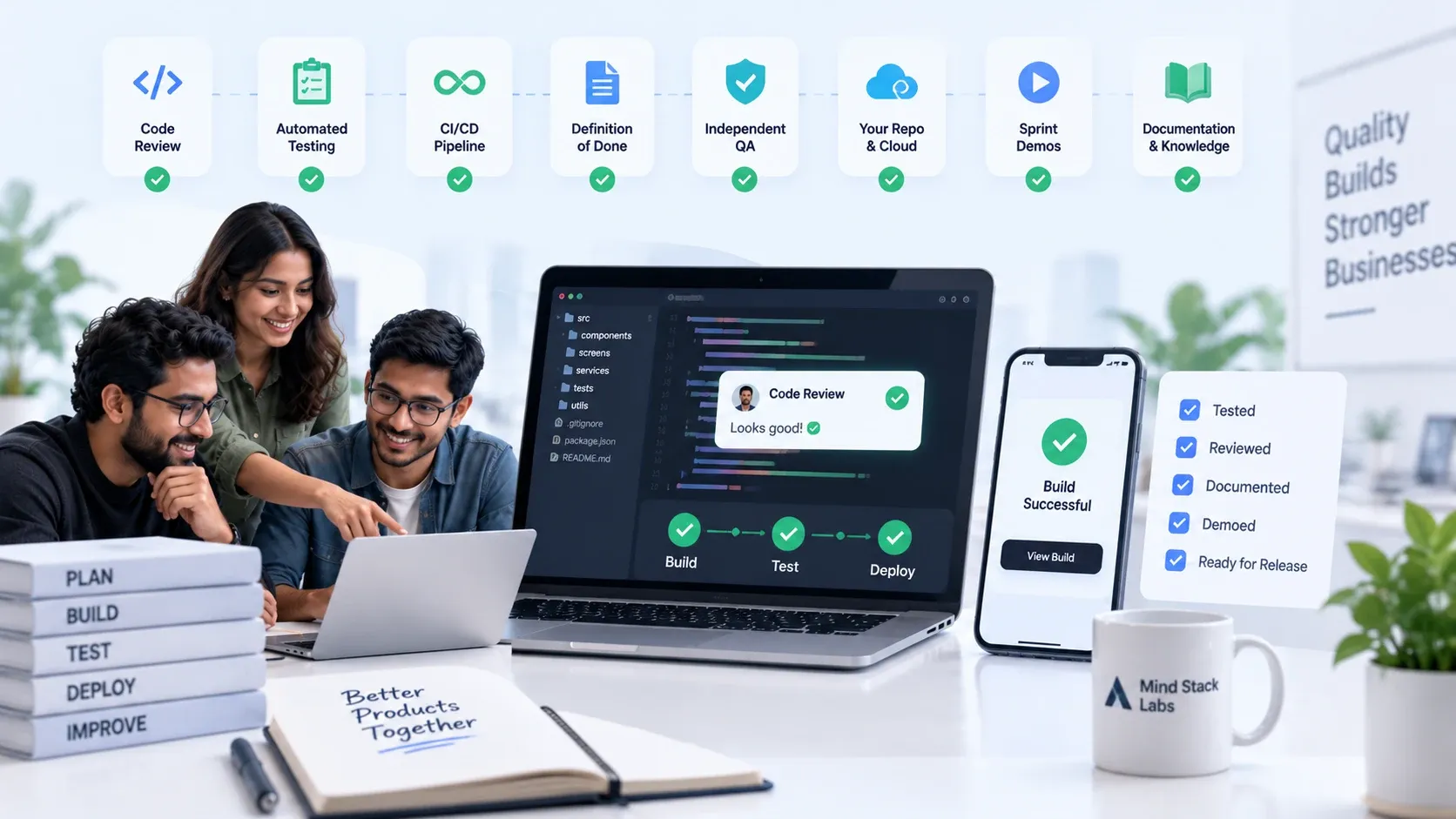
These eight controls predict build quality better than any portfolio. I ask for all eight in writing before signing anything.
Code review on every pull request. No developer merges their own work. Ask who reviews, and what happens when the reviewer is on leave.
Automated testing with a stated coverage expectation. Mind Stack Labs publishes a TDD approach using Jest, Mocha and Cypress on its UK Node.js page, which is the level of specificity to ask for. Vague "we test thoroughly" answers mean no policy exists.
CI/CD pipeline with owned release management. Builds should be automated from day one and someone must be named as release owner.
A written definition of done. Code complete is not done. Done includes tested, reviewed, documented and demoed.
Independent QA, not developers testing their own work. Developers test what they built as they built it. A QA engineer tests what a user will actually do.
Your repository, your cloud, your credentials, from day one. If the code lives in the vendor's private repo until final payment, you do not have a project, you have a hostage situation. Slight exaggeration, but only slight.
Sprint demos on a fixed cadence. Working software every two weeks, not status decks.
Documentation and knowledge transfer as sprint deliverables. Architecture notes, environment setup and API docs, written as you go, never at the end.
Pro tip: put all eight controls into a one page annex to the contract, because a vendor's reaction to signing it tells you more than any reference call.
The two week early warning signs
Watch for these in the first two sprints. All of them are visible without reading a line of code.
→ No working build you can install by end of sprint two = red flag
→ Standups reporting activity instead of progress against tickets = red flag
→ Pull requests merged with no review comments at all = red flag
→ The senior engineer from the sales call never appears in the channel = red flag
→ Estimates that never change even as scope changes = red flag
Catch these at week two and the fix costs a conversation. Catch them at week ten and the fix costs the project.
Contracts, IP and Compliance: What to Lock Down Before Kickoff
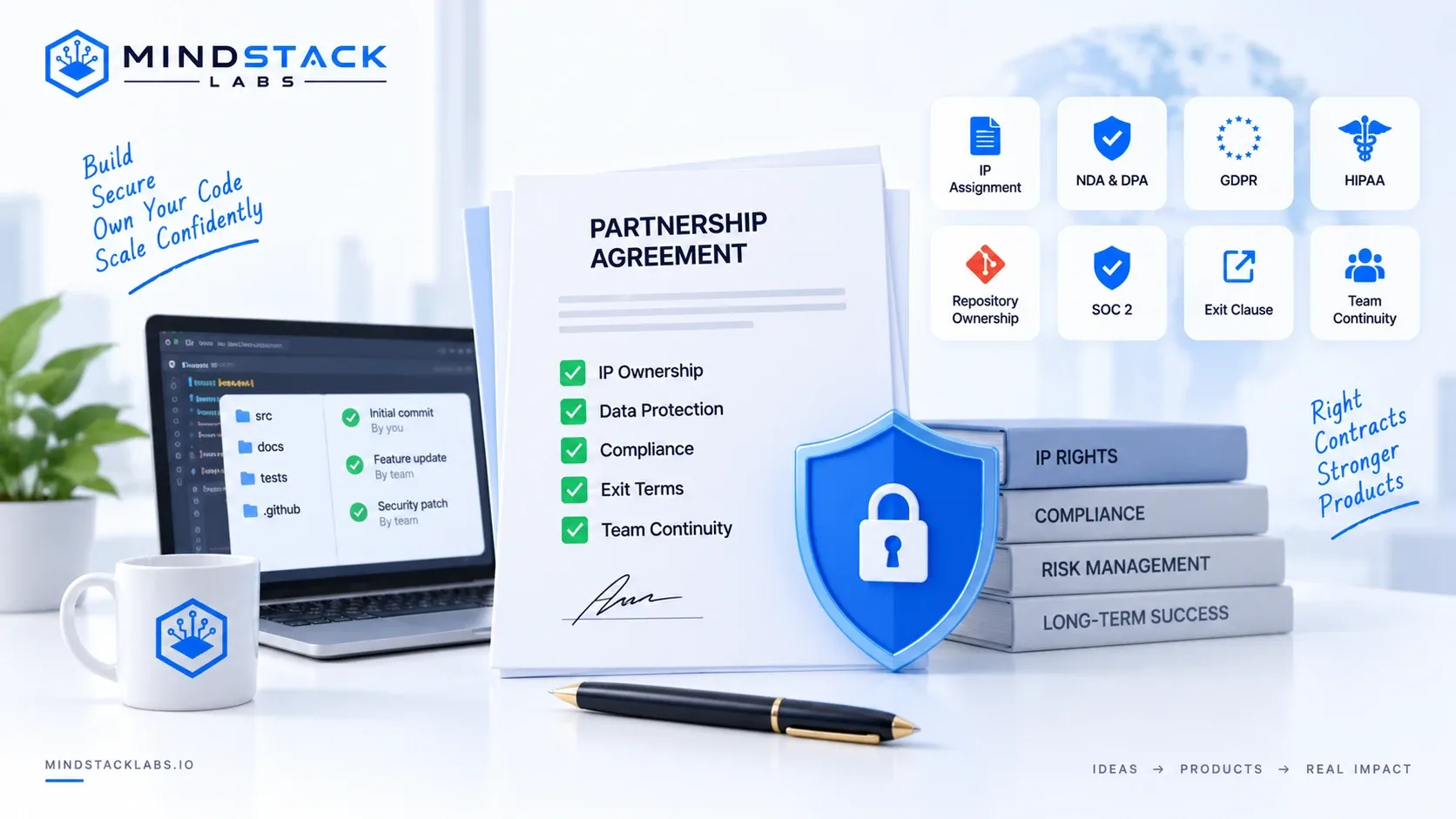
Get IP assignment, data handling and exit terms signed before kickoff, because none of them can be negotiated fairly once you are dependent. Ask your own counsel to review. This is a checklist, not legal advice.
IP assignment clause. All work product assigns to you on creation, not on final payment.
Repository ownership. Code sits in your organisation's repo from the first commit.
NDA and data processing agreement. Required if any real user data touches the development environment.
GDPR. Non-negotiable for UK and EU users. Confirm where data is processed and stored.
HIPAA. Applies if you handle US health data. Ask specifically what the vendor has done before.
SOC 2. Your enterprise customers may require it of you, which pushes requirements down to your vendor.
Source code escrow and exit clause. Define notice period, handover deliverables and final knowledge transfer.
Team continuity. Named resources, a rotation notice period, and overlap on any replacement.
That last one gets skipped most often. It is the clause that stops the team you interviewed from quietly becoming a different team.
How Long Does an Offshore Mobile App Build Take?
Plan on three to four months for a genuine MVP and six to nine months for a complex app, which matches the timeline Mind Stack Labs publishes for cross-platform builds. Anyone promising a complex app in six weeks is describing a prototype.
Build type | Realistic range | What is included |
|---|---|---|
Prototype / clickable demo | 3 to 6 weeks | Design, core flows, no production backend |
MVP | 3 to 4 months | One or two platforms, core feature set, basic analytics |
Version 1 with integrations | 5 to 7 months | Payments, third party APIs, admin panel |
Complex / regulated app | 6 to 9 months and up | Compliance, offline sync, deep integrations |
What extends a timeline
Scope defined in a call rather than a document
A single approver who is also running the company
Design handed over incomplete, so engineers make design decisions
Third party integrations discovered mid-build
The integration is nearly always the thing nobody scoped.
The first two weeks are not build weeks
Ramp-up is real: codebase onboarding, environment setup, access provisioning and domain learning. Budget it honestly rather than being surprised by it.
How to Vet an Offshore Mobile App Development Company
Score every vendor on the same nine criteria and the shortlist builds itself. I stopped relying on portfolio decks years ago, because polished case studies survive terrible delivery.
The nine criteria scorecard
# | Criterion | What a strong answer looks like |
|---|---|---|
1 | Named team | Specific engineers, CVs, and you meet them |
2 | Overlap commitment | A stated hour window in the SOW |
3 | Code review policy | Written, mandatory, no self-merges |
4 | Testing approach | Named frameworks and coverage expectations |
5 | CI/CD ownership | Automated pipeline, named release owner |
6 | Independent QA | A dedicated QA engineer on the team |
7 | IP and repo terms | Assignment on creation, your repo from day one |
8 | Continuity terms | Rotation notice and replacement overlap |
9 | Verifiable social proof | Reviews you can open and read yourself |
On point nine, Mind Stack Labs lists Clutch 5.0 with five reviews, Google 5.0, Trustpilot 5.0 and Upwork Top Rated Plus on its service pages. Five reviews is a small sample and I would say so openly. It is still verifiable, which beats an unnamed logo wall.
Questions that expose a weak vendor on the first call
Who exactly will write the code, and can I meet them this week?
How many hours will we overlap, and on which days?
Who reviews pull requests, and what is your merge policy?
What is your definition of done?
Does a dedicated QA engineer sit on this team or do developers test their own work?
Whose repository does the code live in from day one?
What happens to the team if I pause the project for a month?
What is your notice period if you need to rotate a developer?
What was the last project that went badly, and what changed after it?
That final question is the most useful one on the list. Vendors who cannot answer it either have not shipped enough or are not being straight with you.
Run a paid trial sprint before you commit
Two weeks, paid, real scope, real deliverable. You get code you own, a demo, and direct evidence of how they communicate. It costs a fraction of a bad six month engagement.
Why I Would Trust Mind Stack Labs for Offshore Mobile App Development
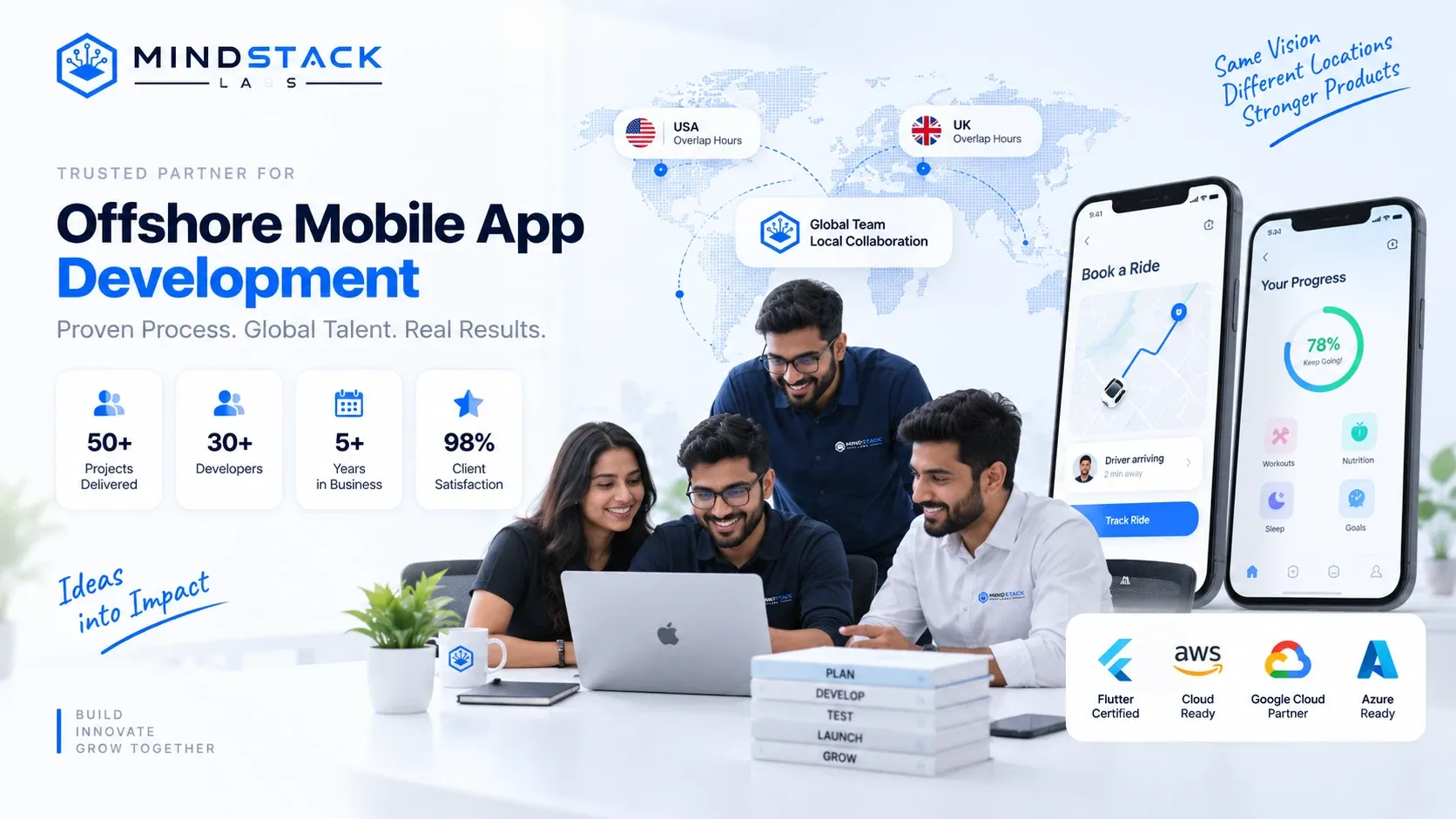
Mind Stack Labs scores well on the process criteria that actually predict delivery quality, based on what it publishes and commits to publicly. Here is what is verifiable from its own service pages.
Track record on record: 50+ projects delivered, 30+ developers, 5+ years operating, 98% client satisfaction, building since 2019.
Overlap is a stated commitment. Both the USA offshore JavaScript development and UK offshore Node.js developers pages commit to US and UK compatible working hours with overlapping office time and daily standups.
Testing is specified, not implied. A stated TDD approach with unit, integration and end to end testing using Jest, Mocha, Cypress and Playwright.
CI/CD and cloud deployment are in scope, across AWS, Google Cloud and Azure with pipeline and container orchestration.
A defined six stage delivery process: discovery and planning → UI/UX design → development → testing and QA → deployment including App Store and Play Store submission → post-launch support and growth.
Flexible engagement models: dedicated developers, hourly consulting, or project-based pricing, with transparent sprint reporting.
Full stack continuity for mobile. If your backend is Node and your frontend is React or Next.js, one team can own the API and the app rather than splitting ownership across vendors.
The shipped mobile builds you can open right now
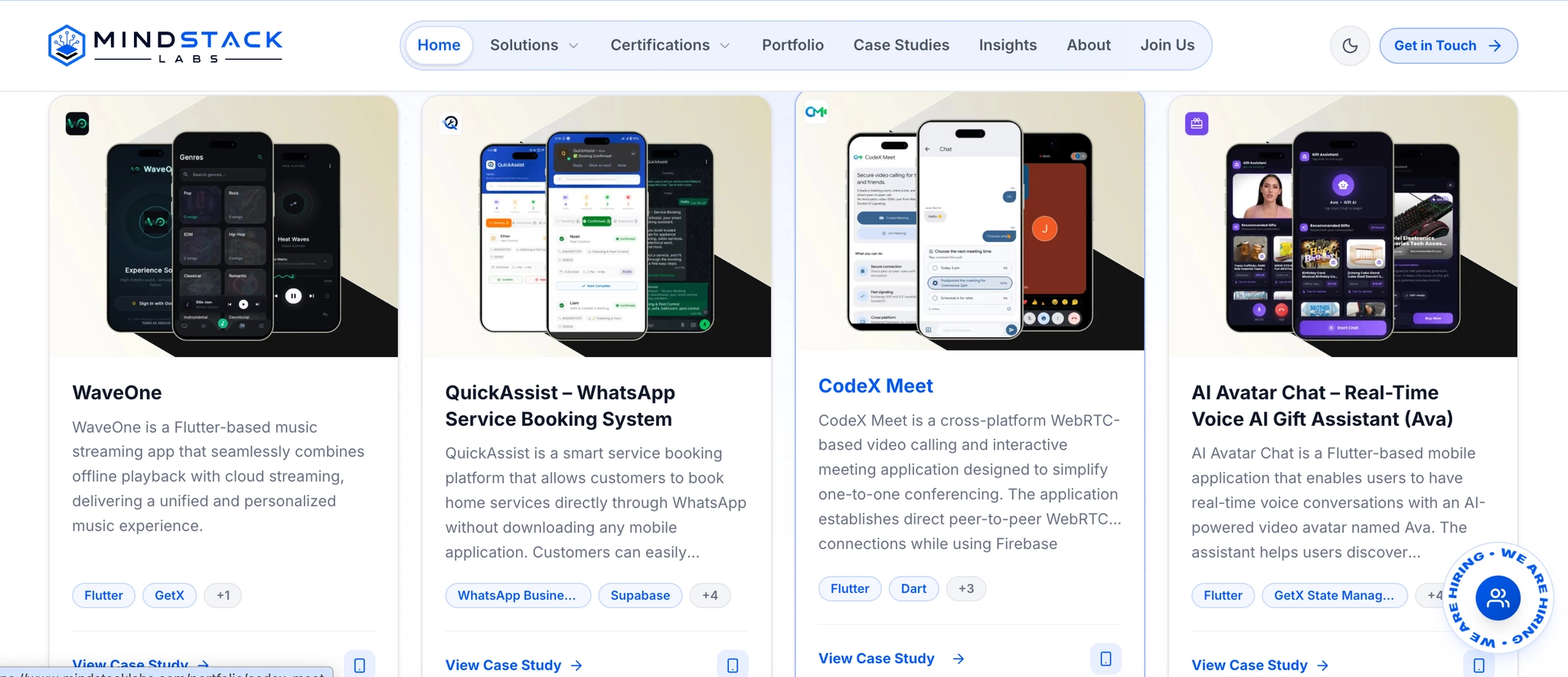
Claims are cheap, so here are live builds with the stack listed on each case study. Open them and judge the work yourself.
Build | What it is | What it proves technically |
|---|---|---|
Cross-platform WebRTC video calling on Flutter and Firebase | Real time peer to peer connections, the hardest thing to fake in a portfolio | |
Flutter music streaming with offline playback and cloud sync | Offline first architecture and media handling | |
Biometric attendance with face recognition and liveness checks | On-device ML and camera pipelines | |
Flutter app with a real time voice AI avatar | Streaming AI integration on a mobile client | |
Flutter and Kotlin screen casting to desktop and smart TVs | Native platform channel work, not just UI layers | |
Offline first cross-platform credential manager | Local encryption and secure storage discipline | |
WhatsApp-based service booking on Supabase | Third party API integration with no app install required | |
Fitness coaching platform | Consumer app with tracking and subscription billing | |
Calorie counting and food tracking app | Data heavy consumer UX at scale | |
Wearable connected coaching app | Wearable and sensor integration |
More consumer and enterprise mobile work sits in the full portfolio, including CareBot AI for healthcare booking, Sprut for taxi booking, TransportPro for logistics and Accelevents for events.
Run the nine criteria scorecard against these. That is what it is for.
Where they are a strong fit: JavaScript-centric mobile and web products, UK and US buyers who want stated overlap hours, and teams wanting one partner across backend and app.
Where I would look elsewhere: pure native Swift or Kotlin work with heavy platform-specific requirements, and highly regulated builds requiring specific certifications, which you should ask about directly rather than assume.
How Mind Stack Labs Compares to Other Offshore Options
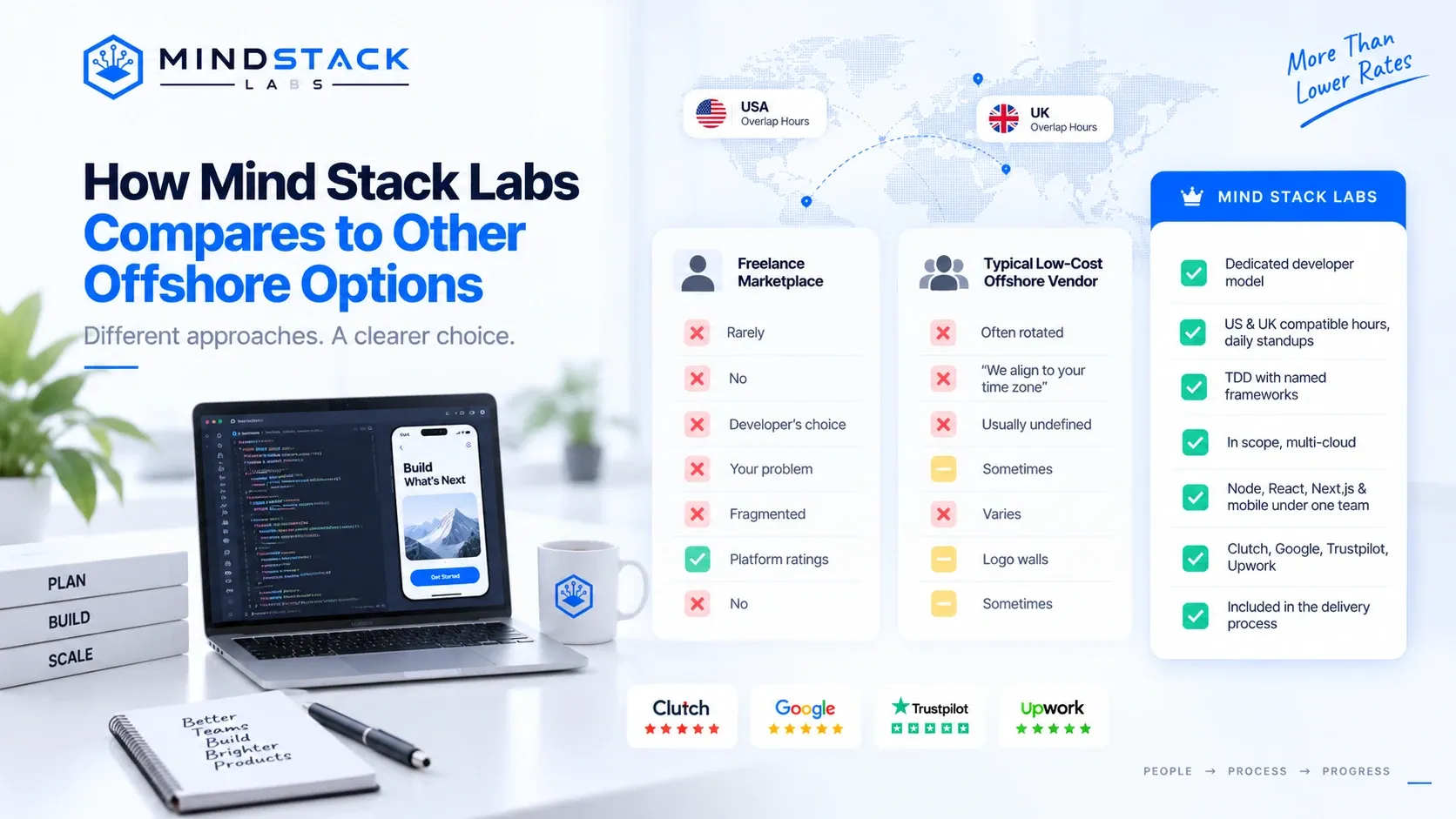
The comparison that matters is process maturity, not rate. Here is how the three common options stack up.
What you need | Freelance marketplace | Typical low-cost offshore vendor | Mind Stack Labs (per published practice) |
|---|---|---|---|
Named, stable team | Rarely | Often rotated | Dedicated developer model |
Stated overlap hours | No | "We align to your time zone" | US and UK compatible hours, daily standups |
Testing policy | Developer's discretion | Usually undefined | TDD with named frameworks |
CI/CD ownership | Your problem | Sometimes | In scope, multi-cloud |
Full stack continuity | Fragmented | Varies | Node, React, Next.js and mobile under one team |
Verifiable reviews | Platform ratings | Logo walls | Clutch, Google, Trustpilot, Upwork |
Store submission handled | No | Sometimes | Included in the delivery process |
The honest gaps: the public review base is small at five Clutch reviews, and the published FAQ content leans toward Flutter and JavaScript work rather than deep native specialisms. If native iOS is your whole product, ask about it explicitly.
I would rather flag that than pretend it is not there. So would you, if you were the one signing.
Start small, verify, then scale
Test us on a two week paid sprint before you commit
You get a named team, a written definition of done, code review on every pull request and repository access from day one. At the end you own the code and the decision. Continue, adjust the team, or walk away.
Named developers with a stated rotation notice period
Full IP assignment and your repository from commit one
Overlap hours agreed in writing before kickoff
Detailed proposal within 24 hours
Building on JavaScript or Node? See offshore JavaScript development for US companies and offshore Node.js developers for UK businesses.
Frequently Asked Questions
1. Is offshore mobile app development worth it?
Yes, when your scope is defined and you enforce a written quality process. The savings come from rate arbitrage, but they only survive if code review, QA and overlap hours are contractual rather than assumed.
2. How much does offshore mobile app development cost?
Expect $22 to $60 per hour offshore, which puts a cross-platform MVP at $35k to $60k and a complex app at $120k or more. Add project management, QA, DevOps and 15 to 20% of build cost per year for maintenance, none of which usually appears in the headline quote.
3. Do I own the code my offshore team writes?
Only if the contract says IP assigns to you on creation, not on final payment. Insist the repository sits in your organisation from the first commit and add a knowledge transfer clause to the exit terms.
4. How many overlap hours do I need with an offshore team?
Four hours of genuine overlap covers almost any mobile build. Two is workable with strong async habits. Get the specific hour window written into the statement of work rather than accepting a general time zone promise.
5. How do I know if my offshore developers are writing good code?
Inspect the process, not the code. Mandatory pull request review, automated tests with a stated coverage expectation, independent QA and an installable build every sprint are all verifiable without technical skills.
Your Next Step
Offshore mobile app development is not risky because of geography. It is risky when rates, overlap hours and quality controls stay undefined until something breaks.
Define all three before kickoff and the model works.
If you want help turning that into an actual scope, book a free 30 minute scoping call with Mind Stack Labs. You will get a detailed proposal within 24 hours, with no commitment attached.