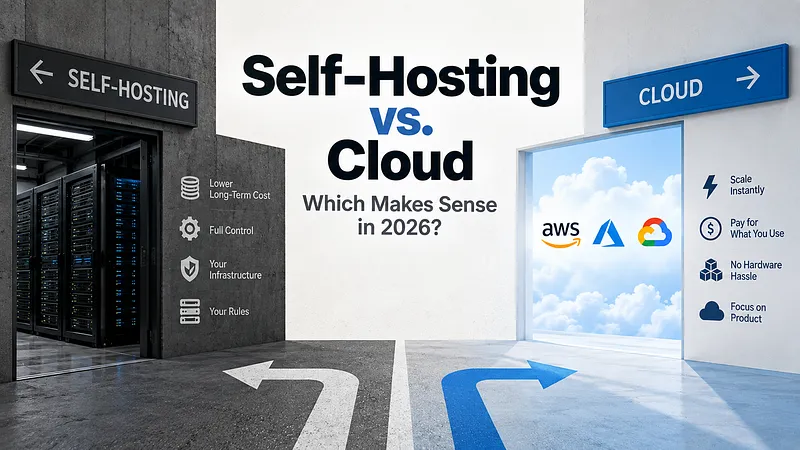
The era of “cloud-by-default” is officially over. Here is how to make the right choice for your workload.
Imagine opening your monthly AWS bill and seeing a $250,000 charge for infrastructure you could run on a few dedicated servers for a fraction of the cost.
For years, the default advice for any company was brain-dead simple: put everything in the cloud.
It made perfect sense. AWS, Azure, and Google Cloud allowed tiny teams to build massive platforms without ever touching a physical server. But in 2026, the tides are shifting.
The most famous case is 37signals (the creators of Basecamp and HEY), who dramatically pulled their workloads off AWS, slashing their annual cloud bill from $3.2 million to $1.3 million.
So, is self-hosting making a massive comeback?
Not exactly. But we are finally moving past the hype. The real question in 2026 isn’t which one is better — it’s when does self-hosting actually make business sense?
The Real Problem the Cloud Solved
The cloud didn’t win because engineers hated hardware. It won because managing servers is hard.
If you are a fast-growing startup, your traffic is a moving target. One week you have 10,000 users; the next week, a viral feature spikes that to a million.
If you buy physical hardware for the peak, you waste money when traffic drops.
If you buy too little, your application crashes.
The cloud solved this beautifully. You pay for what you use, scale up instantly, and scale down when the rush is over. That flexibility is worth every single penny of the premium you pay.
In fact, public cloud adoption is still skyrocketing. Gartner projects cloud spending in India alone to reach $17.5 billion in 2026 — a massive 28% jump from last year. The cloud is not dying. It’s just maturing.
The Turning Point: Predictable Workloads
The math changes completely when your workload becomes predictable.
Imagine a mature SaaS product. Your traffic is steady, your data storage grows at a predictable rate, and your servers run 24/7. At this stage, the cloud’s greatest feature — instant elasticity — is no longer useful to you.
You are essentially renting a house for years when it would be significantly cheaper to buy.
“Build the things that are your core competitive advantage. For everything else, rent. But once your rented infrastructure becomes a massive, predictable utility bill, it’s time to run the math on buying.”
However, self-hosting comes with a massive catch.
When you leave the cloud, you inherit the operational debt:
Hardware failures are now your problem.
Security patches, backups, and networking redundancy fall on your team.
You need a dedicated infrastructure team to keep the lights on.
The monthly bill might be smaller, but the operational responsibility is vastly larger.
The AI Factor: Re-writing the Rules
AI has thrown a massive wrench into this debate.
Deep learning, LLMs, and high-volume data pipelines require astronomical amounts of compute and specialized GPU power.
For exploratory AI features, renting specialized cloud infrastructure is the only viable path
But for mature, high-volume AI workloads, the markup on cloud GPUs is so high that buying dedicated hardware is becoming the preferred strategy for scaled enterprises.
This is why 2026 is the year of the hybrid architecture. Companies are keeping their dynamic web interfaces in the cloud while pulling heavy, predictable data processing pipelines back to colocated hardware.
The 2026 Decisive Framework
If you are staring at your infrastructure bill today, here is the rule of thumb for 2026:
Early-Stage / Unpredictable Traffic: Stick to the cloud. Speed to market and flexibility matter far more than optimizing server costs.
Highly Predictable, Scaled Workloads: Run a strict financial analysis. If your cloud bill is high enough to hire a small infrastructure team and still save money, self-hosting is a viable option.
AI & High-Compute Workloads: Adopt a hybrid approach. Rent for R&D, but consider buying hardware for steady-state production models.
The future isn’t a battle of Cloud vs. Self-Hosting. It’s about engineering teams growing up and choosing the right tool for the right job.
Are you currently running on cloud, self-hosted, or a hybrid setup? What was the turning point that made you switch? Let’s talk in the comments!