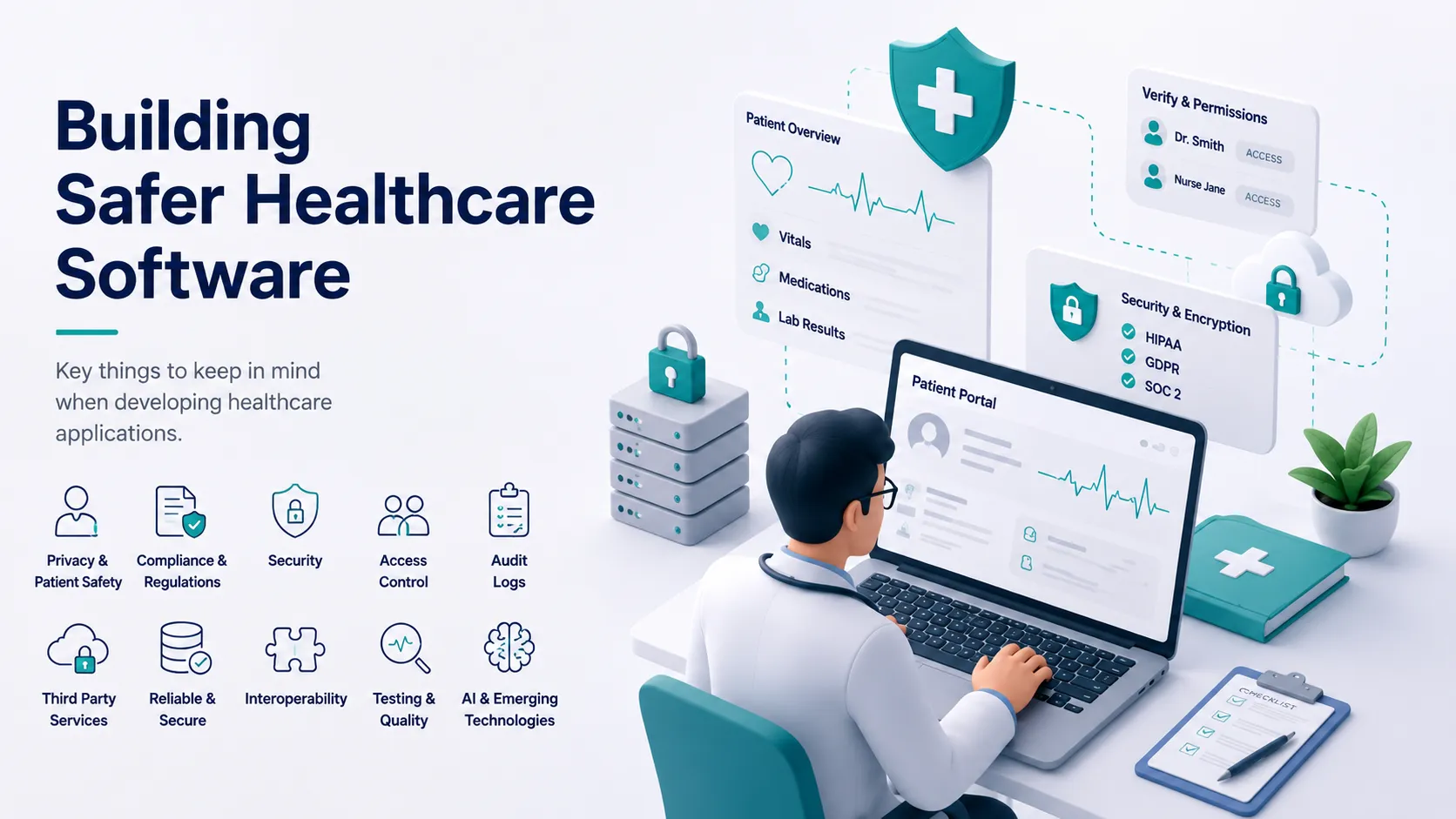
Healthcare software is different from a regular business application. It often involves sensitive patient information, strict privacy requirements, and workflows in which reliability and accuracy are critical.
Before starting a healthcare project, development teams should consider the following areas.
1. Privacy & Patient Data
Healthcare applications may handle:
- Patient details
- Medical records
- Prescriptions
- Lab reports
- Insurance information
- Appointment history
Only the necessary data should be collected, and access should be limited to authorized users.
2. Compliance & Regulations
Requirements depend on the target market and type of healthcare service.
For example:
- HIPAA for applicable US healthcare organizations
- DPDP requirements in India
- GDPR where applicable
- FDA requirements for certain medical software
Compliance should be considered from the beginning rather than after development is completed.
3. Security
Healthcare systems should have strong security measures such as:
- Secure authentication
- MFA where appropriate
- Role-based access control
- Encryption
- Secure APIs
- Secure storage
- Vulnerability management
- Regular security testing
4. Access Control
Not every user should have access to everything.
For example:
- Patient → Own health information
- Doctor → Authorized patient information
- Receptionist → Scheduling and administrative information
- Admin → Administrative functions
The principle should be least privilege — users should only receive the access they actually need.
5. Audit Logs
Healthcare systems should be able to answer:
Who accessed the patient’s information, when, and what did they change?
Important actions should therefore be logged and monitored.
6. Third-Party Services
Before integrating services such as:
- Cloud platforms
- Analytics
- AI services
- Messaging
- Video calling
- Crash reporting
- Storage
we should understand what data is being shared with them and how that data is handled.
Third-party integrations should also be reviewed for security, privacy, data retention, and contractual requirements before they are introduced into a healthcare workflow.
7. Reliability & Backup
Healthcare applications may support important day-to-day operations, so we should plan for:
- Backups
- Disaster recovery
- System availability
- Failure handling
- Data recovery
- Monitoring
A backup strategy should also be regularly tested to ensure that data can actually be recovered when needed.
8. Interoperability
Healthcare applications often need to communicate with other systems such as EHRs, hospitals, laboratories, and pharmacies.
Teams may therefore need to understand standards such as:
- HL7
- FHIR
- DICOM
- Healthcare terminology standards
Good interoperability can make it easier for healthcare systems to exchange information consistently and securely.
9. Testing & Quality
Testing should go beyond checking whether features work.
We should also test:
- Security
- Privacy
- User permissions
- Data accuracy
- API security
- Failure scenarios
- Performance
- Audit logging
Healthcare applications should also be tested against realistic workflows because an application can technically work while still producing incorrect or unsafe results.
10. AI & Emerging Technologies
If AI is introduced, we need to understand:
- What healthcare data is sent to the AI?
- Is the data retained?
- Is it used for training?
- How accurate is the output?
- Is human review required?
- Could the AI output affect clinical decisions?
The higher the potential impact on patient care, the greater the need for careful validation, appropriate human oversight, and regulatory assessment.
Final Takeaway
Healthcare development is not simply:
Build → Test → Deploy
It should be:
Understand Healthcare → Assess Privacy & Compliance → Design Securely → Develop → Test → Monitor → Continuously Improve
The most important mindset is:
Don’t just ask, “Does the application work?”
Also ask:
“Is patient data protected, is access appropriate, is the system reliable, and are we meeting the requirements applicable to this healthcare use case?”
That is what makes healthcare software development different from general software development.