AI can generate code faster than any developer. Whether it's creating a REST API, building a Flutter widget, writing SQL queries, or generating unit tests, AI can often produce working code within seconds.
But one important question remains:
When should you trust AI-generated code, and when should you verify every line?
The answer isn't always or never. The best software engineers treat AI like an exceptionally fast teammate—trusting it for well-defined tasks while relying on human judgment for complex engineering decisions.
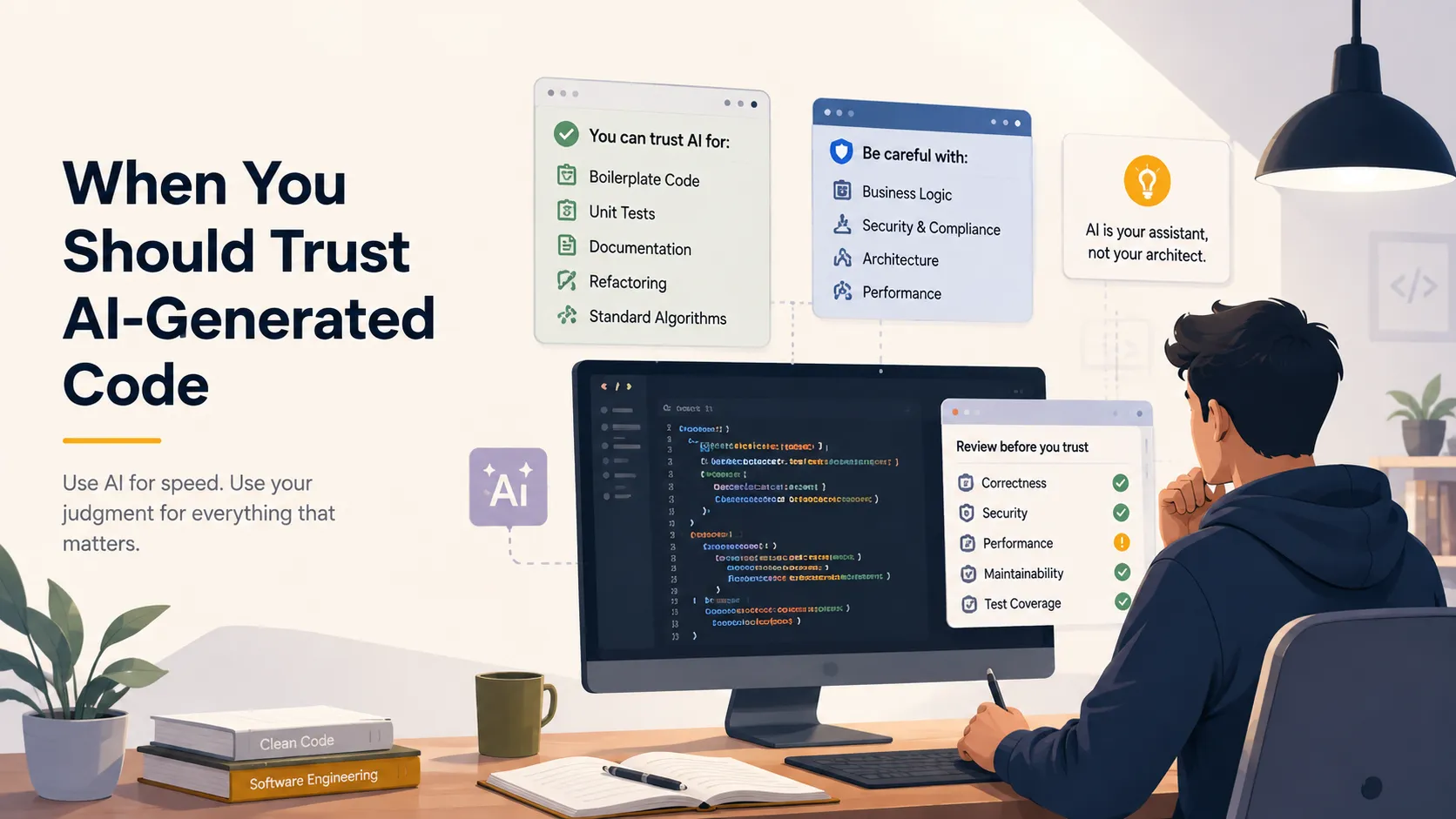
When You Can Usually Trust AI-Generated Code
AI performs exceptionally well on repetitive tasks with established programming patterns.
Boilerplate Code
Generating repetitive code is one of AI's greatest strengths.
AI can quickly create:
- Flutter widgets
- React components
- REST API controllers
- Repository classes
- Model classes
- Configuration files
- Dependency injection setup
This significantly reduces repetitive work while allowing developers to focus on solving business problems.
Unit Tests and Documentation
AI is highly effective at generating:
- Unit tests
- Integration test templates
- Edge-case scenarios
- API documentation
- README files
- Pull Request summaries
- Code comments
Most of these outputs require only minor review before use.
Refactoring and Standard Algorithms
AI can often improve existing code by:
- Reducing duplication
- Improving naming
- Simplifying conditional logic
- Increasing readability
- Applying common design patterns
It also performs well when implementing well-known programming patterns such as CRUD operations, pagination, sorting algorithms, validation, and data transformation.
When You Should Be Careful
As software becomes more complex, human review becomes increasingly important.
Business Logic
Business rules are unique to every organization.
Pricing engines, subscription billing, tax calculations, insurance workflows, compliance rules, and internal processes depend on domain knowledge that AI cannot fully understand.
Business-critical logic should always be carefully reviewed and tested.
Security and Compliance
Authentication, authorization, encryption, payment processing, access control, and personal data handling should never rely solely on AI-generated implementations.
Industries such as finance, healthcare, and legal technology also require regulatory compliance that AI cannot reliably guarantee.
Architecture and Performance
AI is excellent at generating individual functions but struggles with:
- Distributed systems
- Microservice architecture
- Infrastructure design
- Performance optimization
- Scalability planning
Code that appears correct may still perform poorly under real production workloads.
How to Evaluate AI-Generated Code
Before accepting AI-generated code, ask yourself:
| Question | Why It Matters |
|---|---|
| Does it solve the correct problem? | Verify functionality and edge cases. |
| Is it efficient? | Evaluate scalability and performance. |
| Is it secure? | Validate authentication, authorization, and input handling. |
| Is it maintainable? | Ensure readability and consistency with team standards. |
| Is it tested? | Confirm unit tests, integration tests, and failure scenarios. |
Remember, code that compiles successfully isn't necessarily correct.
A Practical Rule of Thumb
The more unique the problem, the less you should trust AI without verification.
Routine implementation tasks can often be accelerated safely with AI. Business logic, security-sensitive systems, architecture decisions, and compliance-critical applications require careful engineering review.
Common Mistakes to Avoid
- Copying AI-generated code directly into production.
- Assuming AI understands business requirements.
- Ignoring security or performance implications.
- Skipping testing because the code compiles.
- Treating AI as an authority instead of an assistant.
AI can generate convincing code—but convincing doesn't always mean correct.
Conclusion
AI-generated code is an incredibly powerful productivity tool that helps developers write boilerplate faster, generate tests, improve documentation, and simplify refactoring.
However, trust should always be proportional to the complexity and impact of the problem being solved.
The most effective developers don't blindly trust AI or reject it entirely. They combine AI's speed with human judgment, testing, architectural thinking, and domain expertise to build software that is reliable, secure, maintainable, and production-ready.