Introduction
AI coding assistants have become an essential part of modern software development. They can generate functions, build APIs, write tests, and even refactor large sections of code within minutes.
This has significantly increased developer productivity.
However, there’s a common misconception that AI-generated code is ready for production the moment it appears on the screen.
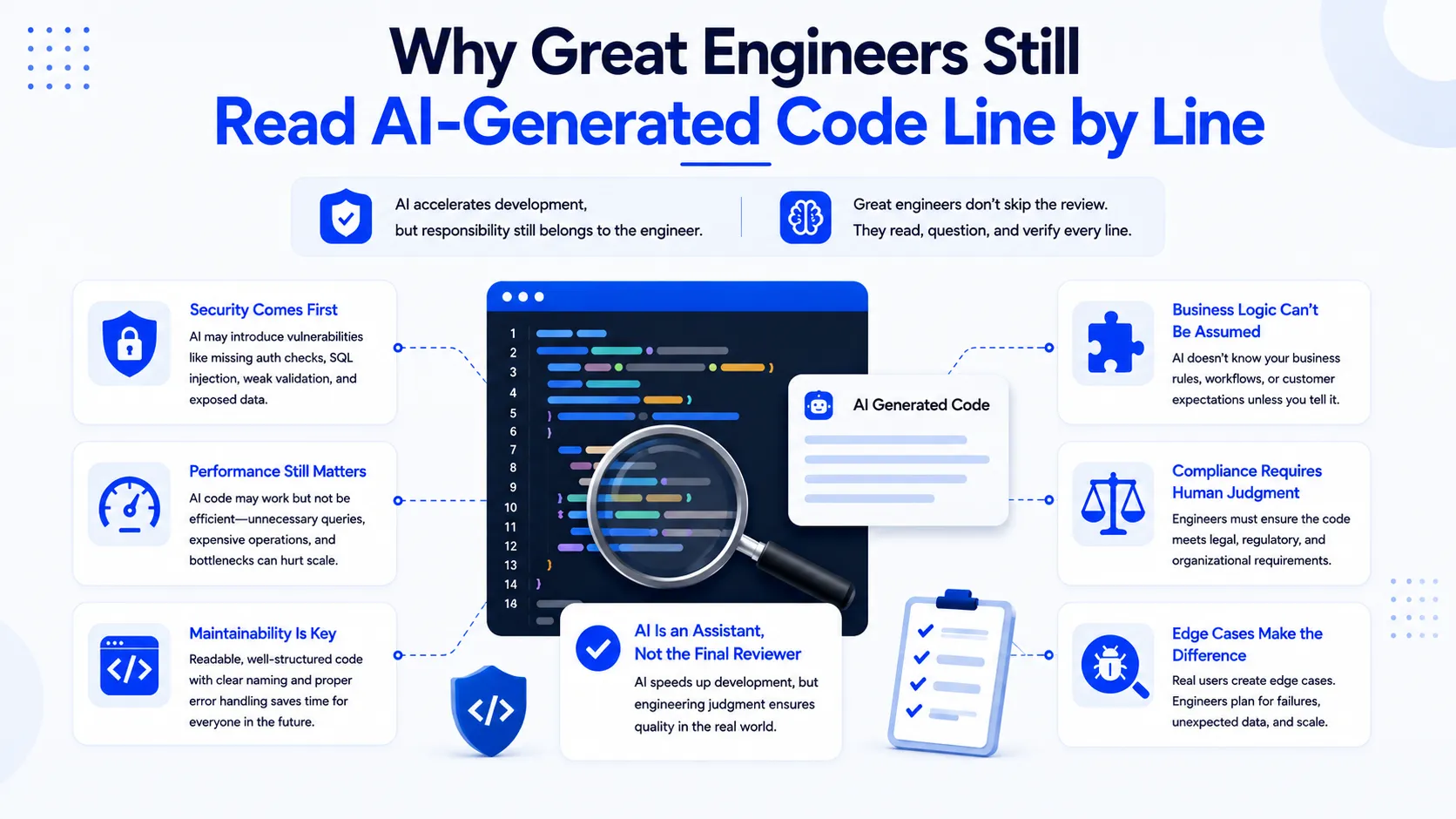
In reality, experienced engineers rarely copy and paste AI-generated code without reviewing it carefully. They read every line, question every assumption, and verify that the code actually solves the problem.
AI accelerates development, but responsibility still belongs to the engineer.
Security Comes First
One of the biggest risks of blindly trusting AI-generated code is security.
AI may generate code that works perfectly in a demo while introducing vulnerabilities such as:
- Missing authorization checks
- SQL injection risks
- Weak input validation
- Exposed sensitive information
- Insecure API endpoints
These issues may not be immediately visible, but they can become serious problems in production.
Great engineers review code with security in mind before anything is deployed.
Performance Still Matters
AI usually generates code that is functionally correct, but not always efficient.
For example, it may:
- Perform unnecessary database queries
- Execute expensive operations inside loops
- Load more data than required
- Create memory or performance bottlenecks
The code may work, but it might not scale.
Experienced engineers look beyond functionality and evaluate how the code performs under real-world conditions.
Maintainability Is Just as Important
Software is rarely written once and never touched again.
Future developers — including your future self — will need to understand, modify, and extend the code.
That’s why engineers review AI-generated code for:
- Readability
- Consistent naming
- Proper structure
- Reusable components
- Clear error handling
Clean, maintainable code saves time long after the feature has been shipped.
Business Logic Can’t Be Assumed
AI understands patterns, but it doesn’t fully understand your business.
It doesn’t know your company’s pricing rules, approval workflows, subscription policies, or customer expectations unless you explicitly provide that context.
A feature may be technically correct while still violating important business rules.
This is why engineers validate whether the implementation matches the actual product requirements — not just whether the code compiles.
Compliance Requires Human Judgment
Many industries have strict legal and regulatory requirements.
Applications handling healthcare, finance, or personal data often need to comply with standards and regulations.
AI isn’t aware of your organization’s compliance policies unless they’re provided as context.
Engineers must ensure the final implementation meets legal, security, and organizational requirements before it reaches production.
Edge Cases Separate Good Software from Great Software
AI generally focuses on the most common scenarios.
Real users don’t.
Engineers ask questions like:
- What happens if the network fails?
- What if the input is empty or invalid?
- What if the API returns unexpected data?
- What happens when thousands of users access the feature simultaneously?
Thinking about these edge cases is what makes software reliable in production.
AI Is an Assistant, Not the Final Reviewer
The role of AI is to accelerate development, not replace engineering judgment.
Great engineers don’t review code because they distrust AI.
They review it because software quality depends on much more than generating syntactically correct code.
A careful review ensures the solution is:
- Secure
- Efficient
- Maintainable
- Scalable
- Aligned with business requirements
- Ready for real-world usage
Conclusion
AI has transformed the way software is written, but it hasn’t changed the importance of engineering responsibility.
The best engineers don’t measure success by how quickly code is generated. They measure it by how well that code performs in the real world.
Before any AI-generated code reaches production, it should be reviewed for:
- Security
- Performance
- Maintainability
- Business logic
- Compliance
- Edge cases
AI may write the first draft, but great engineers are the ones who ensure it’s the right final version.