Introduction
Software development has always started with an idea. The challenge was turning that idea into working code.
Today, AI can generate code, write tests, suggest database schemas, and even build entire features in minutes. But there’s one thing it still can’t do well without human guidance: understand vague or incomplete requirements.
That’s why writing clear specifications is becoming one of the most valuable skills for software engineers.
The Problem Isn’t the Code
Many software bugs don’t happen because developers write bad code. They happen because the requirements were unclear from the beginning.
Consider these two requests:
Build a user profile page.
Now compare it with:
Build a user profile page where users can update their name, profile picture, and phone number. Changes should be saved instantly, validate required fields, and display an error if the update fails.
The second request gives both developers and AI a much clearer understanding of what needs to be built.
Why Specifications Matter More in the AI Era
AI is excellent at implementation, but it depends heavily on the information it receives.
A vague prompt produces a vague solution.
A detailed specification produces software that is much closer to production-ready.
The better the instructions, the fewer revisions are needed.
Clear requirements also reduce the number of assumptions AI needs to make when generating a solution.
A Good PRD Saves Time
A Product Requirements Document (PRD) doesn’t need to be dozens of pages long.
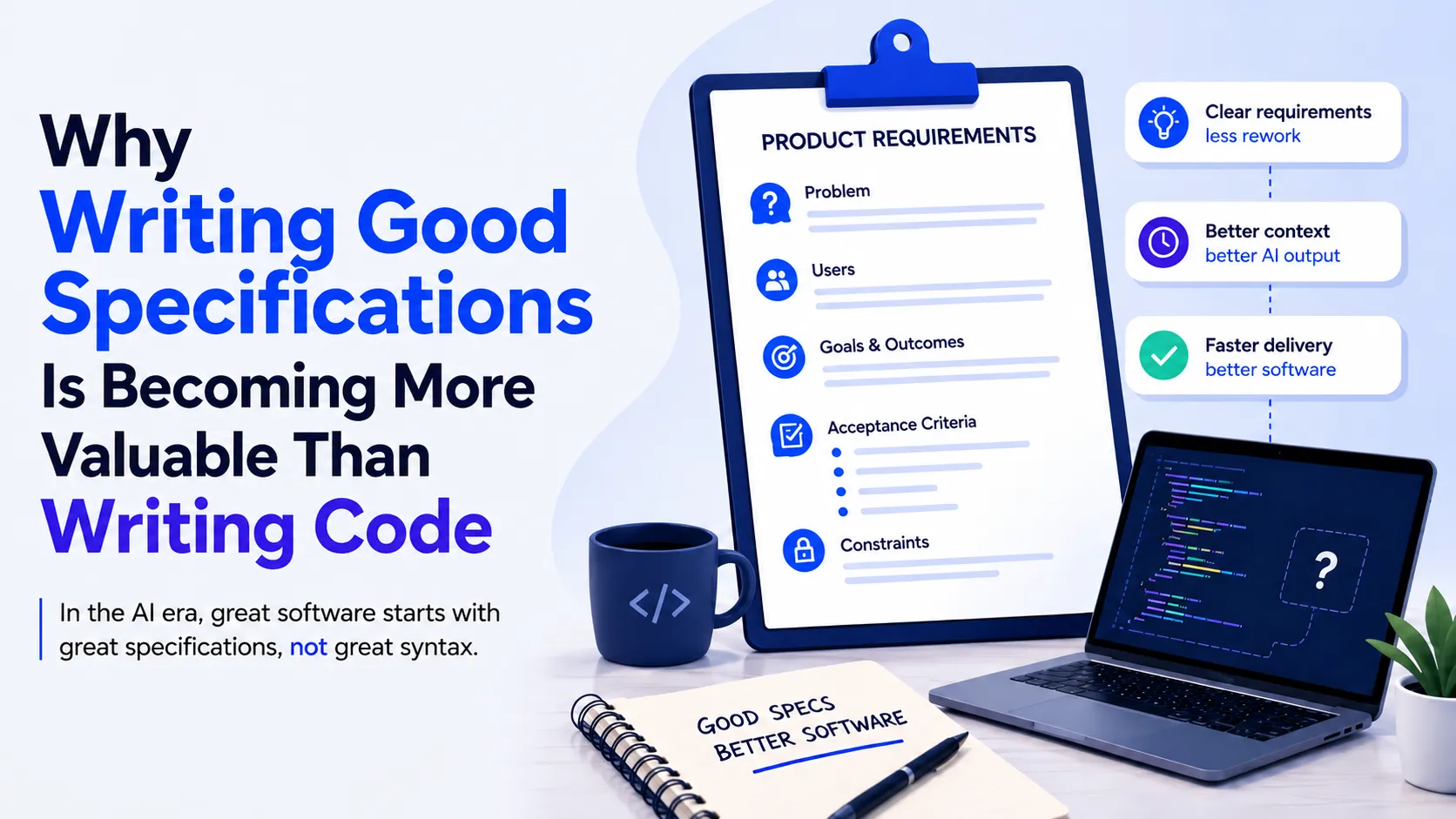
Even a simple PRD should answer questions like:
What problem are we solving?
Who is this feature for?
What should the user be able to do?
What are the expected outcomes?
What constraints should be considered?
When these questions are answered early, development becomes much smoother.
A well-written PRD can also become useful context for AI coding assistants, helping them understand the feature before generating implementation details.
Acceptance Criteria Reduce Confusion
Acceptance criteria define when a feature is considered complete.
Instead of saying:
Users should be able to upload files.
Be more specific:
Users can upload files up to 10 MB.
Only PDF and image files are allowed.
An error message appears if the upload fails.
A success message is shown after a successful upload.
Clear acceptance criteria reduce misunderstandings and make testing much easier.
They also give AI a concrete definition of what the implementation needs to accomplish.
Context Engineering Is the Next Step
Good prompts are useful, but good context is even better.
AI performs best when it understands:
The project’s architecture
Coding standards
Business rules
Existing APIs
Technical constraints
Existing implementation patterns
Providing this context helps AI generate solutions that fit naturally into your project instead of producing generic code.
The goal isn’t simply to ask AI to write code.
The goal is to give AI enough information to make better implementation decisions.
Prompt Design Still Matters
A prompt isn’t just a question — it’s a set of instructions.
Instead of asking:
Create a login screen.
Try:
Create a responsive login screen in Flutter with email validation, password visibility toggle, loading state, and clear error messages.
A few extra details can significantly improve the quality of the generated code.
Even better, combine the prompt with project context, existing code patterns, technical constraints, and acceptance criteria.
Communication Is the Real Superpower
Specifications aren’t written only for AI.
They’re also written for developers, designers, testers, and stakeholders.
The clearer your communication, the fewer assumptions people need to make.
Whether you’re writing a PRD, creating user stories, defining acceptance criteria, or prompting an AI assistant, the goal is the same:
Remove ambiguity.
Good communication creates a shared understanding of what needs to be built, why it matters, and how success will be measured.
Conclusion
As AI continues to automate coding, writing code is becoming easier. Defining the right problem is becoming harder — and far more valuable.
Great software starts with great specifications, not great syntax.
In the AI era, engineers who can clearly communicate requirements, define acceptance criteria, provide meaningful context, and write precise prompts will consistently build better software with fewer iterations.
The future of software development isn’t just about writing better code.
It’s about writing better instructions.